
How to Choose a CNC Machining Service Maker
Most RFQ answers look the same on paper. This guide gives you the checks that actually separate a capable cnc machining service maker from one that will cost you a rework cycle: tolerance capability, machine travel, material coverage, quoting speed and certification scope. Written for design engineers and sourcing managers who need to pick a supplier before the next build.
In this article
- 1
- 2
- 3
- 4
- 5
- 6
- 7
Key takeaways
What to check before you send an RFQ
Each row is a check you can verify from a drawing, a quote or a certificate. Rows that come back vague are the ones that turn into delays.
| Check | What to ask | Good answer looks like | Risk if vague |
|---|---|---|---|
| Tolerance | Which machine holds it? | ±0.005 mm stated per feature | Rework on bores and fits |
| Max part size | Travel in X, Y, Z | 4,000 mm max processing size | Part outsourced, no control |
| 5-axis count | Simultaneous or indexed? | 16 simultaneous 5-axis centers | Extra setups, worse position error |
| Surface finish | Ra value after finishing | Ra 0.8–1.6 μm standard | Seal faces leak or wear |
| MOQ | One piece allowed? | No minimum order quantity | Setup cost buried in unit price |
| Certifications | Which standard, which site? | ISO 9001, IATF 16949, ISO 13485 | Audit failure at your customer |
| Quote turnaround | With DFM feedback? | 12 hours, free DFM analysis | Design flaws found after cutting |
| Inspection | What is checked, when? | 100% inspection before shipment | Defects found at your line |
Pick the supplier that answers the hard questions first
If a cnc machining service maker gives you the machine, the plant, the tolerance per feature and the inspection method without being pushed, the rest of the project usually runs on rails. If those four answers are vague, the price is the only thing you are comparing, and that is the wrong basis for a release.
The checks that separate a real cnc machining service maker from a broker
A cnc machining service maker can be a factory with its own spindles or a trading office that forwards your file. The difference shows up when something goes wrong. Ask for the machine list and the plant address. If the answer is a list of partner factories, you have no control over the process and no recourse when a tolerance drifts.
Tolerance claims need a machine behind them. A shop holding ±0.005 mm on a 200 mm aluminum bracket is doing something different from a shop holding it on a 1,200 mm steel plate. Heat, tool deflection and fixture rigidity all scale with part size. Ask which machine will run your part and what tolerance that machine holds on that geometry.
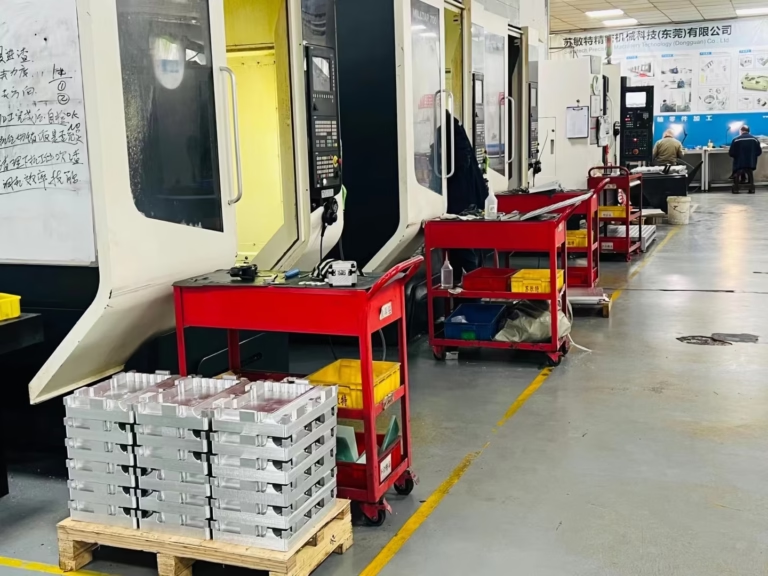
Machine count tells you about scheduling, not just capability. 127 high-precision CNC machines across 3 wholly-owned plants means your job is not sitting behind a single spindle that broke down on Monday. 16 simultaneous 5-axis machining centers means complex contoured parts do not need to be repositioned four times.
The plants matter for logistics too. GreatLight runs 7,600 m² in Dongguan plus a Singapore factory at No.3 Joo Koon Circle, Singapore 629032. For buyers shipping into Southeast Asia, that second site changes freight time and duty exposure.
- 1Ask for the plant addressA factory visit or a video walkthrough beats a capability PDF.
- 2Ask which machine runs your partTolerance without a machine model is a marketing line.
- 3Ask who owns the spindlesSubcontracted work means a second quote layer and no direct fix.
Match the machine, material and finish to your part
Most sourcing mistakes start with the wrong machine class. A flat plate with a few holes is a three-axis job. A part with undercuts, deep pockets on five faces, or a contoured impeller surface is a 5-axis job, and forcing it onto three axes adds setups, which adds position error.
Size is the hard filter. GreatLight runs 4,000 mm maximum processing size, with travel options at 4,000 × 400 × 150 mm for long parts, 750 × 1,150 × 550 mm and 600 × 600 × 600 mm for mid-size work, and 500 × 500 × 450 mm or 500 × 310 × 200 mm for compact parts. A Ø400 mm rotary table covers round work that would otherwise need a custom fixture.
Material coverage tells you how many suppliers you actually need. Aluminum 6061-T6 and 7075, stainless 304 and 17-4PH, 4140 and 4340 steel, C36000 brass, Ti-6Al-4V and Inconel all cut differently. A shop that lists all of them has tooling and speeds already dialed in; a shop that lists two will subcontract the rest.
Finish is usually the last thing specified and the first thing that fails. As-machined at Ra 1.6–3.2 μm is fine for brackets. Sealing faces and bearing bores want Ra 0.8–1.6 μm, and optical or sliding surfaces want Ra 0.2–0.8 μm. Anodizing, electroless nickel, powder coating and bead blasting all change dimensions slightly, so state whether the finish is before or after the tolerance callout.
- 1Three-axis is fine for prismatic partsIf the part has no undercuts, do not pay for 5-axis time.
- 2Watch tolerance on long partsA 4,000 mm part and a 100 mm part do not hold the same number.
- 3Specify finish before or afterCoating thickness can eat half your tolerance band.
Lead time, MOQ and certification: the commercial checks
Lead time is a process claim. GreatLight quotes and returns free DFM analysis within 12 hours, production can start within 24 hours, and parts ship in 3–5 days. The number is only useful if it survives your part. A complex 5-axis job with two finishing steps will not match a simple bracket, and a supplier who quotes the same number for both is guessing.
Historical late-delivery probability below 2% is a better indicator than a promised date. Ask for the on-time rate over the last year, and ask what happens when a machine goes down. A shop with 127 machines can move your job. A shop with 8 cannot.
MOQ is where prototypes get punished. No minimum order quantity means a single prototype and a 10,000+ part run go through the same quoting path. If a supplier adds a large setup charge for one piece, they are a production shop, and your prototype is an interruption to them.
Certifications only help if the scope matches your risk. ISO 9001:2015 covers general quality systems. IATF 16949:2016 is what automotive programs expect. ISO 13485:2016 is the medical device standard. ISO 27001:2022 covers information security, which matters when your CAD files are the product. Send a drawing with proprietary geometry and see how the supplier handles it before you sign anything.
- 1Ask for the on-time rateA date is a promise. A rate is a track record.
- 2Check the certification scopeA group certificate may not cover the site running your parts.
- 3Test confidentiality earlyAn NDA on request is a normal answer. Silence is not.
How to read a quote from a cnc machining service maker
A useful quote lists material grade, machine class, tolerance per critical feature, finish, inspection method and lead time. If any of those are missing, the price is not comparable to another quote, and you are choosing on a number you cannot verify.
Watch for the setup line. A quote with one setup for a part that clearly needs three is either wrong or planning to cut corners. On 5-axis parts, the setup count is the main cost driver, and a shop that quotes one setup on a contoured part is claiming simultaneous 5-axis capability. Ask them to confirm that.
Inspection is the other silent line item. 100% inspection before shipment, with raw material check, in-process monitoring and final inspection reports on request, is the baseline for anything going into a regulated product. A shop that only inspects the first article is quoting a different risk level than the one you need.
Finally, check whether DFM feedback comes with the quote. A 12-hour quote that flags a thin wall or an unreachable feature saves a week. A quote that just returns a price pushes the problem to the first article, which is the most expensive place to find it.
- 1Compare feature by featureTwo prices for two different tolerance bands are not comparable.
- 2Count the setupsSetup count drives both cost and position error.
- 3Expect DFM commentsNo feedback on a complex part is a red flag.
Step by step: qualifying a supplier in one week
Run these in order. Each step filters out suppliers before you spend engineering time on them.
- 1Send the drawing with critical features markedMark datum surfaces and the two or three dimensions that matter. If the reply ignores them, the quote is generic.
- 2Ask for the machine and plantRequest the specific machine class and the site address. Cross-check travel against your part's largest dimension.
- 3Request DFM feedback with the priceGive a 12-hour window. Useful feedback names a wall thickness, a tool reach limit or a tolerance that needs relaxing.
- 4Confirm material grade and stock formGrade alone is not enough. Plate, bar and forging cut differently and change lead time.
- 5Ask how inspection is documentedRequest the report format before production. First-article plus in-process checks should be described, not promised.
- 6Run one prototype before the production releaseOne part validates the setup, the finish and the communication. Release the run only after it measures in spec.
- 7Put confidentiality in writingSign the NDA before you upload native CAD, not after. Ask where files are stored and who can open them.
Questions engineers ask before awarding a job
What tolerance can a cnc machining service maker actually hold?
GreatLight works to ±0.005 mm (±0.0002 in) on critical features. Treat that as a capability, not a default. On long parts or thin walls, the achievable number depends on fixturing and material, so mark which features need the tight band.
If a supplier claims the same tolerance on every feature regardless of geometry, ask which machine holds it and how they verify it. The answer should mention the machine class and the inspection method.
Is there a minimum order quantity for prototypes?
GreatLight has no minimum order quantity. One prototype and a 10,000+ part run both go through quoting. That matters when you are validating a design and do not want a setup charge that only makes sense at volume.
If a supplier quotes a large one-off fee, they are optimized for production runs. That is a fine choice for a released part, but a poor fit for design iteration.
Which materials and finishes are available?
Aluminum grades include 6061-T6, 7075, 2024 and 6082; stainless includes 304, 316L, 17-4PH and 440C; steel includes 4140, 4340 and tool steel; titanium includes Ti-6Al-4V (TC4) and Inconel. Copper, brass and engineering plastics such as PEEK and POM are also on the list.
Finishes cover anodizing (clear, color, hardcoat, conductive), electroless nickel, zinc, silver and gold plating, powder coating, black oxide, bead blasting, brushing, polishing, and laser marking with a minimum character height of 1.5 mm.
How fast can parts ship?
Quotation and free DFM analysis come back within 12 hours. Production can start within 24 hours, and parts ship in 3–5 days. Historical late-delivery probability is below 2%.
Those numbers assume the drawing is released and the material is in stock. A special alloy or an outsourced finishing step adds time. Ask for the schedule per operation if the part has plating or heat treatment.
How is my design data protected?
Uploads are secure and confidential, and an NDA is available on request. GreatLight holds ISO 27001:2022 for information security, which is the standard that covers how files and access are controlled.
For proprietary R&D, sign the NDA before sending native CAD. Ask which staff can open the files and whether the model leaves the site for any operation.
What certifications should I check for my industry?
ISO 9001:2015 is the baseline quality system. IATF 16949:2016 applies to automotive programs. ISO 13485:2016 applies to medical devices. ISO 27001:2022 covers information security.
Match the certificate to the site that will run your parts, and confirm the scope covers your process. A group-level certificate is not automatically valid for a specific plant.
Send a drawing, get a real answer in 12 hours
Upload your CAD and get a quote with DFM feedback, machine class, tolerance per feature and a 3–5 day ship window. One prototype or 10,000 parts.
12-hour quote + DFM100% inspection before shipmentNo MOQNDA on request
More machining notes and updates
We publish setup notes, tooling trials and inspection data from the factory floor.











