
CNC Machining Service Dongguan: A Buyer's Checklist
This guide is for engineers and sourcing managers comparing CNC machining service Dongguan suppliers. It covers the checks that actually change your part cost and delivery date: tolerance, machine mix, MOQ, certifications, and how a quote is written. Read it before you send drawings out for bid.
In this article
- 1
- 2
- 3
- 4
- 5
- 6
- 7
Key takeaways
What to verify before you place a PO
Ranges come from the supplier's own process data, not from a market average.
| Check | What to ask | Typical good answer |
|---|---|---|
| Tolerance | Which features need the tight number? | ±0.005 mm on critical bores, ±0.05 mm elsewhere |
| Machine mix | How many 5-axis and mill-turn centers? | 16 simultaneous 5-axis, 16 mill-turn |
| Max part size | Largest travel and rotary table? | 4,000 × 400 × 150 mm, Ø400 mm table |
| MOQ | Can you run one prototype? | No minimum, 1 part to 10,000+ |
| Quote turnaround | When do I get DFM feedback? | Quote and free DFM within 12 hours |
| First article | Is inspection documented? | 100% inspection, reports on request |
| Confidentiality | Will you sign an NDA? | NDA available on request |
| Finish | What Ra can you hold off the machine? | Ra 1.6–3.2 μm as machined |
Pick the supplier that answers the drawing, not the brochure
If your part has angled features, tight bores or a mixed material stack, choose a shop that lists its machine mix, quotes in 12 hours and takes one part or ten thousand. If your part is a simple bracket at general tolerance, almost any competent shop will do, and price should decide.
How tolerance and finish set the real cost in a CNC machining service Dongguan quote
Every quote starts with the tightest tolerance on the drawing. A general ±0.05 mm callout on a bracket is routine work. A ±0.005 mm bore in the same part changes the plan: slower passes, temperature control, and a CMM check that adds hours to the route. Ask which dimensions carry the tight callout before you ask for a price.
Surface finish behaves the same way. As-machined parts come off the machine at roughly Ra 1.6–3.2 μm. If the drawing asks for Ra 0.8–1.6 μm, the shop adds a finishing pass or a secondary operation. Below that, you are usually buying a polishing step, not a machining step, and the part may need hand work that is hard to repeat across a 5,000-piece run.
The useful question is not "what is your best tolerance." It is "which features drive the price on this specific part." A supplier that answers with a feature list is reading your drawing. A supplier that answers with a single number is quoting a brochure.
One more cost item: thin walls and deep pockets. A 1 mm wall in aluminium 6061 will move under clamping pressure no matter how good the machine is. If the design allows a 2 mm wall, the same part often drops one setup and one inspection step.
- 1Put tight tolerances on a short listMark the 3-5 features that matter and leave the rest at general tolerance.
- 2Check the datum schemeA drawing with stacked tolerances from three datums is hard to inspect and easy to argue about.
- 3Match finish to functionSealing faces need Ra 0.8–1.6 μm. Bracket sides do not.
Machine mix and part size: what the shop can actually hold
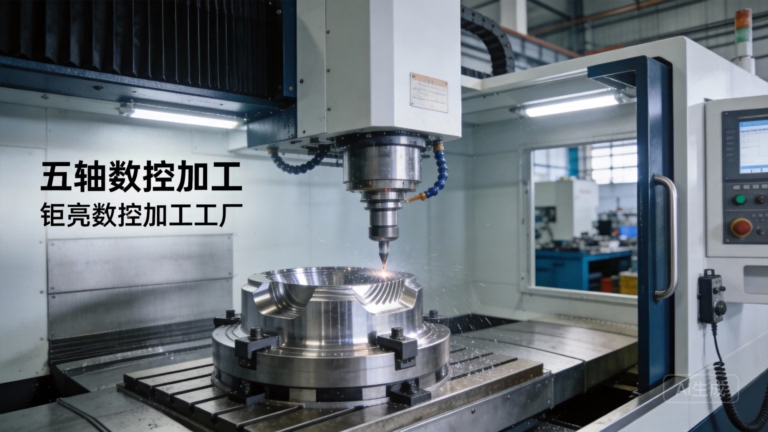
Capacity is not one number. A shop with 127 high-precision CNC machines but no 5-axis centers will quote your angled port as three setups with a fixture. That is not wrong, it is just slower and less repeatable. Simultaneous 5-axis work finishes those features in one clamping, which usually holds position better between holes.
Size limits matter early. Large-frame travel of 4,000 × 400 × 150 mm covers long rails and housings. Medium travels of 750 × 1,150 × 550 mm and 600 × 600 × 600 mm cover most enclosure and manifold work. Compact travels of 500 × 500 × 450 mm and 500 × 310 × 200 mm handle small precision parts where spindle speed matters more than envelope.
For round parts, a Ø400 mm rotary table sets the practical limit for mill-turn work. Above that, the part usually moves to a different machine class, and the quote changes. Send a STEP file with the bounding box noted and you avoid a week of clarification emails.
Material also picks the machine. Titanium TC4 and Inconel cut slowly and wear tools, so a shop needs the right spindle torque and coolant strategy. Aluminium 6061 or 7075 runs fast. If your part is Inconel and the quote comes back at aluminium speed, ask what tooling they plan to use.
- 1Ask for the setup countFewer setups mean fewer datum shifts and less stack-up error.
- 2Check the rotary table sizeØ400 mm is the working number for mill-turn in this shop.
- 3Name the material grade6061-T6 and 7075-T6 machine differently and price differently.
MOQ, lead time and certifications: the three checks buyers skip
Minimum order quantity quietly decides your second order. A supplier with a 500-piece minimum will run your 20-piece pilot on a different route, sometimes a different machine, than the production run. When the pilot passes and the volume order arrives, the process has changed. A shop with no minimum order quantity, from one prototype to 10,000+ part runs, keeps the route stable.
Lead time has two halves. The first is quote and DFM analysis, which should come back within 12 hours. The second is production. Here, production can start within 24 hours of a released order and parts ship in 3–5 days. Ask which clock the supplier is quoting, because a fast ship date on a slow quote is not fast.
Certifications are scoped, not decorative. ISO 9001:2015 covers general quality systems. IATF 16949:2016 applies to automotive work. ISO 13485:2016 applies to medical devices. ISO 27001:2022 covers information security, which matters when you upload CAD files. Ask for the certificate number and the scope statement, not a logo.
Then check inspection. A 99.99% qualification rate only means something if you know how it is measured. Here, inspection is 100% before shipment, with raw material check, in-process monitoring and final inspection. Reports come on request. If your drawing needs a full dimensional report, say so in the RFQ.
- 1Keep pilot and production on one routeChanging process between pilot and volume is where quality drifts.
- 2Separate quote time from ship time12-hour quote, production start in 24 hours, ship in 3–5 days.
- 3Match certificate to industryAutomotive, medical and IT security each have their own standard.
How to read a quote and spot the risks
A good quote lists material grade, finish, tolerance basis, quantity breaks and inspection scope. A bare number forces you to guess, and guessing is how projects slip. If the quote says "aluminium" instead of 6061-T6 or 7075-T6, you cannot compare it to another supplier.
Watch for the missing line items. Deburring, anodizing masking, laser marking and packaging are real costs. Laser marking has a minimum character height of 1.5 mm, so a fine logo may need a different method. If those steps are not in the quote, they will appear later as a change order.
Historical late-delivery probability below 2% is a useful figure, but ask what it covers: the ship date from the factory, or arrival at your dock. Customs and freight are outside the shop's control, so plan buffer there.
Finally, protect the files. Uploads should be secure and confidential, and an NDA should be available on request. If a supplier hesitates on an NDA for a new design, that tells you something about how they handle customer drawings.
- 1Compare line by lineMaterial, finish, tolerance, inspection, packaging, freight terms.
- 2Ask for DFM notesA quote with suggested changes shows the shop read the model.
- 3Confirm shipping termsEx-works and delivered prices are not comparable.
Step by step: how to run the first order
Follow these in order. Skipping step 3 is the most common cause of a late first article.
- 1Send a STEP file plus a PDF drawingInclude the revision letter, material grade and any finish callouts. The STEP carries geometry; the PDF carries tolerance and datum intent.
- 2List critical features separatelyName the 3-5 dimensions that need ±0.005 mm. Leave the rest at general tolerance so the shop can plan passes and inspection time.
- 3Say how many parts now and laterTell the supplier the pilot quantity and the expected annual volume. This lets them pick a process that survives the ramp.
- 4Ask for DFM feedback with the priceExpect suggestions on wall thickness, corner radii and tolerance relaxation. Free DFM analysis should come with the quote, within 12 hours.
- 5Confirm the inspection scopeState whether you need a first article report, a full dimensional report, or material certificates. Reports are available on request.
- 6Sign the NDA before uploading sensitive filesAn NDA is available on request. Do this before sending proprietary geometry, not after.
- 7Approve one sample before the runCheck fit and function on the first part. Production can start within 24 hours of approval, and parts ship in 3–5 days.
Questions buyers ask before the first order
Can I order just one prototype part?
Yes. There is no minimum order quantity, so a single prototype goes through the same process route as a volume run. That keeps the pilot and production parts comparable.
If you expect 10,000+ parts later, mention it in the RFQ so the shop can plan fixture and tooling decisions around the ramp.
What is the tightest tolerance you can hold?
±0.005 mm (±0.0002 in) on critical features, verified by inspection. Not every feature on a part needs that number, and putting it everywhere raises cost without improving function.
Send a drawing with the critical dimensions marked and the quote will reflect the real requirement.
How fast can I get a quote and then parts?
Quotation and free DFM analysis come back within 12 hours. Once the order is released, production can start within 24 hours.
Standard parts ship in 3–5 days. Larger runs and multi-operation parts take longer, and the quote states the actual date.
Which certifications apply to my industry?
ISO 9001:2015 covers general quality management. IATF 16949:2016 is for automotive work, ISO 13485:2016 for medical devices, and ISO 27001:2022 for information security.
Match the certificate to your market and ask for the scope statement, since a certificate only covers what it lists.
What materials and finishes are available?
Aluminium 6061, 7075 and 2024; stainless 303, 304, 316L and 17-4PH; steel 1018, 4140 and 4340; brass C36000; titanium TC4 and Inconel; plus plastics including POM, PEEK and PC.
Finishes include anodizing, electroless nickel, zinc plating, powder coating, black oxide, bead blasting, polishing and laser marking.
How are my drawings protected?
Uploads are handled as secure and confidential, and an NDA is available on request. Sign it before sharing proprietary geometry.
Ask for the NDA early in the conversation so both sides are covered before files move.
Send drawings, get a quote and DFM notes in 12 hours
Upload your STEP file and drawing. We return a quote, a setup plan and DFM suggestions, with no minimum order quantity and an NDA on request.
12-hour quoteNo MOQ100% inspectionNDA on request
More from the shop floor
We publish setup notes, tooling trials and inspection data from the factory floor.











