
CNC machining of gun metal parts
What gun metal actually is, why it machines the way it does, and where it belongs on a real part. Written for engineers and buyers who need to decide between gunmetal, bronze and brass before the first chip is cut.
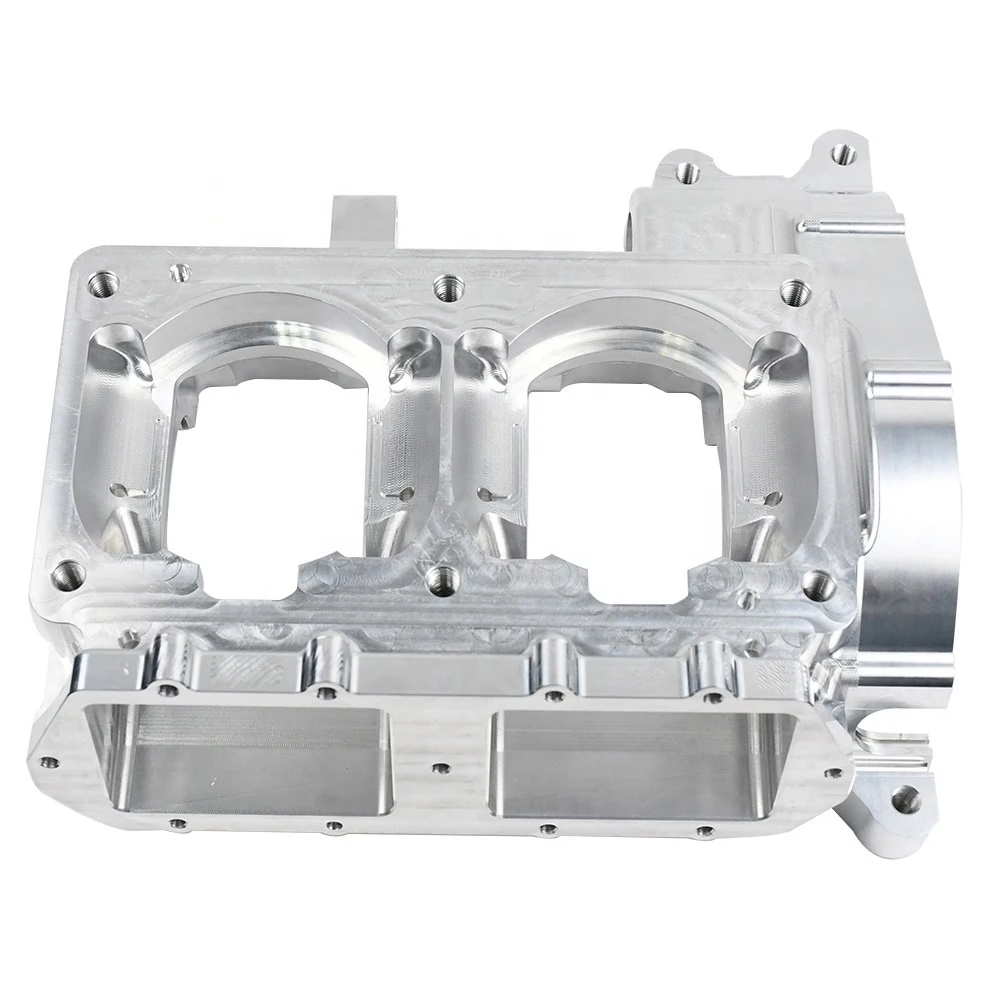
What gun metal is, and what it is not
Gun metal is a tin bronze, not a steel and not a brass. The traditional foundry mix sits near 88% copper, 10% tin and 2% zinc. That tin content is what separates it from the red brass and leaded brass families, and it is the reason the alloy behaves differently under a cutter.
The name comes from castings for ordnance and naval fittings, where the metal had to survive salt water, impact and repeated thermal cycling. Modern CNC machining of gun metal parts uses the same metallurgy but starts from continuous cast bar or centrifugal cast tube instead of a sand mold. Better density, fewer gas pores, tighter starting dimensions.
Do not confuse it with gunmetal gray coatings or with the LG2 and LG4 leaded gunmetals used for valve bodies. Those grades add lead for pressure tightness and machinability, and they machine closer to free-cutting brass than to a true tin bronze.
In practice, when a drawing says gun metal, we ask three questions before quoting. Which standard, which temper, and is the part a bearing, a pressure boundary or a structural bracket? The answers change the tooling, the speeds and sometimes the alloy itself.
- 1True tin bronzeAbout 88% Cu, 10% Sn, 2% Zn; cast, not wrought.
- 2Leaded variantsLG2 and LG4 add lead for pressure tightness and chip control.
- 3Not a steelNo ferromagnetic response and no heat-treat hardening.
How gun metal behaves under a cutting tool
Gun metal cuts at low speeds compared with aluminium, and it work-hardens if you rub instead of cut. Surface speeds typically land between 60 and 120 m/min with carbide tooling, and feed per tooth between 0.05 and 0.15 mm. Below 60 m/min the edge tends to smear and the insert wears on the flank.
Chip formation is short and brittle, which is good news for deep pockets. Chips break, clear the flutes and do not wrap around the tool. The trade-off is that the material is abrasive. Tin bronze wears edges faster than brass, so we run slightly lower feed on finishing passes and change inserts on a count rather than on a sound cue.
Thermal expansion matters more than most people expect. Copper alloys expand roughly 18 × 10⁻⁶ per °C, close to aluminium. A bore that measures on size at 30 °C in the shop will read undersize on a 20 °C inspection bench. For tight bores we let the part stabilize before the final gauge check.
Thin walls are the classic failure mode. A 0.8 mm wall in gun metal will deflect under a 4 mm end mill unless the part is supported. We rough with a larger toolpath offset, leave 0.3 mm for finishing and take the last pass with a sharp, low-radius cutter at reduced radial engagement.
- 1Speed60–120 m/min surface speed with carbide.
- 2Feed0.05–0.15 mm per tooth; lighter on finishing passes.
- 3HeatRoughly 18 × 10⁻⁶ per °C; measure after stabilization.
Design features that survive the process
Gun metal suits parts with thick, simple geometry: bushings, bearing shells, valve bodies, pump housings, marine fittings and wear plates. It does not suit long slender shafts, thin flat plates or parts that need spring properties. If a feature needs to flex, choose a different alloy.
Wall sections should stay above 1.5 mm for structural parts and above 1 mm for non-load-bearing covers. Below that, boring and milling both turn into a support problem rather than a cutting problem. Corners benefit from a 0.5 mm minimum internal radius so a standard end mill can clear the pocket without a separate EDM step.
Threads hold well because the material is tough rather than gummy. We cut threads from 4 mm upward with a form tap or a thread mill, and we avoid roll forming on thin walls where the material would bulge. For sealing threads on valve bodies, a thread mill gives a straighter flank than a tap.
Bores are where the alloy earns its place. A finished bore in gun metal holds its geometry under load and resists galling against a steel shaft. That is the reason the alloy keeps appearing in bushings even when a bronze or polymer part would be cheaper to make.
- 1Good fitsBushings, valve bodies, pump housings, marine hardware.
- 2Poor fitsSlender shafts, thin plates, spring-like parts.
- 3Minimum wall1.5 mm structural, 1 mm for covers.
Tolerances, finish and inspection
GreatLight holds ±0.005 mm on critical features and ±0.0002 in in imperial drawings. Not every feature needs that. We mark the drawing features that do and let the rest run to general tolerance, which keeps cycle time and cost down without touching function.
Surface finish depends on the pass, not on the alloy alone. As-machined gun metal lands around Ra 1.6–3.2 μm. A finishing pass with a sharp insert reaches Ra 0.8–1.6 μm, which covers most bearing and sealing surfaces. Fine finishing to Ra 0.2–0.8 μm is possible but is usually reserved for seal faces.
Inspection runs through the whole order. Raw material check on arrival, in-process monitoring at defined intervals, then 100% inspection before shipment. Reports go out on request. If the drawing calls for a bore gauge, an air gauge or a CMM report, say so at quote stage so the fixturing allows for it.
Porosity is the hidden variable in cast gun metal. Continuous cast bar is denser than sand cast, so a pressure-tight part should be quoted from bar or tube. If a casting is unavoidable, we machine a test coupon first and check it before committing to the full run.
- 1Tolerance±0.005 mm / ±0.0002 in on critical features.
- 2FinishRa 0.8–1.6 μm typical for sealing surfaces.
- 3InspectionMaterial, in-process and 100% final check.
Gun metal compared with nearby alloys
Same part geometry, three alloy families. Use this to pick before you quote.
| Property | Gun metal (tin bronze) | Leaded brass (C36000) | Aluminium bronze |
|---|---|---|---|
| Corrosion in seawater | Very good | Fair, dezincifies | Very good |
| Machinability rating | Moderate | Excellent | Poor to moderate |
| Wear resistance | Good | Fair | Excellent |
| Typical surface speed | 60–120 m/min | 150–300 m/min | 50–90 m/min |
| Relative material cost | High | Low | High |
| Best use | Bearings, valve bodies | Fittings, fasteners | Pump impellers, wear rings |
| Welding | Difficult | Possible | Difficult |
Which alloy should you specify?
Choose gun metal when the part is a bearing, a valve body or a seawater fitting that must resist galling and corrosion. Choose leaded brass when the part is a fitting or fastener and cost and cycle time matter more than wear. Choose aluminium bronze when the part sees sliding wear under high load and you accept slow cutting.
Questions engineers ask before quoting
Can gun metal parts be heat treated for higher hardness?
No. Tin bronze does not respond to quench-and-temper hardening the way steel does. Hardness comes from the tin content and the cooling rate during casting, not from a furnace cycle after machining.
If you need a harder copper alloy surface, look at aluminium bronze or add a wear-resistant coating. We can quote plating and finishing as a separate operation, but it will not turn gun metal into a bearing steel.
How do you hold a thin-wall gun metal bushing without crushing it?
We bore from bar stock and part it off rather than clamping a finished thin wall. Where a finished wall must be held, we use a soft collet or a split sleeve machined to the outside diameter so clamping pressure spreads over the full circumference.
Cutting forces stay low: light radial engagement, sharp inserts and a finishing allowance of 0.2–0.3 mm. A wall under 1 mm is workable on a short bushing but we flag it at DFM stage.
Does gun metal work for food or drinking water contact?
Lead-bearing grades such as LG2 and LG4 are not suitable for potable water contact. Lead-free tin bronze grades exist and are used for pumps and valves in some water systems.
Tell us the end application at quote stage. If a part touches drinking water or food, we will quote a lead-free alloy and document the material certificate.
What is the largest gun metal part you can machine?
Our maximum processing size is 4,000 mm, with large travels of 4,000 × 400 × 150 mm. Larger gun metal work usually arrives as a casting and is machined on a large three-axis or five-axis center.
Bearing shells and valve bodies typically fall well inside that envelope. If your part is over 4,000 mm, we will say so at quote stage rather than after the order.
How do you keep gun metal from galling a steel shaft?
Galling is a surface and lubrication problem more than an alloy problem. A fine finish on the bore and a small clearance band reduce metal-to-metal contact.
For bushings, we hold the bore to Ra 0.8–1.6 μm and keep roundness tight so the load spreads. If the shaft is stainless, pair it with a lead-free tin bronze and specify a lubricant groove at the design stage.
Can you machine a prototype before committing to a production run?
Yes. There is no minimum order quantity, so a single prototype and a 10,000-part run use the same process window. The prototype is the cheapest place to find a wall that is too thin or a bore that will not hold.
We return a free DFM analysis with the quote, usually within 12 hours, and production can start within 24 hours of approval. Prototypes typically ship in 3–5 days.
Send the drawing, get a machining answer
Upload your gun metal part and we will return a quote with DFM notes, alloy recommendations and inspection plan within 12 hours.
12-hour quoteNo minimum order quantityNDA on request
More machining notes
We publish setup notes, tooling trials and inspection data from the factory floor.











