
CNC Direct Drive Technology
The motor turns the load itself. No gearbox, no belt, no screw between rotor and part. This page explains how the motion loop works, what changes on the machine, and which parts actually benefit. By the end you can tell whether a job belongs on a direct drive machine or a conventional one.
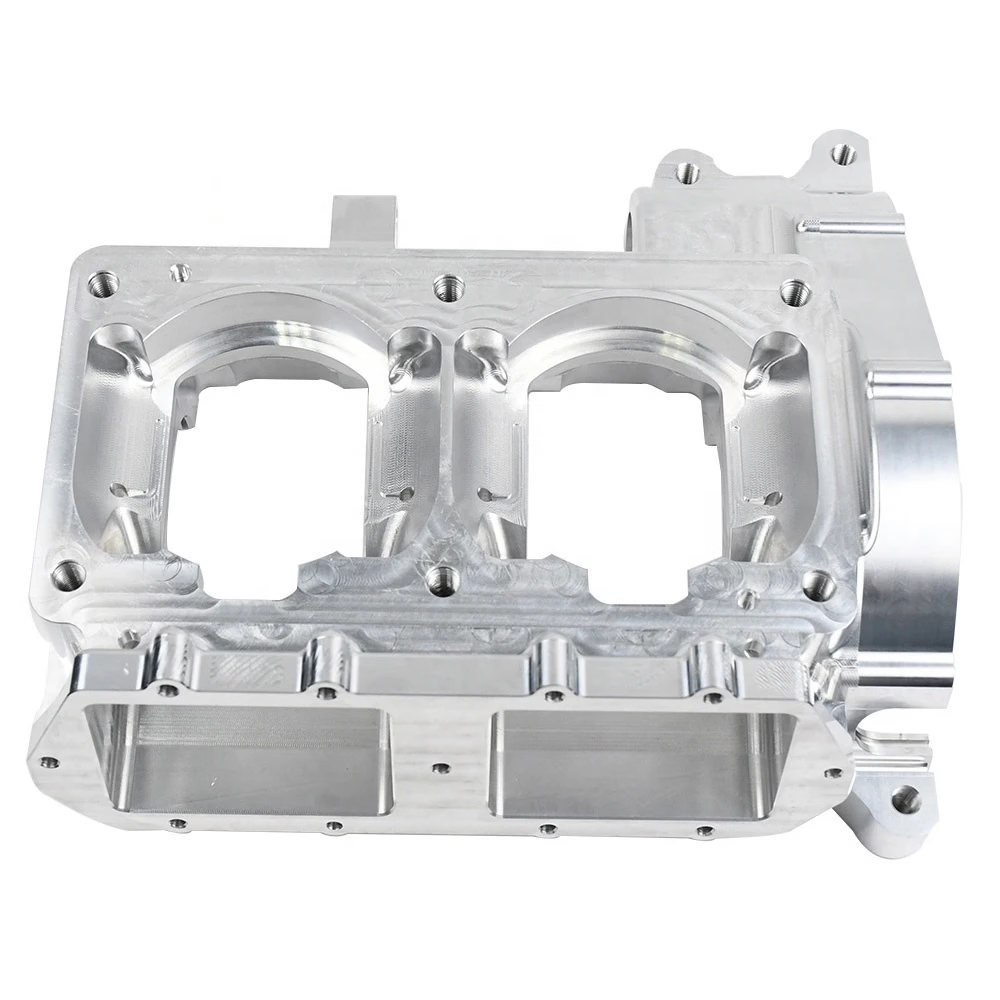
How CNC direct drive technology closes the motion loop
A conventional axis moves in stages. The motor spins fast and weak, a gearbox or timing belt trades speed for torque, then a ball screw converts rotation into linear travel. Every stage adds friction, elastic wind-up and backlash. The control fights all three with tuning and compensation.
Direct drive removes those stages. A torque motor, or a linear motor, couples straight to the load: the rotor is the table, or the magnet track is the slide. Position feedback comes from a glass scale reading the load itself, not from the motor shaft. One loop, one measured mass.
That single change matters because backlash is a mechanical property. It lives in gear teeth, belt teeth and screw nuts. Take the transmission out and there is nothing left to compress, stretch or rattle. The axis repeats what the scale sees, and the scale sees the part.
The trade is torque density. A torque motor makes its force at low speed and low inductance, so it needs a capable drive and real cooling. The mechanics get simpler; the electrical side gets harder. That is the honest summary of the technology.
Accuracy, speed and finish: what the engineer sees
Backlash shows up as a step at direction reversal. On a ball screw axis you compensate in the control, but compensation is a guess that drifts with temperature and wear. A direct drive rotary table has no reversal error to compensate, so a circular interpolation stays round instead of going slightly oval at the quadrant points.
Dynamic stiffness improves the same way. With no belt to stretch, the loop bandwidth can be set higher, and the axis tracks a fast contour without lagging behind the commanded path. On a die with tight corner radii, that lag is what rounds the corner or leaves a witness mark.
Surface finish follows. When the tool follows the path more closely, the cutter load stays even and chatter drops. We hold Ra 0.8–1.6 μm on a routine basis, and can reach Ra 0.2–0.8 μm when the geometry and the tool allow it. The machine is only one input; the cutter and the setup still decide a lot.
None of this is free. Direct drive axes are less forgiving of a bad setup, because there is no belt to soak up a crash or a resonance. A loose fixture that a geared axis would tolerate can excite the servo and trip it.
Heat, growth and the limits of holding tolerance
Torque motors put their heat into the stator, which sits close to the structure that carries the part. A 10 °C rise across 300 mm of aluminum grows the part about 0.07 mm. That is more than ten times our ±0.005 mm tolerance, so thermal control is not optional on tight work.
We deal with it the way most shops do: rough, let the part and the machine settle, then finish. On a five-axis direct drive table the rotor is water-cooled and the scale is on the load, so the loop closes on the part rather than on a warm motor. The reading stays honest even as the frame moves.
This is also why a direct drive machine is a poor fit for one-off roughing of a large steel weldment. The cutting forces are high, the material moves as it cools, and the precision the machine offers gets buried under thermal drift that no servo can cancel.
For parts held to ±0.005 mm, the sequence matters more than the motor. Direct drive buys you a cleaner loop. It does not buy you a stable part if the process plan is wrong.
Which parts belong on a direct drive machine
Good candidates share three traits: tight angular tolerance, many small features, and geometry that needs the part rotated while cutting. Think impeller blades, optical housings, medical instrument bodies and EV motor housings with port faces at odd angles. The table indexes without backlash and the tool reaches five sides in one setup.
Poor candidates are large, thin, or dominated by heavy roughing. A 4,000 mm weldment on a direct drive linear axis is not a good marriage: the mass and the cutting load want damping that the transmission used to provide. A three-axis mill with a box way is often the better and cheaper answer.
There is a middle ground too. A part may need direct drive only on the rotary axes. A four-axis mill with a direct drive trunnion gives you clean indexing and contouring on the A axis while the linear axes stay conventional. That is often the best value for brackets, manifolds and gearbox covers.
The question to ask is simple. Does the failure mode you are fighting come from the transmission, or from something else? If it comes from backlash, reversal error or belt stretch, direct drive fixes it. If it comes from tool deflection, fixturing or material stress, it does not.
Direct drive vs conventional transmission
Match the axis type to the failure mode you are fighting.
| Criterion | Direct drive | Ball screw + servo | Belt or gear drive |
|---|---|---|---|
| Backlash | None mechanically | Small, needs compensation | Largest of the three |
| Reversal error | Not present | Compensated, drifts with heat | Noticeable on contouring |
| Acceleration | Highest, low inertia load | Moderate | Limited by belt stretch |
| Heat path | Into the structure, needs cooling | Into the screw, moderate | Into the housing, moderate |
| Crash tolerance | Low, no cushioning | Moderate | Highest |
| Best for | Rotary tables, fast contouring | General milling and turning | Low-cost, low-speed axes |
| Maintenance | Few wear parts | Screw and nut wear | Belts and gears wear |
When to choose direct drive, and when not to
If your scrap comes from backlash, reversal error or a lagging contour, put the job on a direct drive axis. If it comes from tool deflection, weak fixturing, thin walls or heavy roughing on large weldments, a conventional machine with a stiff setup will beat it and cost less.
Common questions
Is a direct drive motor the same as a linear motor?
They are the same family. A torque motor produces rotation and drives a rotary table or a spindle. A linear motor unrolls that stator into a flat track and produces straight travel.
Both remove the transmission between motor and load. The choice comes down to whether the axis rotates or slides.
Does direct drive mean the machine needs no maintenance?
No. The transmission wear parts are gone, so there are no belts to tension and no screw nuts to replace. But bearings, scales, cooling circuits and drives still need service.
The failure modes shift from mechanical wear to electrical and thermal issues, which require different checks.
Can a direct drive machine hold ±0.005 mm on any part?
The axis can. The part often cannot. Thermal growth, residual stress and tool wear all move the cut, and none of them are servo problems.
We hold ±0.005 mm on parts that are small enough and stable enough for the process plan to support it.
Why not use direct drive on every axis?
Cost and damping. Torque motors and their drives are expensive, and they absorb less crash energy than a belt or gear train. On a roughing axis that money buys little.
We put direct drive where the failure mode is backlash or contour lag, and keep conventional axes where stiffness and cost matter more.
How does direct drive affect surface finish on a contoured face?
A tighter motion loop means the tool follows the commanded path with less lag, so cutter load stays even and chatter drops. That shows up as a more consistent finish across the face.
We hold Ra 0.8–1.6 μm routinely and reach Ra 0.2–0.8 μm when the tool and geometry allow it. The cutter still sets the floor.
What do you need from me to quote a direct drive job?
Send the 3D model and the 2D drawing with tolerance callouts, material, finish and quantity. Note any feature that needs five-axis access in one setup.
We return a quotation and a free DFM analysis within 12 hours, and production can start within 24 hours of approval.
Send the model. We will tell you if direct drive is the right fit.
Upload your drawings and we will review the tolerances, the geometry and the failure mode before quoting. If a conventional machine does the job better and cheaper, we will say so.
12-hour quote100% inspectionNDA on request
More from the shop floor
We publish setup notes, tooling trials and inspection data from the factory floor.











