
Circulation Recycler 3D Printing: Closing the Metal Powder Loop
This page explains how a circulation recycler works inside a metal 3D printing cell, what happens to unused powder, and where reuse stops being safe. It is written for design engineers and sourcing teams who need to judge material cost, part quality, and documentation before they commit a build.
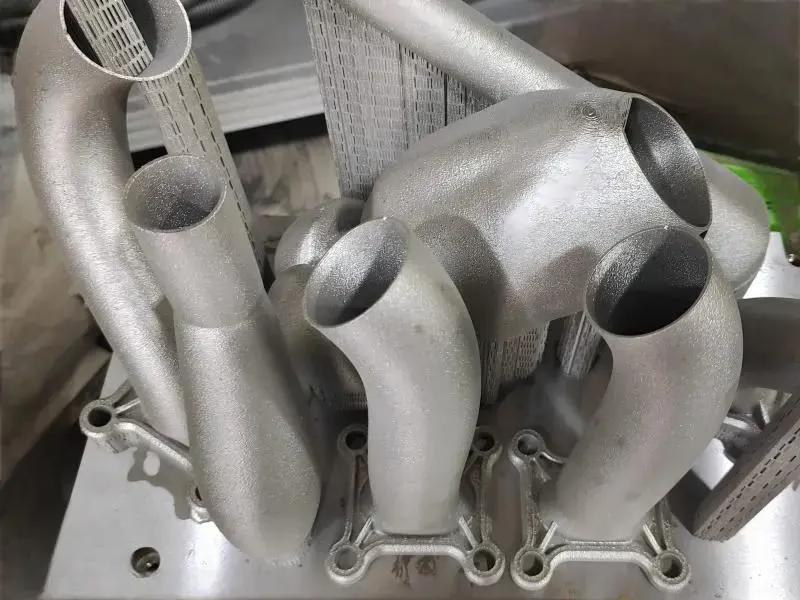
What a circulation recycler actually does
Recovery, conditioning, and re-introduction of metal powder in a laser powder bed fusion workflow.
Where the powder goes after a build
In laser powder bed fusion, a build does not consume all the powder you load. Depending on part geometry and nesting, 30 to 70 percent of the bed stays loose. That leftover sits in the overflow bins, in the gap between the recoater and the build plate, and in the depowdering station. A circulation recycler captures this stream, conditions it, and returns it to the feed hopper instead of sending it to a waste drum.
The loop has four stages. First, vacuum recovery pulls loose powder from the chamber into a sealed container, usually under argon. Second, the powder passes a sieve, typically 45 to 63 μm for laser systems, to strip out spatter, agglomerates, and broken particles. Third, a sampling step measures particle size distribution and chemistry. Fourth, the conditioned batch is blended back with virgin powder at a controlled ratio.
None of this is free. Every stage needs hardware, gas, and time, and every pass through the loop changes the powder a little. The engineering question is not whether to recycle. It is how many cycles a given alloy can take before the part properties move outside the drawing.
What changes in the powder each cycle
Reused powder is not the same powder. Laser spatter generates satellites and irregular particles that flow worse through the recoater. The oxygen content creeps up, especially in titanium and aluminium alloys, because every transfer exposes the powder to trace moisture and air. Particle size distribution drifts coarser as fines are consumed or lost to the sieve.
These changes show up in the part. Poor flow gives inconsistent layer density, which turns into porosity. Higher oxygen in Ti-6Al-4V raises strength and drops ductility, so elongation can fall below the specification you designed around. In 316L the effect is milder, but surface finish and density still drift after enough cycles.
That is why a circulation recycler is only half the system. The other half is the test plan. Particle size distribution, apparent and tap density, Hall flow, oxygen and nitrogen content, and chemistry by ICP are the routine checks. Without them, you are guessing at the blend ratio.
- 1Particle size distributionLaser diffraction; watch the D10 shift and the fines fraction.
- 2Oxygen and nitrogenInert gas fusion; the key number for titanium and aluminium.
- 3Flow and densityHall flow and tap density track how the powder will spread.
- 4ChemistryICP checks for alloy drift and cross-contamination between materials.
Reuse behavior by alloy
Typical trends reported for laser powder bed fusion. Actual limits depend on your machine, gas system, and part requirements.
| Alloy | Main risk on reuse | Routine check | Practical reuse window |
|---|---|---|---|
| 316L stainless | Slight coarsening, density drift | PSD, flow, density | Broad; many cycles with blending |
| 17-4PH stainless | Chemistry shift, lower ductility | Chemistry, PSD, hardness | Moderate; verify after heat treat |
| Ti-6Al-4V | Oxygen pickup, ductility loss | Oxygen, nitrogen, PSD | Narrow; cap oxygen first |
| Inconel 625 / 718 | Minor drift, stable chemistry | PSD, chemistry | Broad; good loop candidate |
| AlSi10Mg | Oxide pickup, flow problems | Oxygen, flow, PSD | Moderate; humidity control matters |
When recycling is the right call, and when it is not
Recycling pays off when the part is large, the build is nested loosely, and the alloy is expensive. Titanium and nickel alloys sit in that zone. A well-run loop can cut virgin powder purchases substantially over a production year, and the material cost per part follows.
Recycling is a poor fit when the part is safety-critical and the qualification is tight. Aerospace structural hardware, implantable medical devices, and anything with a fatigue or fracture-toughness requirement usually needs a fixed virgin-to-reused ratio that is written into the process specification. Changing that ratio mid-program invalidates the qualification.
There is also a floor on batch size. If you build one or two parts a month, the powder sits in the loop long enough to pick up moisture, and the testing overhead per build outweighs the savings. In that case, buy virgin powder in smaller lots and skip the loop entirely.
GreatLight runs metal 3D printing alongside its CNC operations, so a printed blank can go straight to machining for critical faces, bores, and threads. That combination lets us hold ±0.005 mm on machined features while keeping the additive geometry where it saves material.
Documenting the loop so a customer can audit it
A recycler without records is just a bin. For each build we track the powder lot number, the number of prior cycles, the sieve size used, the measured PSD and oxygen, and the blend ratio charged into the machine. Those records travel with the part.
Specifications differ by industry. ISO 9001:2015 and IATF 16949:2016 customers generally want the traceability chain and a statement of the reuse ratio. Medical work under ISO 13485:2016 adds validation of the reuse process itself, which means documented limits and evidence that parts made from reused powder still meet the drawing.
We do not publish a fixed cycle count, because the honest answer depends on the alloy and the application. What we can do is test the powder, report the numbers, and agree on a blend ratio before the first build. If the data says the powder is out of window, it comes out of the loop.
Uploads and drawings stay confidential. An NDA is available on request, and files are handled under the same controls that cover our ISO 27001:2022 information security scope.
Questions engineers ask about powder reuse
Does reused powder change the mechanical properties of the part?
It can, and the size of the change depends on the alloy. Titanium and aluminium are the sensitive ones because oxygen and oxide content rise with each cycle, which lowers ductility. Nickel alloys and 316L are more forgiving.
The way to control it is to fix a blend ratio, test the powder before each build, and verify the finished part. If the tensile results stay inside the drawing, the loop is doing its job.
Which metals can go through a circulation recycler?
The common ones are 316L and 17-4PH stainless steel, titanium alloys such as Ti-6Al-4V, nickel alloys including Inconel 625 and 718, and various tool steels. Compatibility depends on how the alloy reacts to repeated melting and on how well your recovery hardware keeps it dry and clean.
Aluminium alloys are recyclable too, but they demand tighter humidity and oxygen control. Ask about your specific powder before assuming it fits the loop.
How much does powder recycling actually save?
The savings come from buying less virgin powder and paying less for waste disposal. How much you save depends on part geometry, build success rate, and the alloy price, so the range is wide.
The reliable way to judge it is to compare virgin powder consumption per shipped part before and after the loop is running. That number is specific to your production, not a general figure.
Can you mix reused powder from two different builds?
Only if the alloy and the lot history match, and only after the blend has been tested. Mixing powder from different alloys causes contamination that no sieve will fix.
In practice we keep powder segregated by alloy and by cycle count, and we blend within a single material family. Cross-material mixing is a scrap event, not a recycling event.
What happens to powder that fails the test?
It leaves the loop. Depending on the alloy and the contamination level, it goes to a licensed recycler or to controlled disposal, and the lot is closed out in the records.
Keeping failed powder out of production is cheaper than scrapping a build that used it.
Can printed parts be machined afterward to tighter tolerances?
Yes, and that is often the point. Additive gives you the internal channels and organic shapes. CNC gives you the sealing faces, bearing bores, and threaded ports at ±0.005 mm with a finish down to Ra 0.2–0.8 μm.
GreatLight runs both processes in house, so the printed blank and the machining program are planned together rather than handed between vendors.
Send a drawing and we will tell you if the loop fits
Quotation and free DFM analysis within 12 hours. No minimum order quantity, from one prototype to 10,000+ part runs.
Quotation within 12 hours100% inspection before shipmentNDA on request









