
China CNC Machining Turning Service
This guide is for engineers and sourcing managers comparing turning suppliers in China. It covers the checks that actually change part quality and delivery: tolerance, machine fit, quote detail, inspection and MOQ. Read it before you send a drawing.
In this article
- 1
- 2
- 3
- 4
- 5
- 6
- 7
- 8
- 9
Key takeaways
Which supplier fits your part
Match the part first, then compare price.
| Your situation | What to check | Warning sign |
|---|---|---|
| Ø6–80 mm shaft or pin, tight OD | Live-tool lathe, ground stock, in-process gauging | Only a general tolerance block on the drawing |
| Part with cross holes or flats | Mill-turn center or a stated second setup | Quote assumes turning alone |
| Prototype, 1–10 pieces | No MOQ, free DFM notes, 3–5 day ship | Minimum batch of 500 before quoting |
| Automotive bracket, 10,000 parts | IATF 16949, PPAP-style documents, SPC data | No traceability on material lots |
| Implant or surgical instrument | ISO 13485, Ra 0.2–0.8 μm, passivation | Finish spec left to the machine operator |
| Long shaft up to 4,000 mm | Stated maximum processing size and support | No answer on how the part is held |
| Thin-wall bushing, 0.8 mm wall | Soft jaws, low clamping pressure, spring passes | Quote with no note on deformation control |
Send the drawing, get a real answer
A turning quote is only useful if it names the material, setups, tolerance and inspection method. Send your drawing and we will come back with those details, plus DFM notes, within 12 hours.
What a China CNC machining turning service actually does
Turning removes material from a rotating workpiece. The tool stays largely fixed while the spindle turns the stock, so the finished shape is a body of revolution: shafts, pins, bushings, connectors, valve bodies, fittings. A milling machine does the opposite, moving the tool around a stationary block. That difference decides which features are cheap and which are expensive.
A pure turned part with diameters, shoulders, grooves and threads is fast. Add a cross hole, a flat or a slot and the part leaves the lathe envelope. Shops handle this in one of two ways: a mill-turn center with live tooling, or a second milling setup. The second route adds a fixture, a re-datum step and usually 0.01–0.03 mm of positional error between features.
Most parts we quote for a China CNC machining turning service are hybrids. A stainless connector might be turned to Ø12 mm, then cross-drilled, then deburred and passivated. Knowing that sequence early changes the price. It also changes which tolerance you can hold without a special process.
Materials matter for chip control. Aluminium 6061 and 6082 cut cleanly at 300–500 m/min surface speed. Stainless 316L work-hardens, so feeds stay aggressive and coolant stays on the cutting edge. Titanium TC4 and Inconel need lower speeds and more rigid setups. Copper and brass turn fast but grab the tool if rake angles are wrong.
- 1Turned onlyDiameters, threads, grooves, chamfers. One setup, best cost.
- 2Turn + cross featuresLive tooling or a second op. Budget 10–25% more time.
- 3Turn + grindWhen you need Ra 0.2–0.8 μm or a hard shaft seat.
- 4Turn + finishAnodize, electroless nickel, passivation, bead blast.
Tolerance and surface finish: what to ask for
A general tolerance block of ±0.1 mm is fine for brackets and spacers. It is not fine for a bearing seat. Write the critical diameters with their own tolerance, and mark the datums. Shops quote what they read, so an ambiguous drawing gets a safe, expensive quote or a cheap quote that fails at inspection.
±0.005 mm is achievable on a turned diameter, but only with the right conditions: a rigid spindle, temperature-stable shop, sharp tooling and measurement at the machine. It gets harder as the part grows. A Ø10 mm pin at ±0.005 mm is routine. A 800 mm shaft at the same band needs care with thermal growth and support.
Surface finish runs on a separate scale. Ra 1.6–3.2 μm is standard as-machined turning. Ra 0.8–1.6 μm needs a wiper insert or a finishing pass. Ra 0.2–0.8 μm usually means grinding, lapping or a fine boring head, and it adds a process step and cost.
Ask the shop how they verify. A micrometer across the diameter at the machine tells you nothing about roundness, taper or runout. Those need a CMM or a dedicated gauge. If the supplier cannot describe the measurement, the tolerance claim is marketing.
- 1Mark critical dimensionsOne or two per drawing, not twenty.
- 2State the finish per surfaceSealing faces differ from mounting faces.
- 3Define the inspection methodCMM, gauge pin, air gauge, or optical comparator.
Lead time, MOQ and quote detail
A realistic turning timeline has four parts: DFM feedback, material purchase, machining, and inspection plus packing. Shops that hold common stock (6061, 304, 303, brass) can compress the material step. Shops that buy per order add 2–4 days. Ask which materials sit on the floor.
No minimum order quantity sounds generous, and for prototypes it is. It also means the shop runs many small jobs and changes setups often. That is fine for one-off parts and low-volume runs. If you need 10,000 identical bushings per month, a shop with dedicated lines and locked-in process parameters will give you better consistency.
Read the quote line by line. A good one lists material grade and cert, stock size, number of setups, tolerance callouts, finish, inspection method and packaging. A one-line price with a lead time is a placeholder. The gap between two quotes is usually hidden in setup count and finish, not in the hourly rate.
Payment and shipping terms belong in the quote too. Incoterms, who pays duties, and how parts are packed for a container all affect your landed cost. Ask for the packing method before you compare unit prices.
- 1DFM notesFree drawing review catches impossible features early.
- 2Setup countEach extra setup adds cost and position error.
- 3PackingFoam, trays or bulk bags change handling damage.
Certifications and inspection paperwork
ISO 9001:2015 is the baseline. It says the shop has a documented quality system. It does not say the shop can hold ±0.005 mm on your part. Certificates open the door; process data keeps it open.
Industry certificates are different. IATF 16949:2016 is expected for automotive and EV work, and it comes with control plans and traceability. ISO 13485:2016 applies to medical devices and pushes process validation and clean handling. ISO 27001:2022 covers information security, which matters when you send proprietary drawings.
Inspection paperwork should be agreed before production, not after. Options range from a simple dimensional report on critical features to a full first-article report with material certs. 100% inspection before shipment is a good floor for turned parts, because a single bad diameter can scrap an assembly.
Ask how nonconforming parts are handled. A shop that quarantines and reports is easier to work with than one that ships and hopes. Documented corrective action matters more on repeat orders than on the first one.
Machine fit: why the lathe list matters
Turning covers a wide size range, and no single machine does all of it. A Ø400 mm rotary table and a Swiss-style lathe are built for different parts. When you compare suppliers, ask for the machine list that would run your job, not the total machine count.
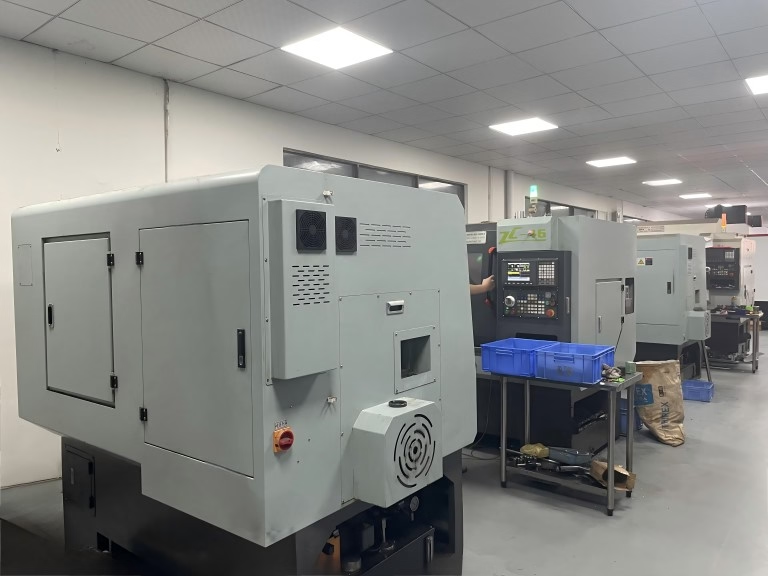
At GreatLight, the turning and mill-turn capacity includes 16 mill-turn centers and 16 simultaneous 5-axis machining centers, within a total of 127 high-precision CNC machines. Maximum processing size is 4,000 mm. That covers long shafts, but it also means the shop can hold small parts by the thousand on the same floor.
Size and feature density decide the route. A Ø20 mm pin with two grooves runs on a lathe in one setup. A Ø120 mm housing with a bolt circle and a cross bore runs on a mill-turn center. A 2,000 mm shaft needs steady rests and a plan for deflection.
For thin-wall parts, clamping is the whole problem. Soft jaws, low pressure and spring passes hold a 0.8 mm wall without crushing it. If the quote does not mention workholding, ask about it. That is where the scrapped parts come from.
Common traps when buying turning in China
The first trap is comparing unit price without comparing scope. One quote includes material cert and CMM report; the other does not. The cheaper number usually hides a missing step that you pay for later in sorting or rework.
The second trap is assuming a milling quote covers turning features, or the reverse. Turned threads and milled threads are made on different machines. So are drilled holes along the axis and drilled holes across it. List every feature family before you ask for a price.
The third trap is skipping the sample. For a new supplier, one or two parts reveal more than a certificate package. Check the surface where the tool entered, the chamfer consistency, and whether the part matches the drawing dimensions you consider critical.
The fourth trap is communication lag. A shop that answers technical questions in a day is easier to correct than one that answers in a week. Time zones matter less than whether an engineer, not a salesperson, reads your drawing.
Step by step: from drawing to shipped parts
Six steps, with the parameters we work to.
- 1Send 2D drawings and a 3D modelInclude STEP or IGES plus a PDF with tolerances, datums and finish callouts. Note the material grade, not just 'stainless'. Add the annual volume and the first-order quantity.
- 2Read the DFM feedbackExpect notes on wall thickness, tool reach, thread depth and datum choice. At GreatLight, quotation and free DFM analysis come back within 12 hours. Push back on anything you do not understand.
- 3Confirm the process routeAgree the setup count, workholding and inspection method. For a Ø6 mm pin, state the gauge. For a thin-wall bushing, agree the clamping pressure and spring-pass allowance, typically 0.02–0.05 mm.
- 4Approve material and finishLock the alloy and temper. 6061-T6 behaves differently from 6061-O. For anodizing, state the type and color; for passivation, state the standard. Laser marking needs a character height of 1.5 mm or more.
- 5Run the first articleCheck critical dimensions, runout and finish at the shop before the batch runs. Production can start within 24 hours of approval, and parts ship in 3–5 days for standard turning work.
- 6Agree the paperwork and packingDecide which reports travel with the parts: material cert, dimensional report, or full first-article. Choose packing that survives the freight mode. Keep an NDA in place if the drawings are sensitive.
Turning supplier questions we hear often
What tolerance can a China CNC machining turning service hold on a typical part?
On a rigid setup with stable temperature, ±0.005 mm is realistic on a turned diameter for small and medium parts. The band widens as the part grows or the wall thins.
For non-critical features, ±0.05 to ±0.1 mm keeps cost down. Only mark the dimensions that matter.
When is a turned part better made on a mill-turn center?
When the part has cross holes, flats, slots or an off-axis bore. One mill-turn setup removes the re-datum error of a second operation, usually 0.01–0.03 mm.
Simple parts with only diameters and threads do not need it, and paying for mill-turn time is wasted money.
Do I need to order a minimum quantity?
No. There is no minimum order quantity, so a single prototype and a 10,000-part run are both possible. The economics change with volume, not the willingness to quote.
For high volume, ask for the process plan once the design is frozen. Consistency comes from locked parameters, not from a bigger batch.
Which certifications should I check for turned parts?
ISO 9001:2015 is the baseline for general industrial work. Add IATF 16949:2016 for automotive and EV, ISO 13485:2016 for medical devices, and ISO 27001:2022 when drawings and data need protection.
Certificates tell you the system exists. Ask for inspection records to confirm it runs.
How should I specify surface finish on a turned part?
Give a Ra value per functional surface. Ra 1.6–3.2 μm is standard as-machined. Ra 0.8–1.6 μm needs a finishing pass. Ra 0.2–0.8 μm usually adds grinding or lapping.
Sealing faces and bearing seats deserve their own callout. Cosmetic surfaces can stay looser.
What affects the price of a turned part most?
Setup count, material, and the tightest tolerance on the drawing. A single extra setup can add more cost than a material upgrade.
Volume spreads setup cost. At low volume the setup dominates; at high volume material and cycle time dominate.
Start your turning order with a clear process plan
Upload your 2D and 3D files. We review the drawing, flag risky features and quote the route we will actually run.
12-hour quoteNo MOQ100% inspectionNDA on request
More from the shop floor
We publish setup notes, tooling trials and inspection data from the factory floor.











