
CNC Machining Brass Parts: How the Alloy Behaves on the Machine
Brass is the easiest copper alloy to cut, and that is exactly why engineers overspecify it. This page explains how free-cutting and wrought brass grades behave at the spindle, where the tolerance window really sits, and when you should pick a different material.
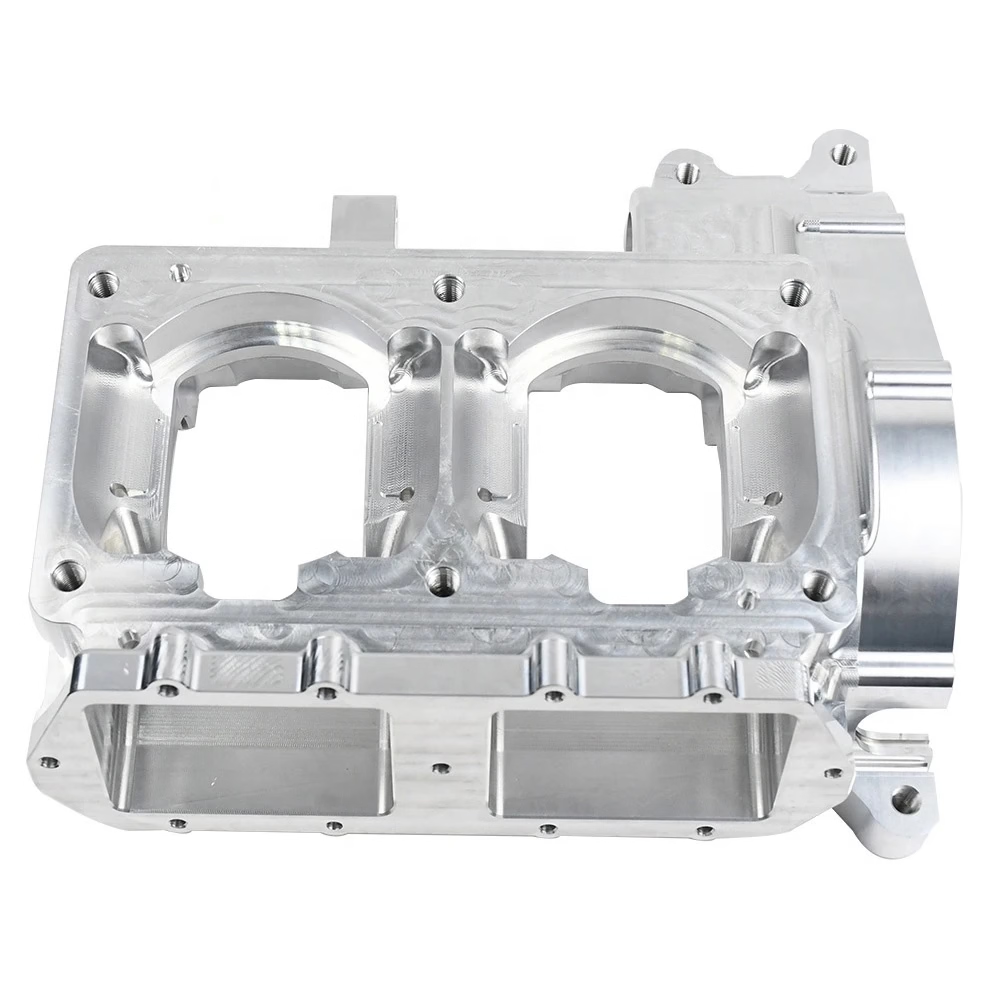
Why CNC machining brass parts cut the way they do
Brass is copper with zinc as the main alloying element. The zinc content usually sits between 5% and 45%, and that single number changes almost everything: color, strength, corrosion behavior, and how the chips break at the cutting edge. Below roughly 35% zinc you get single-phase alpha brass, which is ductile and forms long stringy chips. Above that you enter the alpha-beta range, where the second phase acts as a built-in chip breaker.
The free-cutting grades add lead, and lead is what makes CNC machining brass parts so predictable. Lead does not dissolve in the copper matrix. It sits as tiny discrete particles that concentrate stress ahead of the tool edge, so the chip fractures instead of stretching. That is the whole trick behind C36000, which machines at roughly 100% on the standard machinability scale while pure copper sits near 20%.
Zinc also lowers the melting point, so brass cuts at lower spindle load than steel. Tools last longer and surface finish comes out clean without a secondary operation. The trade-off is thermal: brass conducts heat away from the cut quickly, which protects the part but leaves the tool edge running hotter than operators expect on a light finishing pass.
One consequence matters for anyone specifying these parts. Leaded brass is not food-safe and faces restrictions in potable water applications under US and EU rules. If the part touches drinking water or skin for long periods, the alloy choice has to change before the drawing is released.
C36000, C27400 and C28000: picking the right grade
C36000 is the default for screw machine work and the grade most shops quote first. It runs 61.5% copper, 3% lead, balance zinc, and it turns, mills and drills at high feed rates with short chips. Use it for fittings, connectors, valve bodies, bushings and any part where cycle time drives cost. It is not weldable in any practical sense, and hot working will crack it.
C27400 and C28000 are the wrought brasses, with zinc in the 37–40% range and no deliberate lead addition. They cold-form well and hold up better under vibration than C36000 because they are stronger and more ductile. Choose them for brackets, terminals, and parts that get bent or stamped after machining. Feed rates drop, chip control gets harder, and you may need peck drilling on deep holes.
C110 and C101 are the oxygen-free and electrolytic tough pitch coppers, not brasses, but they show up in the same RFQ pile. They give you the highest conductivity, around 100% IACS, at the cost of gummy chips and built-up edge on the tool. If the part carries current, copper earns its place. If it only needs to look like brass and hold a thread, C36000 is cheaper and faster.
Beryllium copper is a separate conversation. It machines to high strength and keeps conductivity, but the dust is a health hazard, so shops need controlled swarf handling and air monitoring. We quote it, and we flag the safety requirement on the drawing review.
Tolerances, finishes and the limits of the process
Brass holds tight dimensions better than most metals because it is stiff relative to its cutting forces and it does not spring back much. On our machines the standard window is ±0.005 mm (±0.0002 in) on critical features. That number is achievable on a bored bore or a turned diameter, but it is not automatic across a whole part. Datum strategy decides the outcome.
Finish follows the same logic. A sharp tool at moderate feed gives Ra 0.8–1.6 μm off the machine. Push to Ra 0.2–0.8 μm and you are looking at a wiper insert, higher spindle speed, and a lighter depth of cut, which adds cycle time. As-machined at Ra 1.6–3.2 μm is fine for internal features nobody sees.
Thin walls are where brass bites back. A 0.5 mm wall on a Ø40 mm bushing will deflect under chuck pressure even though the cutting forces are low. The fix is usually a soft jaw or a expanding mandrel, not a slower feed. Deep small holes are the other common problem: below Ø1 mm, chip evacuation becomes the constraint, and peck cycles with full retract beat any parameter change.
Threads and knurling are routine. Brass threads clean up well and hold class 2 fit without much fuss. Laser marking works down to 1.5 mm character height. We inspect 100% before shipment, and reports are available on request if your quality system needs the paper trail.
When brass is the wrong call
Brass is a bad choice when the part sees seawater or chloride-rich environments. Dezincification eats the zinc out of the alloy and leaves a porous copper sponge behind. C36000 is the worst offender because of its high zinc and lead content. If the part lives near salt water, move to bronze, 316L stainless, or a coated aluminum.
Weight is the second reason to walk away. Brass runs about 8.5 g/cm³, roughly three times aluminum. On a drone arm or a handheld tool housing, that density kills the design. Aluminum 6061 or 7075 gives you the same geometry at a third of the mass, and anodizing covers the finish requirement.
Cost is the third. Copper and zinc prices swing, and brass stock costs more per kilogram than mild steel or aluminum. For a large bracket that only needs stiffness, 1018 or 6061 will be cheaper on both material and cycle time. Brass earns its premium on small, complex, high-count parts where machinability dominates the cost equation.
Finally, high-temperature service rules brass out. Above about 200 °C, leaded brass loses strength and creep becomes a real risk. If the part sits near an engine manifold or a soldering reflow oven, pick a steel or a titanium grade instead.
What to put on the drawing
State the alloy by UNS number, not by trade name. "Brass" alone means nothing on a shop floor. C36000 and C27400 machine differently, cost differently, and finish differently. A UNS callout removes the ambiguity before the quote stage.
Call out the critical tolerances explicitly and leave the rest general. If every dimension carries ±0.005 mm, the shop has to inspect every dimension, and the price reflects that. Mark the two or three features that matter and let the rest run to a general tolerance block.
Note the finish requirement per surface when it differs. A polished cosmetic face and a as-machined internal bore should not share one blanket note. Debris from a polishing operation can lodge in a threaded hole, so sequence matters too.
Add the application context. If the part carries current, touches water, or sees vibration, say so in a note. That single line often changes the alloy recommendation before the first chip is cut. Uploads stay confidential and we sign an NDA on request.
Brass and copper grades at a glance
Machinability index is relative to C36000 at 100%.
| Grade | Machinability | Typical use | Watch out for |
|---|---|---|---|
| C36000 | 100% | Fittings, connectors, bushings | Not weldable, lead content |
| C27400 | 60–70% | Bent brackets, terminals | Long chips, needs peck drilling |
| C28000 | 60–70% | Forged and formed parts | Lower strength than C36000 |
| C110 | 20% | Bus bars, current-carrying parts | Gummy chips, built-up edge |
| C101 | 20% | High-conductivity electrodes | Soft, easy to mark |
| Beryllium copper | 40–50% | Spring contacts, high-strength pins | Dust hazard, controlled swarf |
The short version
Pick C36000 for high-volume small parts where cycle time drives cost, and move to C27400 or C28000 the moment the part bends, vibrates, or touches water. If the part carries current, use C110 instead.
Common questions
Can you machine brass to ±0.005 mm on every feature?
We can hold ±0.005 mm (±0.0002 in) on critical features, and we do it regularly on turned diameters and bored holes. It is not a blanket capability across an entire part.
The limiting factor is usually datum strategy and fixturing, not the machine. Send the drawing and we will tell you which features can hold that window and which ones need a looser callout to keep the price sane.
Does leaded brass cause problems for medical or food contact parts?
Yes. C36000 contains roughly 3% lead, and that rules it out for potable water fittings and long-term skin contact under US and EU rules.
For those applications we switch to a lead-free grade, 316L stainless, or a compliant bronze. Tell us the end use on the RFQ and we will flag it during DFM review.
How does brass compare to aluminum for CNC prototyping?
Brass machines faster and holds tighter tolerances with less fixturing effort, so a one-off prototype often comes off the machine closer to print.
Aluminum wins on weight and cost per kilogram. For a housing or a bracket, 6061 is usually the better call. For a small connector or a threaded insert, brass is faster to make and looks better finished.
What surface finishes are available on brass parts?
As-machined brass comes off the tool at Ra 1.6–3.2 μm. A wiper insert and a lighter finishing pass get you to Ra 0.8–1.6 μm, and Ra 0.2–0.8 μm is possible on cosmetic faces.
Beyond cutting, we run bead blasting, tumbling, brushing, polishing, and plating. Electroless nickel, silver and gold plating are common on brass contacts. Laser marking works down to 1.5 mm character height.
Can brass parts be welded or soldered?
Leaded grades like C36000 are effectively not weldable. The lead volatilizes and the joint cracks. Brazing and soldering work better, and that is how most brass assemblies are joined.
If the design needs a welded joint, specify a lead-free wrought brass or switch to a weldable alloy such as 304 stainless. We can review the joint design before the parts are cut.
What is the lead time for a brass machining run?
Quotation and DFM analysis come back within 12 hours. Production can start within 24 hours of approval, and parts ship in 3–5 days for standard runs.
There is no minimum order quantity, so a single prototype and a 10,000-part run go through the same review. Historical late-delivery probability sits below 2%.
Send us your brass part drawing
Upload the STEP file and we will return a quote with DFM notes within 12 hours. No minimum order quantity, and your files stay confidential.
12-hour quote100% inspectionNo MOQNDA on request
More from the shop floor
We publish setup notes, tooling trials and inspection data from the factory floor.











