
Cheap Sheet Metal Fabrication for Wholesale Parts
This page explains what actually drives cost in sheet metal work: cutting method, bend count, material grade, tooling and finishing. It is written for design engineers and sourcing staff who receive several quotes for the same bracket and need to tell which one is genuinely cheap and which one moves cost into assembly.
What Makes Sheet Metal Fabrication Cheap
Unit price is a result, not a design decision. Change the geometry and the price moves.
Cutting Method Sets a Cost Floor You Cannot Negotiate Away
Laser cutting cost is mostly time on the bed plus gas and electricity. A part nested at 60 percent material utilization costs more per piece than the same part nested at 85 percent, and no supplier can fix that with a lower labor rate. When you ask for cheap sheet metal fabrication, the first useful question is how the parts were nested and how many sheets ran.
Turret punching is faster than laser on large runs of simple profiles with repeated hole patterns, because the tool is already in the turret and there is no pierce time per hole. It stops being cheap the moment the profile changes often or the hole count is low. Above roughly 500 identical pieces with a stable design, punching usually wins; below that, laser does.
Thickness matters more than people expect. Cutting 3.0 mm mild steel takes noticeably longer than 1.5 mm, and the cut edge on stainless needs nitrogen rather than oxygen, which raises gas cost. If the drawing can go to 2.0 mm CRS without losing stiffness, that single change often beats any negotiation on price.
- 1NestingTighter nesting is the cheapest saving available.
- 2Hole countMany small holes favor punching, few holes favor laser.
- 3Gas choiceStainless needs nitrogen; check whether it is quoted.
Bend Count and Flange Height Decide the Real Price
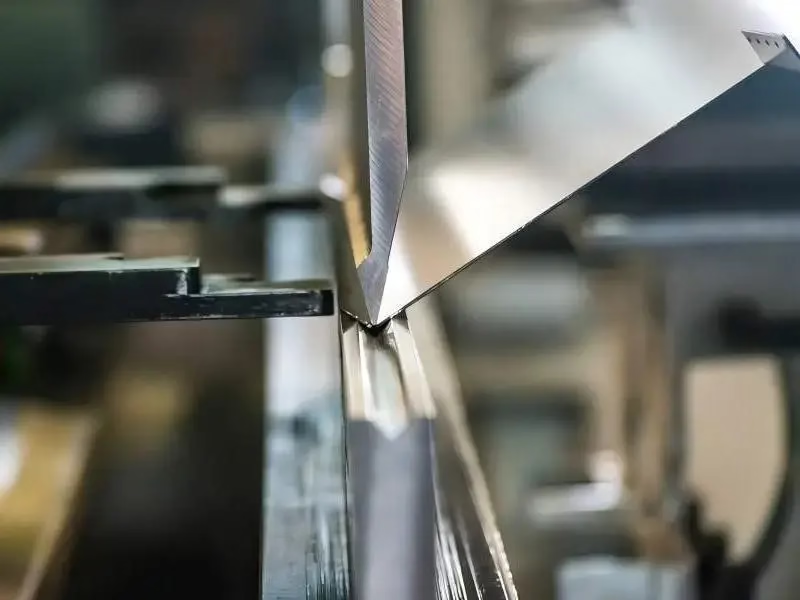
Every bend is a separate hit, a separate handling step, and a separate chance of a tolerance stack-up. A bracket with four bends is not twice the cost of one with two; it can be three times once you add re-fixturing and inspection. Designers who want cheap wholesale parts should count bends on the drawing before they count suppliers.
Flange height is the second trap. A flange shorter than about 4 times the material thickness cannot be formed reliably on a standard punch and die set, so the shop either uses a special tool or accepts a loose angle. Both raise cost, and the loose angle shows up later as a fit problem on the line.
Bend relief and hole-to-bend distance matter too. A hole placed closer than material thickness plus bend radius to the bend line will deform. Cheap quotes that ignore this come back as parts that need reaming, which is not cheap at all.
- 1Under 4 bendsKeep the part in one setup family where possible.
- 2Flange ≥ 4 × thicknessStandard tooling then applies.
- 3Hole ≥ t + R from bendAvoids deformation at the bend line.
Process Cost Drivers at a Glance
Relative cost behavior for common sheet metal operations.
| Operation | Cheap when | Gets expensive when |
|---|---|---|
| Laser cutting | Nesting above 80%, thin gauge | Thick plate, tight kerf, nitrogen assist |
| Turret punching | 500+ identical parts, stable design | Frequent design changes, low volume |
| Press brake bending | Under 4 bends, standard tooling | Short flanges, special dies, long parts |
| MIG / TIG welding | Few short seams, thin gauge | Long seams, full penetration, thin stainless |
| Deburring | Punch-laser with light burr | Heavy dross, hand finishing required |
| Powder coating | Large batches, one color | Small batches, multiple colors, masking |
Grade Substitution Is Where Cheap Quotes Turn Expensive
The most common failure in low-cost sheet metal work is not a machine problem. It is material. A supplier under margin pressure substitutes commercial-grade CRS for the structural grade on the drawing, or 201 stainless for 304. Without mill certificates and a documented incoming inspection, you find out when the part rusts in the field or fails a salt-spray test.
GreatLight runs material verification at goods-in and keeps traceability on file. Our stocked sheet grades include 6061, 5052 and 5053 aluminium, 304 and 316L stainless, 1018 and 4130 steel, and copper alloys such as C110 and C36000. If a grade is not in stock, we say so before quoting rather than after shipping.
Thickness tolerance is the quieter substitution. Sheet is sold to a nominal gauge with a permitted range, and material at the low end of that range bends and welds differently. On parts where stiffness matters, specify the actual thickness range you need, not just the nominal number.
- 1Ask for certificatesMill certs are a normal request, not an insult.
- 2Specify thickness rangeNominal gauge hides a wide band.
- 3Check finish compatibilitySome grades anodize unevenly.
Finishing and Deburring Are Not Optional Add-Ons
A sharp burr from laser cutting tears gloves on the assembly line and can cut a gasket when the part is torqued down. Low-margin shops often skip vibratory finishing to hold the price, which pushes the problem to your team. Deburring belongs in the process plan, not in a separate negotiation.
Cosmetic requirements are the other hidden cost. Powder coating a batch of 20 in one color is reasonable; the same batch in four colors with masked threads is not. Anodizing clear is straightforward on 6061 and 5052; on 7075 the same bath produces a darker, less uniform result, which surprises people who specified by alloy strength alone.
GreatLight offers anodizing in clear, color, hardcoat and conductive types, electroless nickel, zinc, silver and gold plating, powder coating, black oxide, bead blasting, tumbling, brushing and polishing. Laser marking is available down to 1.5 mm character height. Tell us the cosmetic callouts up front and we quote them, rather than discovering them at final inspection.
- 1Deburr in the planNot a post-quote add-on.
- 2One color per batchMultiple colors raise handling cost.
- 3Alloy affects anodize7075 does not match 6061 in clear.
How to Compare Wholesale Quotes Without Getting Burned
Put the quotes side by side and check four things: material grade and thickness, bend count and tooling assumptions, finishing specification, and inspection scope. A quote that is 30 percent lower usually differs on at least one of these. That is not automatically bad, but it should be a deliberate choice, not a surprise on the dock.
Volume breaks are real but they are not linear. Going from 50 to 500 pieces reduces cost per piece mainly through setup amortization and better nesting. Going from 5,000 to 50,000 reduces it through dedicated tooling and automated handling. A supplier quoting the same per-piece price across a 100 to 10,000 piece range is either guessing or leaving something out of the specification.
GreatLight quotes from one prototype to 10,000+ part runs with no minimum order quantity, and returns a quotation with free DFM analysis within 12 hours. Production can start within 24 hours, and parts ship in 3–5 days. We would rather flag a bend that will not form than take the order and send you parts that need rework.
- 1Compare four linesMaterial, bends, finish, inspection.
- 2Volume is not linearSetup and tooling break points matter.
- 3DFM before POCheaper than fixing parts later.
Questions Engineers Ask Before Ordering
How do I know a low quote is not just thin material?
Ask for the mill certificate and the measured thickness range, not the nominal gauge. Any supplier quoting structural steel or 304 stainless should be able to supply that without hesitation.
If the answer is vague, treat the quote as commercial-grade material and price the risk into your decision.
What tolerance can sheet metal work actually hold?
Formed sheet metal is a different world from machining. Bend angle and flange length accumulate tolerance across every hit, so a four-bend part is not as tight as a single-bend part regardless of who makes it.
Where a sheet metal assembly needs a precise interface, machine that feature after forming rather than fighting the bend stack-up. GreatLight holds ±0.005 mm on machined features and can combine both processes on one part.
Is punching always cheaper than laser for wholesale volumes?
No. Punching wins when the profile is stable and the volume is high, generally from a few hundred identical pieces upward with repeated hole patterns.
Below that, laser is usually faster and needs no dedicated tool. If your design changes every few weeks, laser keeps you flexible and avoids tooling cost you would have to write off.
How do I avoid distortion after welding?
Keep weld seams short and symmetric, use the thinnest filler that meets the joint, and allow the part to cool between passes. Long continuous seams on thin stainless are the usual cause of visible bowing.
If flatness matters, specify it on the drawing with a measurable value. Otherwise the shop has no number to inspect against and you will argue about it at receiving.
Can you mark parts with a logo or part number?
Yes. Laser marking and engraving are available down to 1.5 mm character height.
Send the artwork or the text with position and orientation. Marking before finishing and marking after finishing give different contrast, so tell us which look you want.
What about confidentiality on a new design?
Uploads are kept secure and confidential, and a non-disclosure agreement is available on request. We can sign before drawings are shared if your process requires it.
That applies to quoting as well as production, so prototypes and pre-release geometry stay covered.
Send the Drawing, Get a Costed Answer
Quotation with free DFM analysis within 12 hours, 100% inspection before shipment, and no minimum order quantity.
12-hour quoteNo MOQ100% inspection3–5 day shipping









