
Cheap CNC Machining Options for Small Businesses
Low unit cost does not come from a cheaper machine. It comes from matching the process, the batch size and the drawing tolerance to the part you actually need. This page is written for shop owners, product engineers and buyers at small companies who have to place a machining order with a limited budget and still get parts that fit. Read it and you will know which low-cost routes cut real money, which ones only move the cost somewhere else, and when a budget approach is the wrong choice.
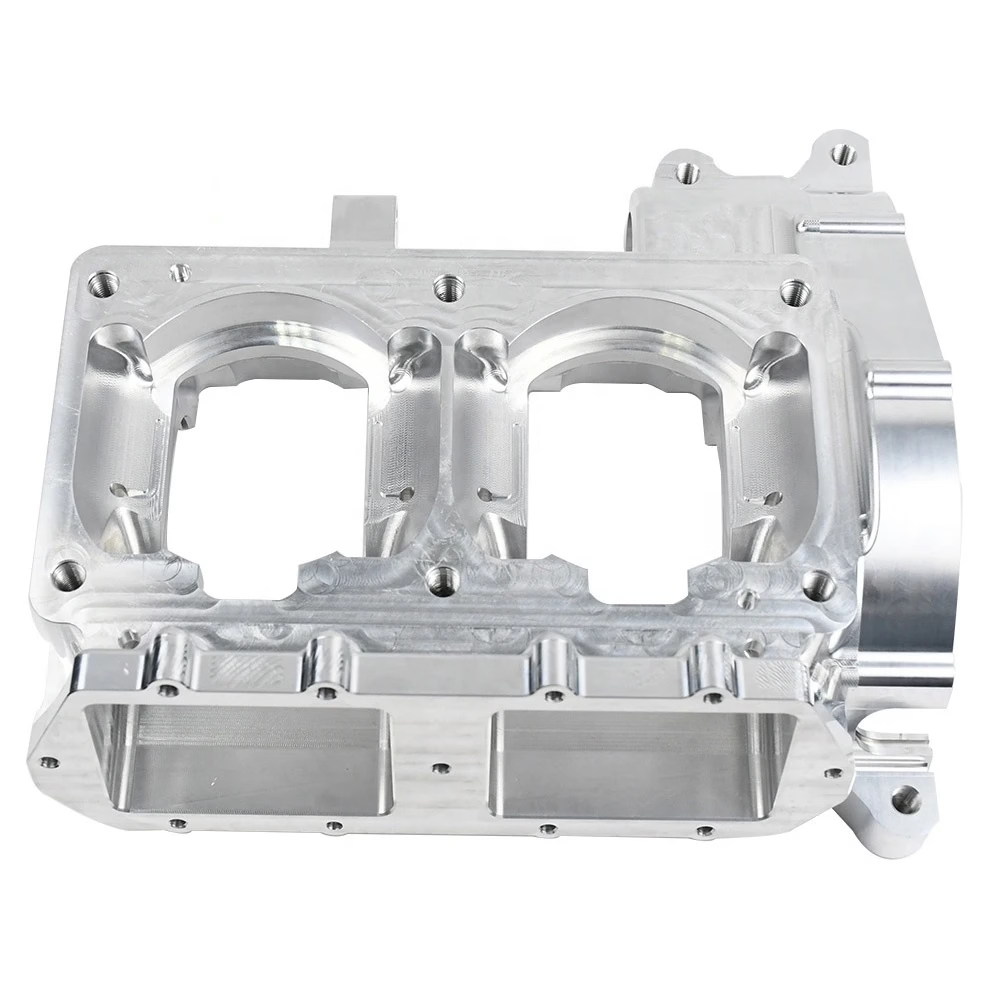
What actually makes CNC machining cheap
Cost is set by geometry, batch size and tolerance, not by the hourly rate alone.
Where the money goes on a machined part
A machined part carries four costs: setup, material, cutting time and inspection. Setup is the fixture, the program and the first-article check. Material is the stock you buy minus what the cutter removes. Cutting time is spindle hours across every operation. Inspection covers the measurements that prove the part is good. On a one-off part, setup dominates. On a 5,000-part run, cutting time and material dominate. That is why a process that looks cheap on a prototype can be expensive in production, and the reverse.
Geometry drives all four numbers. A part with deep pockets, thin walls or features on five faces needs more setups, longer tools and slower feeds. A part that can be reached from two faces with standard end mills runs fast and cheap. When a drawing calls for ±0.005 mm on every dimension, the shop has to slow down, use more passes and inspect more often. Tightening only the critical dimensions, usually the ones that mate with something else, keeps the cost down.
Batch size changes the best process, not just the price. Ten brackets are usually cheapest milled from plate. Ten thousand identical brackets may be cheaper die cast or stamped, with a machining pass on the critical faces. The crossover point depends on part size, wall thickness and finish. A supplier who can run both routes in-house will tell you where that point sits for your part instead of quoting one process for everything.
Material choice is the quiet cost. Aluminium 6061 machines three to four times faster than 316 stainless and costs less per kilogram, so a design change from stainless to 6061 can cut the part price in half without touching the geometry. Titanium and Inconel are only worth their cost when corrosion, weight or temperature demands them.
- 1SetupFixtures, programming and first-article inspection. Dominates low-volume work.
- 2MaterialStock price plus scrap. Aluminium is the cheapest common option.
- 3Cutting timeSpindle hours. Deep pockets, thin walls and hard alloys raise it fast.
- 4InspectionMore tight tolerances means more measuring, on every part.
The cheap CNC machining options that hold up
Three-axis milling is the workhorse. A part with features on one or two faces, reachable with standard tooling, runs on a 3-axis machine at the lowest hourly rate. Most brackets, plates, housings and covers fit here. Adding a fourth axis lets the table rotate so the part can be machined on several sides in one setup, which removes re-fixturing error and often removes a whole operation. For a part with holes on four sides, 4-axis is usually cheaper than three separate 3-axis setups.
Five-axis machining looks expensive per hour, and it is. It becomes the cheap option when the part has complex contours, undercuts or features that would otherwise need three or four fixtures. One 5-axis setup can replace four 3-axis setups, and the part comes off with better positional accuracy because it never moved. For small businesses, the right question is not the hourly rate. It is how many setups the geometry forces.
Turning and mill-turn centers handle round parts. A shaft with a keyway, a cross-hole and a threaded end can often be finished on a mill-turn center in one cycle instead of turning, then milling, then drilling on three machines. Fewer handoffs means less queue time and less handling damage. For bushings, fittings and small motor parts, this is usually the lowest-cost route.
Prototype routes sit alongside CNC when quantities are tiny. Vacuum casting and 3D printing produce a usable part in days without a fixture, but they do not match CNC for tolerance or surface finish. They are worth it for form-and-fit checks and for parts where the geometry will change next week. Once the design freezes, move to CNC.
- 13-axis millingCheapest hourly rate. Best for simple parts reached from two faces.
- 24-axis millingOne extra setup removed. Good for holes on several sides.
- 35-axis machiningPays off when it replaces three or four separate setups.
- 4Mill-turnRound parts with cross features finished in one cycle.
Matching the process to the part
Use this to pick a route before you request a quote.
| Part type | Best low-cost route | When it stops being cheap |
|---|---|---|
| Flat bracket, 2 faces | 3-axis milling from plate | More than 5,000 parts: consider stamping |
| Housing, holes on 4 sides | 4-axis milling | Deep cavities need 5-axis |
| Impeller, complex contour | 5-axis machining | Simple geometry wastes the rate |
| Shaft with cross-hole | Mill-turn center | Part too large for the chuck |
| 10 identical covers | 3-axis, one setup each | Batch drops below 5: setup dominates |
| Thin-wall enclosure | 3-axis with light passes | Wall under 0.5 mm: deflection risk |
| Prototype, form and fit | 3D printing or vacuum casting | Tolerance tighter than ±0.1 mm |
| High-volume small part | Die casting plus finish pass | Fewer than 1,000 parts |
Drawing changes that cut cost without hurting function
Relax tolerances that do not matter. A general tolerance block of ±0.1 mm on a bracket is normal and cheap. Calling ±0.005 mm on a clearance hole adds nothing and raises the price. Mark only the mating dimensions as critical, and let the rest run to the general block. This single change often moves a quote more than switching suppliers.
Cut the number of setups. Add a chamfer so a tool can exit cleanly. Give the part a flat face the vise can grip, or a hole that can be used as a locating feature. Avoid features on the bottom that require flipping the part unless they are necessary. Every re-fixture adds time and adds a chance of error.
Standardize tool sizes. A pocket with a 6 mm corner radius can be cut with a 12 mm cutter. A pocket with a 2 mm corner radius needs a small cutter, run at lower feed, and it takes longer. If the design allows, use corner radii that match common cutter sizes. It is a small change on the screen and a real saving at the machine.
Choose a machinable material. Aluminium 6061-T6 is the default for most small-business parts: good strength, easy to cut, available in many stock sizes. Stainless 303 machines better than 304. If corrosion is the only reason for stainless, anodized 6061 may do the same job for less. Send the drawing for a DFM check and ask what a material swap would save.
- 1Tolerance block±0.1 mm general, tight only on mating features.
- 2Setup countEvery flip is extra time and extra risk.
- 3Corner radiiMatch them to standard cutter sizes.
- 4Material6061-T6 aluminium is the cheap default.
Getting a low price without losing the part
Ask for the price breakdown. A quote that lists material, machining, finishing and inspection tells you where to aim your design changes. A single lump sum hides that. Suppliers who run their own machines and their own finishing can quote the whole route, which removes the markup a broker adds.
Match the order quantity to the setup. A shop charges setup once, then a falling unit price. If you need 20 parts now and 200 next quarter, ask whether one run of 220 is cheaper overall than two runs. Storage is usually cheaper than a second setup. If the design may change, order small and accept the higher unit price.
Keep the finishing simple. As-machined surfaces at Ra 1.6–3.2 μm cost nothing extra. Bead blasting or tumbling is a low-cost way to remove tool marks and deburr at the same time. Hard anodizing, tight cosmetic polishing and multi-colour finishes add cost quickly. Specify finishing only on the faces a customer will see or touch.
Check the quality system before you chase the last few percent. A supplier with ISO 9001:2015 and IATF 16949:2016 runs documented inspection, which is why a cheap part can still fit. A 100% inspection before shipment catches the one bad part that stops your assembly line. A low quote from a shop with no inspection process costs more when the parts arrive wrong.
- 1BreakdownAsk for material, machining, finishing and inspection separately.
- 2Batch planningOne larger run usually beats two small runs.
- 3FinishingAs-machined finish is free. Cosmetic polishing is not.
- 4InspectionDocumented quality control is worth more than a lower quote.
Common questions from small businesses
What is the cheapest CNC machining option for a one-off part?
For a single part, 3-axis milling from standard plate is almost always the lowest-cost route. Setup is the main cost, so keep the part simple, reachable from two faces, and use a general tolerance block.
If the part is round, a mill-turn center can finish it in one cycle and remove the need for a second machine.
Is 5-axis machining ever cheaper than 3-axis?
Yes, when the geometry would otherwise need three or four separate setups. One 5-axis setup can replace them, and the part keeps its position accuracy because it never moves.
For simple brackets and plates, 3-axis stays cheaper. The hourly rate is lower and the setup is short.
How do I lower the price without changing the design?
Order a larger batch to spread the setup cost, and ask whether one run covers your next two builds. Accept the as-machined surface and skip cosmetic finishing.
You can also ask the supplier to quote two materials side by side. A swap from 304 stainless to 6061 aluminium can cut the price sharply.
What is the smallest order a shop will accept?
It varies by supplier. We have no minimum order quantity and run anything from one prototype to 10,000+ part runs.
Small orders carry a higher unit price because setup is spread over fewer parts. That is normal, not a penalty.
When should I not use a cheap route?
Skip it when the part is safety-critical, when the tolerance is genuinely tight, or when the material must survive heat or corrosion. Titanium and Inconel are expensive for a reason.
Also skip it when the surface finish is a functional requirement. A cheap finish that fails in service costs more than the part.
How fast can a low-cost order ship?
We return a quotation and a free DFM analysis within 12 hours. Production can start within 24 hours of approval, and parts ship in 3–5 days.
Historical late-delivery probability is below 2%. Every part is inspected before shipment, with reports on request.
Send your drawing and see what it costs
Upload your files for a quotation and a free DFM analysis within 12 hours. No minimum order quantity, from one part to a full run.
12-hour quoteFree DFM analysisNo minimum order quantityNDA on request









