
Cheap CNC machining: 5 affordable options that hold tolerance
This page is for engineers and buyers who need lower part cost but cannot accept loose dimensions. We break down five cost levers we actually use in the shop, show where each one stops working, and give the numbers behind the trade-offs.
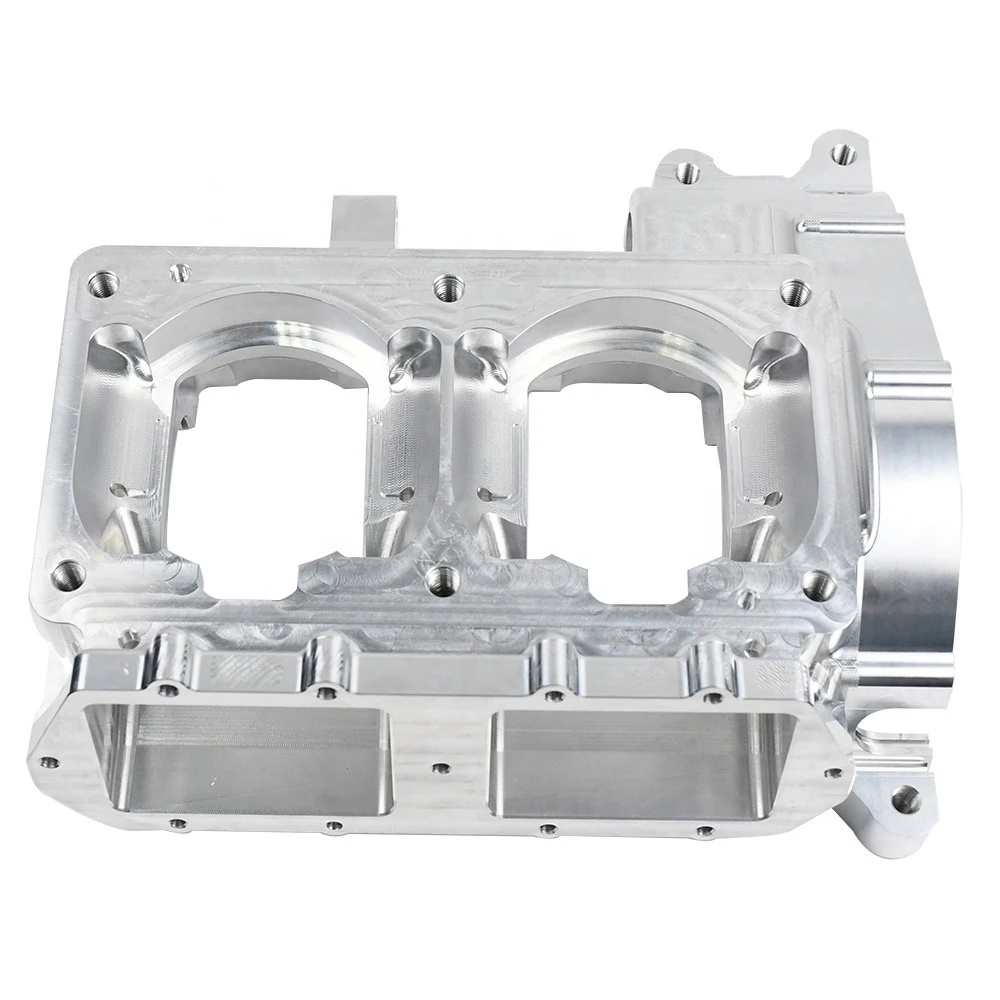
Where CNC cost actually comes from
Five levers, ranked by how much they move the price on a real quote.
Cut setup count, not machine time
Most quotes are dominated by setup, not by spindle hours. A part that needs three setups on a 3-axis mill carries three fixture builds, three zeroing steps, and three chances for stack-up error. Move the same geometry to a 4-axis or 5-axis machine and one setup often covers what took three.
We run 16 simultaneous 5-axis centers and 12 four-axis mills. For a bracket with features on five faces, the 5-axis route is usually cheaper even though the hourly rate is higher. The saving is in labor and fixturing, not in the cut.
There is a limit. Tiny parts with one flat face and two holes do not benefit from 5-axis. On those, a three-axis machine with a soft jaw is faster, and cheaper. If your part fits in a 500 × 310 × 200 mm envelope and has features on two faces, ask for the 3-axis price first.
Ask your supplier how many setups they quoted. If the answer is vague, the price probably has hidden setup in it.
- 1One setup beats three5-axis handles five faces without re-clamping.
- 2Fixture cost is realA custom fixture can add more than the machining.
- 3Small flat partsStay on 3-axis; 5-axis adds no value.
Pick material by machinability, not by habit
Aluminum 6061-T6 cuts about three times faster than 304 stainless at the same surface finish. On a 500-part run, that gap is the single largest line item after material cost itself. If the drawing says 304 because the last project used 304, re-check whether 6061 or 7075 meets the load case.
Titanium TC4 (Ti-6Al-4V) and Inconel cost more per kilo and cut slowly. They are correct for high-temperature and high-strength parts. They are the wrong answer for a sensor housing that never sees 80 °C.
Plastics are the cheapest route when the part does not carry load. POM and ABS machine fast and hold decent tolerance; PEEK costs far more and is only worth it for chemical or thermal resistance.
Material substitution is a design decision, not a purchasing one. Get your stress engineer to sign off before you ask for the cheaper alloy.
- 16061-T6 firstFast cutting, good strength, wide stock availability.
- 2304 only when neededCorrosion resistance has a real machining cost.
- 3PEEK is not cheapUse it for temperature or chemistry, not for looks.
Machinability and relative cost by material
Relative cost is a shop-floor guide for small to medium runs, not a quotation.
| Material | Machinability | Relative cost | Typical use |
|---|---|---|---|
| Aluminum 6061-T6 | Excellent | 1.0× | Brackets, housings, fixtures |
| Aluminum 7075 | Good | 1.3× | High-strength aerospace parts |
| Brass C36000 | Excellent | 1.8× | Fittings, connectors, valves |
| Stainless 303 | Good | 2.2× | Shafts, fasteners, bushings |
| Stainless 304 / 316L | Fair | 2.6× | Food, medical, marine parts |
| Steel 1045 | Fair | 1.6× | Shafts, gears, general machine parts |
| Steel 4140 | Fair | 2.0× | High-stress structural parts |
| Titanium TC4 | Poor | 6.0× | Aerospace, implant-adjacent parts |
| Inconel 718 | Very poor | 9.0× | Hot-section and high-load parts |
| POM (acetal) | Excellent | 0.7× | Bushings, insulators, light gears |
Loosen the tolerance where it does not matter
A ±0.005 mm callout on every dimension multiplies inspection time. If a bore locates a bearing, hold it tight. If a clearance hole passes a screw, ±0.1 mm is fine and costs less to verify.
We see drawings where the title block says ±0.005 mm and the part is a cover plate. That single line can add 20 to 30 percent to the price because every feature now needs a CMM report. Mark critical dimensions and leave the rest general.
Surface finish works the same way. Ra 0.2–0.8 μm needs extra passes and sometimes polishing. Ra 1.6–3.2 μm is the natural as-machined result on most aluminum parts. Specify the fine finish only on sealing faces and sliding surfaces.
One more: deep holes, thin walls, and sharp internal corners raise cost more than tight tolerance does. A 0.5 mm internal corner radius forces a small tool that breaks easily and cuts slowly. Open it to 1 mm or the tool radius your supplier names and the price drops.
- 1Mark only critical dimsGeneral tolerance covers the rest.
- 2Ra 1.6–3.2 μm is defaultFine finishes cost extra passes.
- 3Open internal cornersSmall end mills cut slowly and break.
Match the process to the quantity
CNC is not always the cheapest route at every volume. For 1 to 50 parts, machining wins on lead time and accuracy. Above a few thousand identical parts, die casting or vacuum casting can beat it on unit price, though tooling adds cost and time up front.
3D printing sits between them. A printed prototype in a few days costs less than a machined one and lets you check fit before you commit to metal. We run both, so we can tell you which route fits your geometry rather than which one we prefer to sell.
Sheet metal fabrication is the cheap answer for enclosures and brackets under 3 mm thick. Laser cutting plus bending is faster and cheaper than milling a box out of solid stock. If your part is essentially a folded panel, do not machine it.
The decision rule is simple. Few parts and tight tolerance: machine. Many parts and moderate tolerance: cast. Thin and flat: sheet metal. Prototype for fit only: print.
- 11–50 partsCNC gives the best accuracy per dollar.
- 21,000+ partsCasting can lower unit price after tooling.
- 3Thin panelsSheet metal beats milling solid stock.
Buy machining as a service, not as a machine
Buying a used mill and running parts in-house looks cheap on the invoice. Add tooling, coolant, a cam programmer, floor space, and the learning curve on the first ten jobs, and the real number is higher. That math only works when you have steady volume and someone who can run the machine.
An online quotation service removes the capital cost. You upload a STEP file, get DFM feedback and a price, and pay per part. No machine payment, no idle time between jobs, no maintenance schedule. For teams without a machine shop, this is the lowest-risk path to a metal part.
Confidentiality matters here. We work under NDA on request and treat uploads as confidential. If your part is patent-pending or under a customer agreement, ask for the NDA before you send files.
The trade-off is control. You do not see the setup or choose the tool path. That is why the DFM report matters. Read it, fix the flagged features, and the second quote usually comes back lower than the first.
- 1No capital costPay per part instead of per machine.
- 2DFM firstFix flagged features before you order.
- 3NDA on requestProtect design files before upload.
Common questions on cost and tolerance
How much can design changes actually reduce a CNC quote?
On the parts we quote, loosening general tolerance and opening internal corner radii commonly takes 15 to 30 percent off the price. Removing a second setup can take off more. The exact number depends on geometry, so we send a DFM report with the quote and list what to change.
Is a cheaper material always the right call?
No. 6061-T6 is cheaper to machine than 304 stainless and is strong enough for many brackets. It is the wrong choice for a part that sees salt spray or body-temperature corrosion. Check the service environment before you switch alloys.
Does a low price mean a loose tolerance?
Not by itself. We hold ±0.005 mm on critical features regardless of order size, and we inspect 100 percent of parts before shipment. What changes with a lower price is usually the number of tight dimensions, the surface finish, or the number of setups, not the basic accuracy.
When is 3D printing cheaper than CNC?
For fit-check prototypes and low-load parts, printing is usually cheaper and faster. Once the part carries load, sees heat, or needs a tight bore, machining wins. We quote both when the geometry could go either way.
What is the smallest order you accept?
One part. There is no minimum order quantity. Prototype quantities and 10,000+ part runs go through the same inspection process, and production can start within 24 hours of an approved quote.
How do I get a price without sharing my full design?
Send the drawing under NDA, or share the critical features and envelope size for a budgetary number. Quotation and DFM analysis come back within 12 hours. Uploads are treated as confidential.
Send a drawing, get a costed route
Upload your STEP file and we return a price with DFM notes within 12 hours.
12-hour quoteDFM analysis±0.005 mmNo MOQ









