
Changzhou Steel Sheet Protective Cover: Design and Machining Notes
A Changzhou steel sheet protective cover is a folded metal guard that keeps chips, coolant and hands away from moving machine parts. This page is for design engineers and buyers who need to specify one. Read it and you can judge material, thickness, bend radii and tolerance before you send an RFQ.
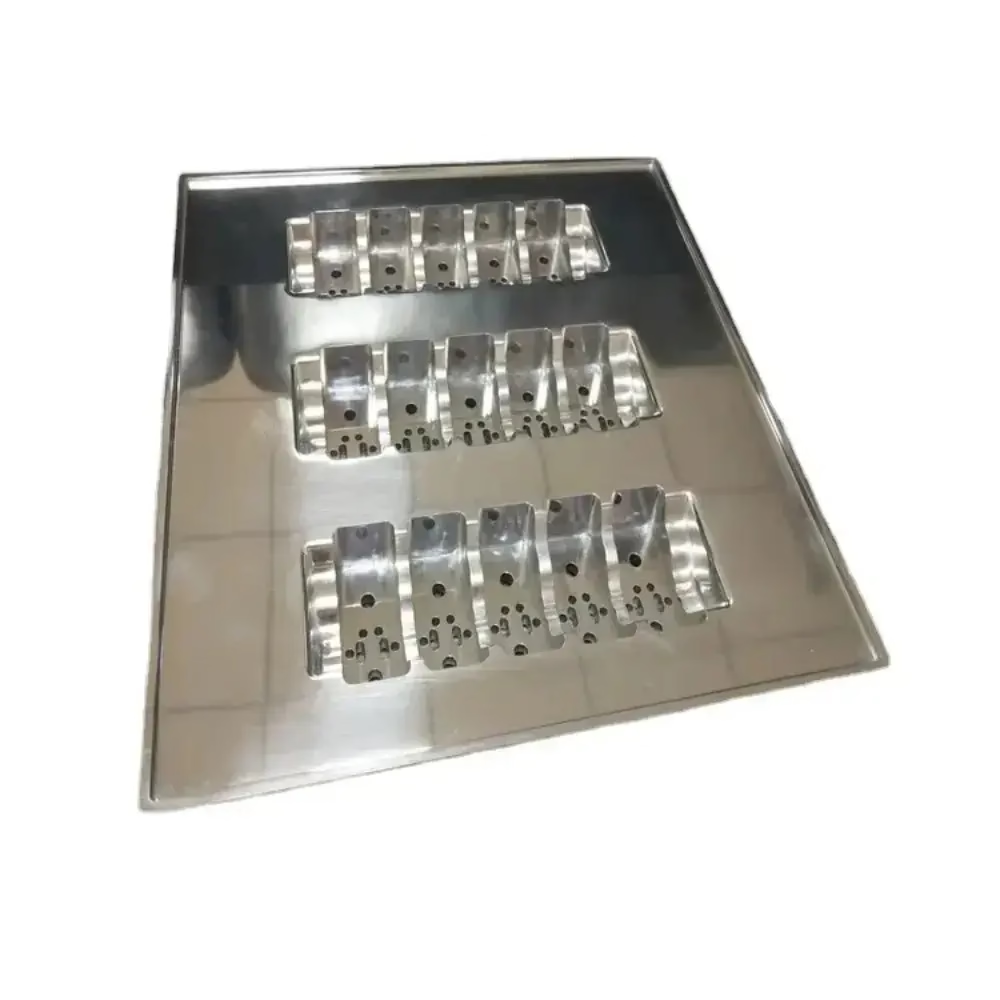
What a Steel Sheet Protective Cover Has to Do
A guard is a mechanical part with a job: survive the environment, keep the gap closed, and stay removable for maintenance.
What the Cover Actually Protects
On a CNC machine, a Changzhou steel sheet protective cover usually sits between the cutting zone and the parts you do not want to touch: linear rails, ball screws, encoders, cable runs and the operator's hands. It is not a cosmetic panel. It sees hot chips, coolant mist and repeated flexing every shift.
Three duties show up again and again. First, contain chips so they cannot pack into a rail track. Second, shed coolant so it drains back to the tank instead of pooling on a slide. Third, stay stiff enough that a 1 mm chip gap does not open up under vibration. A guard that fails at any one of these gets replaced within months.
That is why the drawing matters more than the material grade on its own. A 1.5 mm cover with the right fold geometry will outlast a 3 mm flat plate with no stiffening. Folds, not thickness, carry most of the load.
- 1Chip containmentClosed gaps below 1 mm at the sliding interface.
- 2Coolant drainageSloped faces and drain slots, no flat pools.
- 3StiffnessEdge folds and ribs resist vibration better than added thickness.
Picking the Sheet Grade
Cold-rolled 1018 or 1045 is the default for indoor machine guards. It bends cleanly, takes powder coating, and costs less than stainless. Add zinc plating or black oxide when the guard sees coolant daily, since bare carbon steel will rust at the cut edges first.
Stainless 304 is the choice for food, medical and wash-down equipment. It resists coolant and cleaning agents without a coating, but it work-hardens, so tight bend radii need more springback allowance. Grade 316 or 316L goes on when chlorides are present, such as salt spray or certain cutting fluids.
Aluminium 5052 and 6061 show up where weight matters, like a cover on a moving gantry. They will not rust, but they scratch and dent more easily than steel. Titanium and Inconel are seldom used for a full cover; they are reserved for small brackets and clips in high-temperature zones.
Tell us the environment and we can narrow the grade. Coolant type, wash-down frequency and ambient temperature change the answer more than the part drawing does.
Sheet Grade and Thickness by Application
Starting points, not fixed rules. Final thickness follows the span and the load.
| Application | Typical grade | Sheet thickness | Finish |
|---|---|---|---|
| Indoor CNC way cover | 1018 / 1045 | 1.5–3.0 mm | Powder coat |
| Coolant-heavy lathe guard | 1045 + zinc | 2.0–4.0 mm | Zinc plate |
| Wash-down food equipment | 304 | 1.0–2.0 mm | Bead blast |
| Chloride or salt exposure | 316 / 316L | 1.5–3.0 mm | Passivation |
| Moving gantry cover | 5052 / 6061 | 2.0–4.0 mm | Anodize |
| High-temp small bracket | Ti or Inconel | 0.8–2.0 mm | As machined |
Bend Radii, Gaps and Tolerances
Minimum inside bend radius depends on thickness. A common shop floor rule for cold-rolled steel is one times the thickness; stainless wants about 1.5 times. Push below that and you get cracking on the outside of the bend, especially on 304.
Sliding interfaces deserve attention. A telescoping cover needs a running clearance, and the number depends on how hot the machine gets. Roughly 0.5 mm per side is workable for a short cover at room temperature. Long covers on a hot machine need more, or the two halves will bind once the metal grows.
Dimensional tolerance is a separate question from fit. Laser-cut blanks and CNC-bent parts hold around ±0.1 mm on hole position and ±0.5° on bend angle, which is enough for a guard. When a cover doubles as a locating fixture, we machine the critical features on a 5-axis center and hold ±0.005 mm. Mixing both processes in one part is normal here.
Do not over-specify the whole cover to ±0.005 mm. It raises cost and adds nothing. Mark the two or three features that mate with the machine and leave the rest at sheet metal tolerance.
- 1Bend radius1× thickness for carbon steel, 1.5× for 304 stainless.
- 2Running gapAbout 0.5 mm per side on a short room-temperature cover.
- 3Bend angle±0.5° is standard; tighter needs a check fixture.
- 4Critical holesMachine on a 5-axis center when position matters.
When Sheet Metal Beats Casting or Machining
A folded cover wins on cost and lead time for anything up to a few hundred units. Tooling is minimal, changes are quick, and the part stays light. Prototypes and low-volume machine builds almost always go this way.
Casting makes sense at high volume with complex ribs and a shape that will not change. The tooling cost only pays back over thousands of identical parts. For a guard that gets redesigned every machine generation, that money is usually wasted.
Solid machined covers appear when the guard is also a structural element, or when it needs deep pockets and tight bores. A 5-axis center can cut a one-piece cover with integrated mounting bosses, but you pay in material and cycle time. For a plain guard, it is the wrong process.
Mixed builds are common. Fold the main shell, then machine the hinge blocks, latch plates and mounting pads. We run the sheet work and the CNC work under one roof, so the interfaces line up without shipping parts between vendors.
Inspection and What We Send With the Parts
Every cover is checked before it leaves. That means a raw material certificate, in-process checks on bend angle and hole position, and a final inspection on the finished part. Reports go out on request, not buried in a portal.
For a first article, we usually send a dimensional report covering the mounting pattern and the overall envelope. If the cover has a sliding fit, we check the running clearance assembled, not just as separate pieces. That catches the tolerance stack that a piece-part check misses.
Our shop holds ISO 9001:2015, IATF 16949:2016, ISO 13485:2016 and ISO 27001:2022. The last one matters for customers who send full machine drawings. Uploads stay confidential, and an NDA is available on request.
Production capacity is 127 high-precision CNC machines across three plants, with 16 simultaneous 5-axis centers and a maximum processing size of 4,000 mm. Sheet metal work and machining run side by side, which keeps the handoff short.
Questions Engineers Ask
How thick should a steel sheet protective cover be?
For an indoor machine guard, 1.5–3.0 mm cold-rolled steel covers most cases. Thinner sheet needs more folds to stay stiff; thicker sheet adds weight and bend force without much gain.
The span between supports matters more than the number. A short unsupported span can use 1.5 mm, while a long cover over a wide opening usually needs 2.5–3.0 mm or an added rib.
Can you hold ±0.005 mm on a bent cover?
Not on the formed surfaces. Bending is a sheet metal process, and ±0.1 mm on hole position with ±0.5° on bend angle is the realistic range.
We hold ±0.005 mm on features we machine after forming, such as hinge bores, latch holes and mounting pads. Mark those on the drawing and leave the rest at sheet metal tolerance.
What is the smallest order you accept?
There is no minimum order quantity. We run from one prototype to production runs above 10,000 parts.
A single cover is fine. You get a quotation and a free DFM analysis within 12 hours, and production can start within 24 hours of approval.
How do I stop a guard from rusting at the cut edges?
Cut edges on carbon steel have no coating, so they rust first. Zinc plating handles this well because it covers the sheared face as well as the flat.
Another route is stainless 304 or 316, which needs no coating at all. Pick 316 when chlorides are in the coolant or the cleaning agent.
Will the sliding clearance change when the machine heats up?
Yes. Steel grows about 12 μm per meter per °C, so a 1 m cover on a machine running 30 °C above ambient gains roughly 0.36 mm in length.
Build that into the running gap, or design one side with a slot so the two halves can float instead of binding.
What finishes are available for a cover?
Powder coating, black oxide, zinc plating, electroless nickel, bead blasting, brushing and polishing are all standard here.
Laser marking is available for part numbers and warnings, with a minimum character height of 1.5 mm.
Send the Cover Drawing and Get a Quote
Upload the drawing and we return a quotation with a free DFM analysis within 12 hours. Every part is inspected 100% before shipment, and an NDA is available on request.
12-hour quote100% inspectionNo minimum orderNDA on request









