
BMW's M Visionary Materials seats use 3D printing technology to win an award
BMW's M Visionary Materials seat study combined additive manufacturing with bio-based and recycled content, and it won an award for that combination. This page breaks down what is actually printed, what is machined, and where a seat part should go to an FDM or SLS machine instead of a mill. Written for design and manufacturing engineers quoting interior hardware.
What the award was actually about
A seat study is a materials problem first and a process problem second. Read the order of decisions before you pick a machine.
Why BMW's M Visionary Materials seats drew attention
The BMW M Visionary Materials seat is a concept study, not a catalog option. It was built to test whether a performance seat could be assembled from a much smaller set of materials, with more of them renewable or recycled, without losing the structural behavior an M car interior needs. The award followed that combination of material choice and process choice.
Additive manufacturing carried a large share of the story. Printed lattice cushions, printed trim and printed structural inserts let the team vary stiffness and thickness locally instead of molding one uniform part. In a seat, that matters: the bolster under your hip and the shell behind your shoulder want different densities, and a print head can change density layer by layer.
A second point is assembly count. Fewer parts means fewer interfaces, fewer fasteners and fewer places where two different plastics have to be bonded. Printing a single organic shape can replace a stack of stamped and molded pieces. That is the design freedom the award recognized, and it is the same argument any engineer makes when they move a bracket from welded sheet to one machined block.
Keep the scale in perspective. A study seat is low volume by definition. Nothing about it proves that printed parts beat injection molding at 200,000 units a year. It proves the geometry and the material mix were worth showing.
- 1Printed latticeVarying density across one cushion instead of one foam grade
- 2Fewer interfacesConsolidated shapes reduce fasteners and bonded joints
- 3Material mixBio-based and recycled content tested against interior durability
What gets printed and what still gets machined
Printing wins where the geometry is organic, the volume is low, or the internal structure has to vary. That covers lattice cushions, ducting, clip housings, speaker grilles and one-off ergonomic inserts. It also covers anything that would need a complex mold with slides. Tooling cost for a foam or injection mold is real money, and at 200 seats you never amortize it.
Machining wins where the part carries load, threads, a bearing bore, or a sealing face. Seat rails, recliner plates, hinge pins, mounting brackets and adjuster hardware are machined from 6061-T6, 7075, 4130 or 17-4PH because the tolerance and the grain structure matter. A printed bracket can be strong, but you cannot hold ±0.005 mm on a bearing seat that will see 50,000 adjustment cycles.
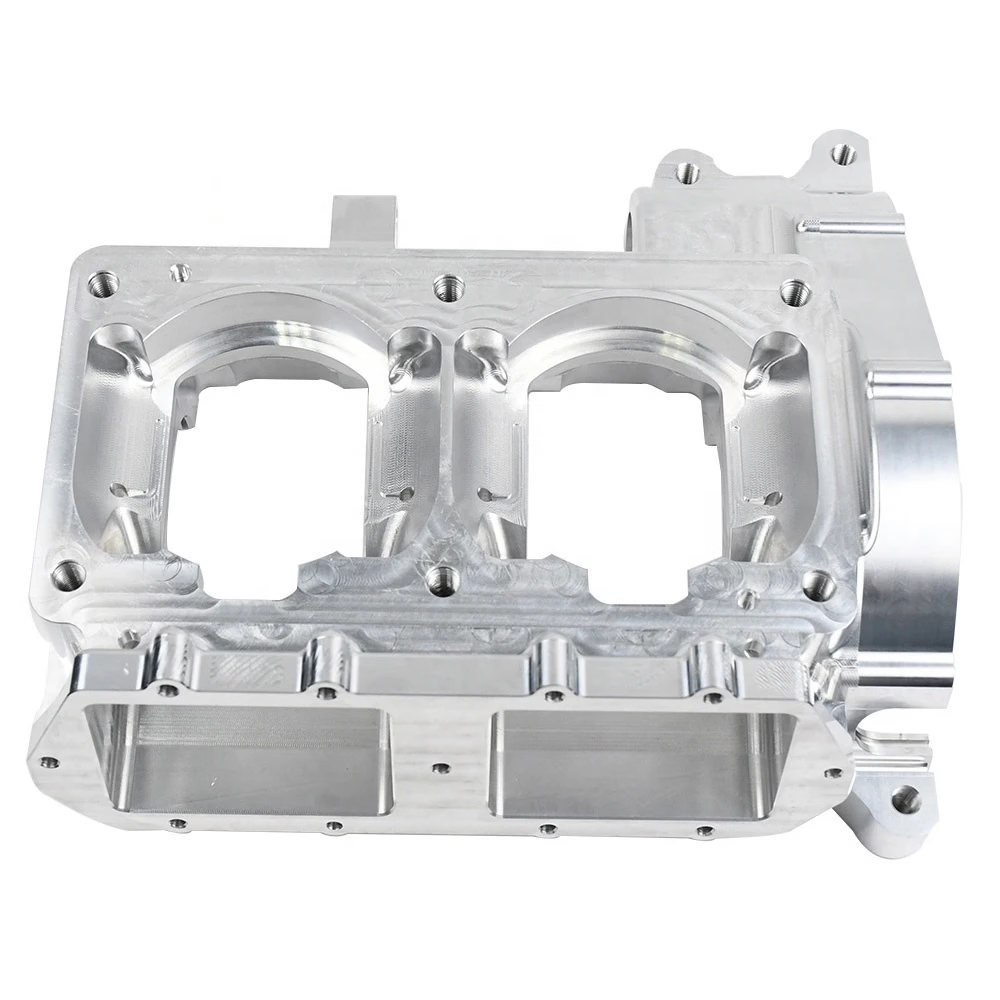
There is a middle path that gets ignored. Print the ergonomic shell, then machine the interface. A printed armrest core with a CNC-machined mounting boss gives you the comfort geometry and a flat, tapped datum in one assembly. We do this often on automotive interior and under-hood work: the print carries shape, the mill carries the fit.
Look at the load path before you look at the process. If a part's job is to position something, print it. If its job is to hold something under vibration for ten years, machine it or cast it and machine the critical features afterward.
- 1PrintLattice, ducts, grilles, clips, low-volume ergonomic inserts
- 2MachineRails, hinges, recliner plates, brackets, threaded interfaces
- 3HybridPrinted shell plus machined mounting boss or datum face
Seat part selection by load and volume
Use this as a first pass. Verify with your own load case before releasing a process.
| Part | Best process | Why |
|---|---|---|
| Lumbar cushion insert | FDM or SLS print | Varying density, low annual volume, no threads |
| Seat back shell (concept) | Print, or print plus machined insert | Organic shape, tooling cost too high for the run |
| Seat rail slider | 5-axis CNC from 6061-T6 or 4130 | Sliding fit and wear surface need tight tolerance |
| Recliner hinge plate | CNC or die cast plus CNC finishing | Load-bearing, needs consistent grain and bore accuracy |
| Headrest guide sleeve | CNC turning from POM or 304 | Round bore, wear resistance, high piece count |
| Trim bezel, low volume | Print or vacuum cast | Cosmetic, simple geometry, small run |
| Trim bezel, high volume | Injection molding | Per-part cost dominates once tooling is amortized |
Material choices that survive a car interior
Interior parts face heat, UV, skin oils and abrasion. That set of conditions eliminates more materials than structural load does. For printed seat components, PA12 and PA11 with glass or carbon fiber fill hold up better than plain PLA or ABS, and they tolerate the 80–90 °C a closed car reaches on a summer dashboard. PEEK is available when a part sits near a heat source, but it costs more and needs a hot print chamber.
For machined seat hardware, aluminium and steel do most of the work. 6061-T6 is the default for brackets and plates because it machines fast and takes anodizing well. 7075 gives higher strength where weight matters. 4130 and 17-4PH cover hinge pins and high-cycle adjuster parts. Stainless 304 and 316 handle exposed trim and any part that sees moisture.
Surface finish is not cosmetic only. A machined Ra 1.6–3.2 μm is fine for a bracket. A sliding surface wants Ra 0.8–1.6 μm or better, plus a hard anodized or electroless nickel layer if it will rub against another metal. Printed parts usually need bead blasting or tumbling to remove support marks before paint, and printed threads should be replaced with a machined insert or a heat-set insert.
Recycled and bio-based feedstocks are worth testing, but they are not drop-in. Print parameters shift with filler content and moisture uptake. Dry the filament, print a test coupon, and measure before you commit a whole seat set.
- 1Printed: PA12, PA11, filled PAHeat and UV tolerance for interior geometry
- 2Machined: 6061-T6, 7075, 4130, 17-4PHBrackets, pins, plates, threaded interfaces
- 3FinishingHard anodize or electroless nickel for rubbing surfaces
Tolerance and inspection on mixed-process seats
When printed and machined parts meet, the printed side usually sets the loose tolerance and the machined side sets the tight one. That is fine as long as the drawing says so. Put the datum on the machined feature, then dimension the printed geometry from it. This avoids stacking two loose tolerances across a joint.
Our machining tolerance runs to ±0.005 mm on critical features, and we inspect 100% of parts before shipment. Printed parts are checked against the same drawing but with realistic callouts: ±0.3 mm on an FDM part is normal, and SLS holds tighter in-plane than across layers. If your drawing demands ±0.05 mm on a printed surface, you are asking for a secondary machining operation whether you wrote it down or not.
Anisotropy is the trap. A printed part is weaker across layer lines. If a cushion clip loads perpendicular to the layers, it will split along a layer even though the coupon test passed. Orient the part in the build, or add a machined insert at the load point.
For seat hardware we issue inspection reports on request, including raw material certificates and dimensional data. That is the same paperwork path used for automotive production parts, so a concept seat and a production bracket can share one quality trail.
- 1Datum on the machined faceDo not dimension printed geometry from printed geometry
- 2Realistic print callouts±0.3 mm typical; tighter needs a machining pass
- 3Watch layer directionLoads across layers split early; reorient or insert
Questions engineers ask after the award story
Is the BMW M Visionary Materials seat a production part?
It is a concept study built to demonstrate a material and process direction, and the award recognized that work. Treat it as a design signal, not a released part number.
The engineering takeaway is the split: organic low-load shapes went to printing, and the hardware that carries load and threads stayed with established processes.
Can a printed part replace a machined bracket in a seat?
Sometimes, if the bracket is a locator rather than a load path and the annual volume is low. Print orientation has to put layer lines away from the main load.
If the bracket has a threaded hole, a bearing bore or a sliding contact, keep it machined. A heat-set insert helps but does not fix a bore tolerance.
What does a hybrid printed and machined seat part cost to develop?
Send the 3D file and we return a quotation with a free DFM analysis within 12 hours. No minimum order quantity, so one prototype and a 10,000-part run go through the same quote path.
We quote machining, printing and finishing separately so you can see which step drives the cost.
Which printed material should I specify for an interior trim part?
PA12 or PA11, filled or unfilled, is the usual starting point for interior geometry. It handles heat better than ABS and prints with fewer warping problems.
Add bead blasting or tumbling if the part will be painted or handled. For high-heat locations near the floorpan or exhaust tunnel, move up to PEEK and expect a higher piece price.
How do you hold tolerance where a printed shell meets a machined mount?
Machine the mount first, then use it as the datum for any secondary operation on the shell. Inspect the assembly, not just the printed half.
Where the joint needs a flat sealing or seating face, machine that face after printing. It takes one extra setup and removes the layer texture from the interface.
Do you sign an NDA for concept interior work?
Yes. Uploads are handled as secure and confidential, and a non-disclosure agreement is available on request before you send files.
For automotive programs we also work under IATF 16949:2016 and ISO 9001:2015 quality systems, with material certificates and inspection reports issued on request.
Quote the machined half of your seat program
Send your 3D files and get a quotation with free DFM analysis within 12 hours. From one prototype to 10,000+ parts, printed and machined under one roof.
12-hour quote±0.005 mm100% inspectionNDA on request









