
Black Oxide Issues on 304 Stainless Steel
Black oxide on 304 stainless steel is a hot alkaline conversion coating, not a plated layer. It darkens the surface and cuts reflectivity, but it adds almost no corrosion protection and almost no wear resistance. This page explains how the coating forms, which parts it suits, and when to pick a different finish.
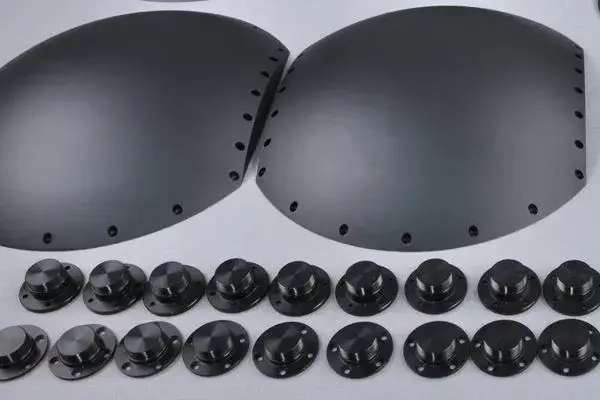
What black oxide on 304 stainless steel actually is
Black oxide on 304 stainless steel forms in a hot alkaline bath, usually sodium hydroxide with nitrates or nitrites, held somewhere between 135 °C and 150 °C. The bath converts surface iron into magnetite, Fe₃O₄. No metal is deposited. The part itself becomes the coating, so the layer grows inward as much as outward.
That matters for tolerances. A hot black oxide layer on stainless is typically under 1 μm thick, and most of it sits below the original surface. A 304 shaft held to ±0.005 mm usually stays inside tolerance after coating. But the dimensional change is not zero, and it is not perfectly repeatable across a rack.
The color comes from the oxide itself, so it cannot be tuned like a dye. On 304 you get a dark gray to near-black that shifts with alloy lot, surface finish, and bath age. Two batches of the same drawing can look different under the same light.
One more point: 304 is austenitic. It does not respond to black oxide the way a carbon steel or a 400-series stainless does. The chromium oxide that makes 304 corrosion resistant also makes it resistant to the blackening reaction.
- 1Layer thicknessUsually under 1 μm on stainless; far thinner than plating
- 2Growth directionMostly inward, so outside dimensions move very little
- 3Color sourceMagnetite, not a dye or pigment
- 4Alloy responseAustenitic 304 reacts less readily than carbon steel
Corrosion and wear limits you should plan around
Magnetite is not a barrier in the way chrome plating or electroless nickel is. It is thin, it can be porous, and it does not seal the surface. On 304 the black oxide layer covers the passive chromium oxide film rather than replacing it with something better.
In a dry indoor environment that is fine. In humid air, salt spray, or any chloride-bearing process fluid, the coating gives you little. Pitting starts at pores and at coating defects. If the part sees washdown, coolant, or coastal air, black oxide alone is the wrong choice.
Wear is the second limit. The layer is thin and brittle. Sliding contact, repeated handling, or abrasive media will polish it through to bare metal, and the bare metal is bright. A worn black oxide part shows every scuff as a light streak.
Heat is the third. Sustained service above roughly 200 °C, or a bake cycle after coating, can shift the color and dull the finish. Welding after blackening destroys the coating locally and leaves an obvious heat-affected zone.
- 1Humid or salty airExpect pitting at pores and coating defects
- 2Sliding contactCoating wears through and shows bright metal
- 3Above about 200 °CColor shifts and finish dulls
- 4Post-coating weldingCoating is destroyed in the heat-affected zone
Why appearance varies from batch to batch
Color uniformity on 304 is the complaint we hear most. Three variables drive it: alloy lot, incoming surface finish, and bath condition. 304 from different heats can carry slightly different chromium and nickel, and that changes how the blackening reaction proceeds.
Surface finish matters just as much. A bead-blasted part and a turned part with Ra 0.8–1.6 μm will not come out the same shade. Blasting gives a matte, even black. A turned surface with visible tool marks tends to look darker in the marks and lighter on the crests.
Bath age and loading are the third factor. A bath near the end of its life blackens more slowly and less evenly. Parts racked in tight contact can shadow each other, leaving light patches where the solution could not circulate.
If color matching across a production run is critical, agree on a visual standard before coating, not after. Send a finished sample and state the light source and viewing angle. Without that, two inspectors can disagree on the same rack.
- 1Alloy lotHeat-to-heat chemistry shifts the final shade
- 2Incoming finishBlasted, turned, and polished parts differ in color
- 3Bath conditionOld solution blackens slowly and unevenly
- 4Rack contactShadowed areas stay lighter
Where black oxide on 304 stainless steel fits
Black oxide earns its place on optical hardware, brackets, and internal components where you want low reflectivity and a dark, non-shiny surface. Camera housings, sensor mounts, and fixture plates are common. None of these see salt spray or heavy sliding contact.
It also works well as a base under a light oil or wax film for indoor parts. The oil fills pores and slows the first stages of rusting. This is a shop-floor practice, not a warranty, so write the requirement into the drawing if you rely on it.
It is a poor fit for anything that will be handled constantly, anything that sees coolant or washdown, and anything that must survive outdoor exposure. For those, choose a finish that actually builds a barrier.
Cost and speed are real advantages. Black oxide is one of the cheaper finishes in our list, it runs in large batches, and it does not change part dimensions enough to force a re-qualification of most tolerances.
- 1Good fitIndoor optical and internal parts, low reflectivity
- 2Good fitLarge batches where cost per part matters
- 3Poor fitMarine, washdown, and chloride-bearing service
- 4Poor fitHigh-contact or abrasive wear surfaces
Finishes to specify instead
If corrosion is the problem, passivation is the first thing to try. It removes free iron and stray contamination from the 304 surface and lets the natural chromium oxide film rebuild. It adds no color, so it is a no-go if you need black.
When you need both dark color and real corrosion protection, electroless nickel is the workhorse. It builds a uniform layer on complex geometry, including blind holes and internal bores, and it holds up far better in humid and mildly chemical service.
For wear, PVD coatings and nitriding are the usual answers. PVD gives a hard, thin film with good abrasion resistance and comes in dark gray and black tones. Nitriding hardens the 304 surface itself, though 304 is austenitic and responds less than 400-series grades.
Anodizing applies to aluminum, not to 304, so it is not on the table here. Powder coating is an option for larger, non-critical housings where a thick, uniform film is acceptable, but it changes dimensions and can chip at edges.
- 1PassivationBest corrosion fix for 304, but leaves the part bright
- 2Electroless nickelUniform coverage plus real barrier protection
- 3PVDHard, thin, wear resistant, available in dark tones
- 4NitridingSurface hardening; limited response on austenitic 304
Finish comparison for 304 stainless parts
Values are typical ranges. Confirm on your drawing before release.
| Finish | Corrosion protection | Wear resistance | When to choose it |
|---|---|---|---|
| Black oxide | Low | Low | Indoor parts needing dark, low-glare finish |
| Passivation | Moderate to high | Low | 304 parts where color is not specified |
| Electroless nickel | High | Moderate to high | Humid, chemical, or washdown service |
| PVD coating | Moderate | High | Sliding contact and abrasive wear |
| Nitriding | Moderate | High | Hardened surfaces; limited on austenitic 304 |
| Powder coating | Moderate | Moderate | Large housings, thick uniform film is fine |
Pick the finish from the service condition, not the color
If the part stays indoors and you mainly need low reflectivity, black oxide on 304 stainless steel is cheap, fast, and dimensionally safe. If it sees humidity, salt, or sliding wear, specify electroless nickel for corrosion or PVD for wear and accept the higher cost.
Questions engineers ask before specifying
Does black oxide on 304 stainless steel change part dimensions?
The layer is usually under 1 μm and grows mostly inward, so a part held to ±0.005 mm normally stays in tolerance.
It is not perfectly repeatable from rack to rack. If a bore or a fit is at the edge of its tolerance band, measure a coated sample before you release the full run.
Can black oxide on 304 pass a salt spray test?
Do not count on it. Magnetite is thin and can be porous, so it does not act as a barrier on its own.
If your drawing calls for salt spray hours, use electroless nickel or a PVD coating instead and confirm the requirement with your finisher.
Why did my 304 parts come out brown instead of black?
Brown or reddish tones usually mean an incomplete reaction. Common causes are a weak or old bath, oil or oxide left on the surface, or too little immersion time.
Pretreat first: degrease, then remove scale and free iron. A part that went straight from machining to the bath without cleaning is the usual suspect.
Is black oxide the same as blackening on carbon steel?
The bath chemistry is similar, but the response is not. Austenitic 304 resists the reaction because of its chromium oxide film, so the color is harder to control and the layer is less uniform.
Carbon steel blackens quickly and deeply. 304 needs tighter process control to reach the same visual result.
Can we blacken only part of a 304 component?
Yes, by masking, but masking lines are visible and hard to hold on a curved surface.
If the masked area must also resist corrosion, plan the masking before coating and inspect the boundary on the first article.
Does black oxide affect the machined surface finish?
It follows the surface rather than filling it. Tool marks and scratches stay visible and often read darker in the valleys.
A light bead blast before coating gives a more even, matte black than a turned surface at Ra 0.8–1.6 μm.
Send the drawing, get a finish recommendation
Upload your 304 parts and tell us the service environment. We will confirm the finish, flag tolerance risks, and quote with DFM notes. Quotation and free DFM analysis within 12 hours.
12-hour quote100% inspectionNo minimum order quantity
More from the shop floor
We publish setup notes, tooling trials and inspection data from the factory floor.











