
BDSM 3D Printing Creation: A Metal Parts Guide
This page is for designers and buyers who need custom metal hardware for restraint and collar systems, and want to know which geometry suits metal printing and which does not. Read it to judge alloy choice, surface finish, load paths and inspection points before you send a file.
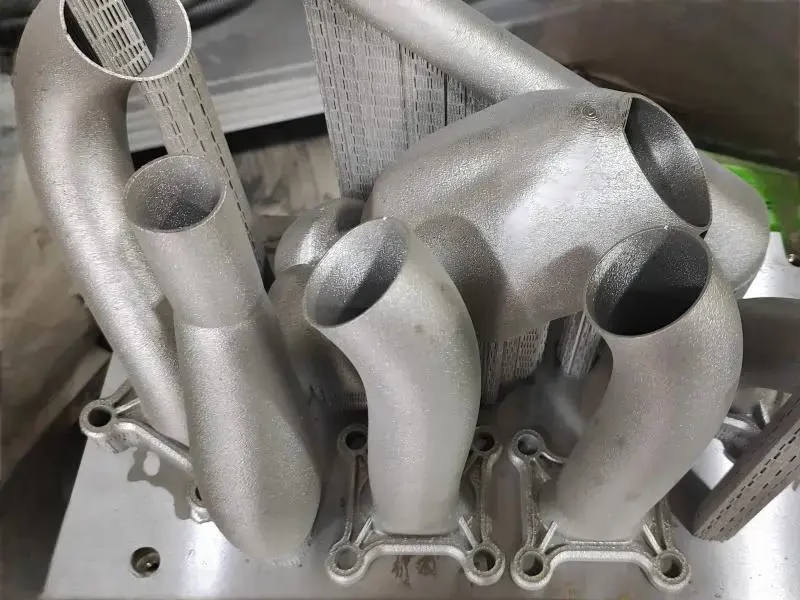
Where metal printing fits in this kind of build
Print the shape that cannot be cut, then machine and polish what has to be exact.
When metal 3D printing beats machining
Most restraint hardware is a small set of shapes: rings, cuffs, buckles, clasps, D-rings, spreader bars, locking pins. If a part is a plain cylinder with one groove, a lathe makes it faster and cheaper than any printer. Printing earns its place when the geometry is internal, hollowed, latticed, or different on every order.
A collar that carries a hidden latch, an organic curve that follows the neck, a hollow bar with an internal cable path: these are hard to reach with a 3 in end mill. Metal printing builds them layer by layer, so internal channels and undercuts cost the same as outside surfaces.
The trade is surface and tolerance. As-built metal printing lands around Ra 8–15 μm with visible layer steps, and typical as-built tolerance is looser than machining. For skin contact and for anything that slides or threads, plan a finishing pass. We machine printed faces on the same 5-axis centers we use for solid stock, so a printed blank can be brought to ±0.005 mm on the mating surfaces that matter.
- 1Print itHollow cuffs, internal latch channels, lattice ribs, per-order curves
- 2Machine itThreads, bores, sealing faces, hinge pins, flat mating surfaces
- 3BothPrint the body, then turn and polish the contact band
Alloy and hygiene choices that survive skin contact
Stainless 316L is the default for anything worn against skin. It resists chloride pitting, tolerates sweat and cleaning agents, and prints densely enough that porosity stays closed after hot isostatic pressing or a controlled heat treat. For lower cost, 17-4PH gives higher yield strength and machines nicely for clasps, but it has less corrosion margin in prolonged salt exposure.
Titanium Ti-6Al-4V (TC4) is the light option. A titanium cuff or bar weighs roughly half the same volume in stainless, which matters on long spreader bars and on anything suspended. Titanium is also the slowest of these to machine, so keep critical surfaces simple: one bore, one flat, one thread.
Do not use aluminum for contact parts unless it is hardcoat anodized, and even then treat it as a light-duty choice. Copper alloys, including beryllium copper, are better kept to springs and electrical contacts. Nickel release is the usual reason a plated part fails a skin-safety review, so specify electroless nickel only where it is not in continuous contact, and prefer bare polished stainless or titanium on the skin side.
Metal options for printed restraint hardware
Values are typical for printed-and-finished parts, not a guarantee for every geometry.
| Alloy | Best for | Watch out for |
|---|---|---|
| 316L stainless | Collars, cuffs, rings, skin contact | Heavier; needs polishing after print |
| 17-4PH stainless | Clasps, pins, high-load latches | Lower corrosion margin in salt |
| Ti-6Al-4V (TC4) | Light bars, suspension hardware | Slow to machine; keep features simple |
| 6061-T6 aluminum | Prototypes, non-contact frames | Not for long skin contact unless coated |
| Beryllium copper | Springs, contacts, flexure clips | Restrict to non-contact internal parts |
Minimum walls, radii and load paths
Thin walls are where printed hardware fails. For 316L, keep unsupported walls at 1.0 mm or thicker; below that, the laser melt pool has too little material to carry heat away and the wall warps. Titanium can go to about 0.8 mm because it conducts heat poorly and holds shape, but thin titanium is fragile during depowdering.
Load does not travel through a printed part the way it travels through a forged one. Layer boundaries run perpendicular to the build direction, so a pull along the Z axis is the weakest case. Orient the build so tension runs in the XY plane, and add a fillet of at least 0.5 mm at every internal corner. Sharp internal corners concentrate stress and are also where powder gets trapped.
Anything that locks, hinges or threads should be a machined feature, not a printed one. Print the housing, then bore the pin hole and cut the thread. A printed thread under repeated clamping load will flatten at the crest. We usually leave 0.3–0.5 mm of stock on those faces for the finishing operation.
Escape holes matter more than most people expect. Any closed internal cavity needs at least two Ø2 mm openings so unmelted powder can drain. If a hollow bar has one hole, powder stays inside and you will hear it later.
Surface finishing for skin contact and cleaning
As-built surfaces trap residue in the layer texture and feel rough. For skin contact, bead blasting followed by vibratory tumbling and hand polish brings 316L to Ra 0.8–1.6 μm, which is smooth enough to clean with soap and water and does not abrade. Where a part needs to glide, such as a sliding collar or a hinge face, we target Ra 0.2–0.8 μm on that face only.
Do not polish everything to a mirror. A highly reflective surface shows every handling mark, and on titanium it hides nothing about the layer lines underneath. A satin or brushed finish on the body with a polished contact band reads better and costs less.
Laser marking is how most customers add a size, a serial or a small motif. Minimum character height is 1.5 mm so the mark stays legible after finishing. Deep engraving with a cutter is possible on machined faces, but it adds a setup and should be reserved for parts where the mark must survive heavy wear.
What to inspect before the part ships
Printing hides defects well. Internal porosity, incomplete fusion and trapped powder all sit below a clean outer skin. Our inspection starts with the raw material certificate, then monitors the build, then checks the finished part 100% before shipment. Reports are available on request.
For parts that carry load, ask for a dimensional report on the critical faces: bore diameter, thread pitch, pin fit, and the flatness of any mating surface. Those are the features that decide whether the assembly locks cleanly. Cosmetic inspection matters too, but it is the fit that fails first.
If your part is a one-off prototype, a dimensional check on the critical features is usually enough. For a run of 200 identical clasps, add a first-article inspection and hold the process. That is where a printed run drifts: laser condition, powder reuse count and build position all move the result slightly.
We hold ISO 9001:2015, IATF 16949:2016, ISO 13485:2016 and ISO 27001:2022. The medical and information-security certificates matter here for two reasons: they cover documented process control and they cover how your files are handled. Uploads are confidential and we sign an NDA on request.
Common questions
Is printed metal strong enough for restraint hardware?
For most restraint loads, yes. A 316L part printed at full density and oriented so tension runs in the XY plane handles several times the load a person can apply by hand.
The exceptions are thin walls under 1.0 mm, printed threads, and sharp internal corners. Fix those by thickening the wall, machining the thread, and adding fillets.
Can you print a part and then machine it?
Yes. We print near-net, leave 0.3–0.5 mm on critical faces, then finish on 5-axis machining centers to ±0.005 mm. This is the usual route for anything with a bore, thread or hinge pin.
It costs more than printing alone, so reserve machined faces for features that actually need the tolerance.
What file format should I send?
STEP is best for parts that will be machined after printing. STL works for pure print geometry but loses the exact surfaces we need for finishing.
If you have a design with a sliding fit, include the mating part or the nominal fit in the drawing. That saves a round of questions.
How do you handle skin contact and cleaning?
We finish contact surfaces to Ra 0.8–1.6 μm, which is smooth and cleanable, and avoid nickel plating on the skin side. 316L and Ti-6Al-4V are the two alloys we recommend for continuous wear.
Every internal cavity gets drain holes so no loose powder stays inside the part.
What is the smallest feature you can print?
As a working rule, 1.0 mm walls in 316L, 0.8 mm in titanium, and 0.5 mm fillets at internal corners. Smaller channels can print but are hard to clear of powder.
If your design needs a finer feature, send it and we will tell you whether printing or machining is the better route.
Send a file, get a manufacturability answer
We reply with a quotation and a free DFM analysis within 12 hours, and every upload stays confidential.
12-hour quote±0.005 mm100% inspectionNDA on request









