
Basic Stainless Steel Models, Collected for Machinists
A practical reference to the stainless grades that show up on most CNC jobs. We cover what each family does well, where it fails, and which questions decide the pick. Written for engineers and buyers who need a decision, not a chemistry lecture.
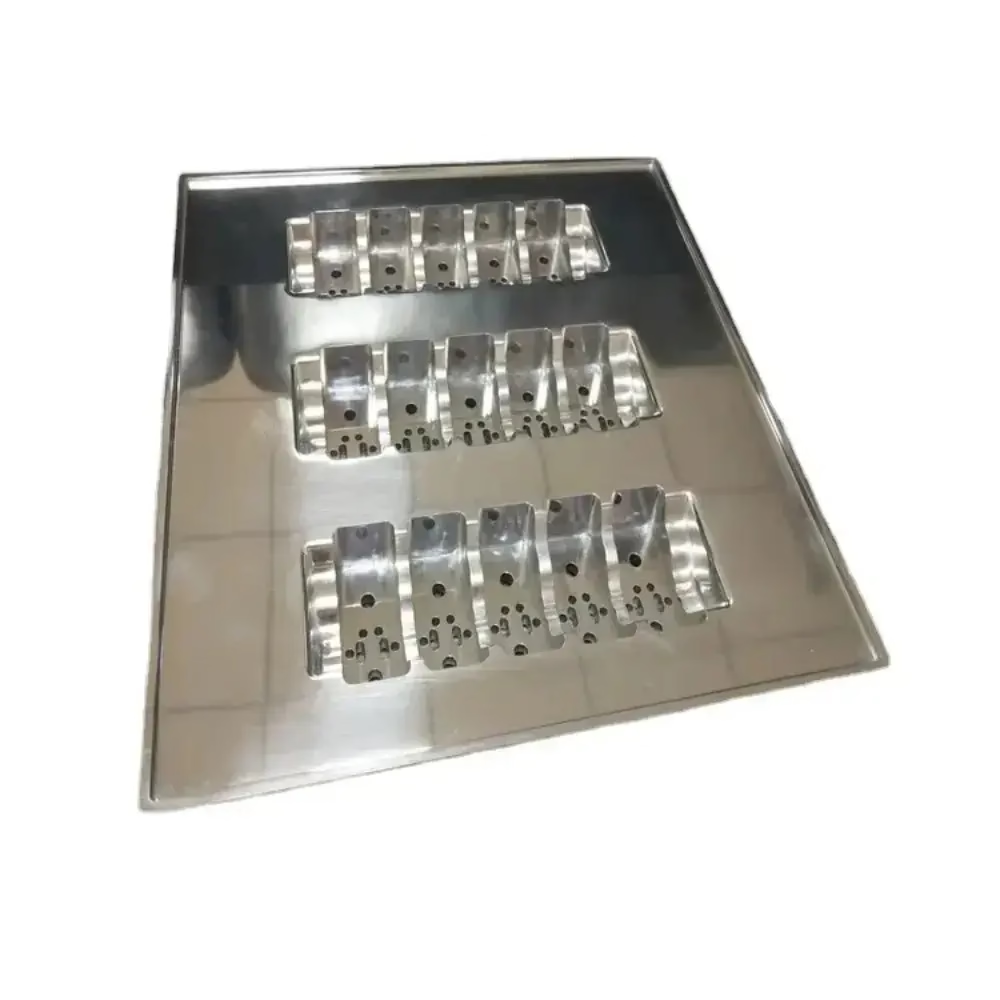
What Makes Basic Stainless Steel Models Resist Corrosion
Stainless steel is not a coating. The corrosion resistance comes from chromium dissolved in the metal. When chromium reaches roughly 10.5%, the surface forms a passive oxide film a few atoms thick. Scratch it and the film rebuilds within seconds, as long as oxygen is present. That single mechanism explains most of what follows.
The film is thin and it is not indestructible. Chlorides attack it locally, which is how pitting starts on a 304 part near seawater. High temperature breaks it down faster, so a 304 exhaust component can scale while the same alloy survives fine at room temperature. Machining does not remove the film, but it can smear it, which is why a passivated surface often outperforms a freshly cut one.
Nickel is the second lever. It stabilizes the austenitic structure that makes 303, 304 and 316L tough and non-magnetic. Molybdenum is the third. Adding 2–3% Mo, as in 316L, raises the pitting resistance enough to survive chlorides that would pit 304. Those three elements, Cr, Ni and Mo, set the price and the performance together.
This is why grade choice is rarely about strength alone. A stronger alloy with the wrong chromium balance will still pit in the wrong environment. Match the environment first, then the strength and the machinability.
303 vs 304: Machinability and Where Each One Fits
303 is the free-machining grade. Sulfur is added deliberately, usually in the 0.15–0.35% range, and it forms manganese sulfide inclusions that break chips cleanly. On a CNC lathe, 303 runs at higher surface speeds and leaves a better finish than 304 with the same tool and feed. For small turned parts in volume, that difference shows up directly in cycle time.
The trade-off is corrosion and welding. Those sulfide inclusions are the first thing chlorides attack, so 303 pits earlier than 304 in a wet or marine environment. Sulfur also promotes hot cracking, which makes 303 a poor choice for welded assemblies. If the part will be welded or will see salt, 304 is the safer call even though it machines worse.
304 is the general-purpose austenitic grade. It work-hardens quickly, so a light pass with a dull tool raises the surface hardness and the next pass cuts harder material. Keep the tool engaged, take a deeper cut rather than many shallow ones, and never let the insert rub. Rigid setups matter more here than on 303.
316 and 316L are the chloride-resistant versions. The L suffix means extra-low carbon, 0.03% max, which prevents sensitization during welding. Use 316L for anything welded that sees moisture or cleaning chemicals. For food, medical and marine hardware, it is the default. The cost premium is real, so do not specify it where 304 already passes.
A quick note on 17-4PH (SUS630). It is precipitation hardening, not austenitic. You machine it in the annealed condition, then age it to reach high strength. That sequence matters: plan the heat treat before you plan the finishing steps.
When the 400 Series Beats the 300 Series
The 400 series is martensitic or ferritic. It contains chromium but little or no nickel, so it is magnetic and it can be hardened by heat treatment. 420, 431 and 440C are the grades you reach for when the part needs wear resistance or hardness rather than maximum corrosion resistance.
420 is the workhorse. In the annealed state it machines reasonably well, then it hardens to roughly 50 HRC depending on section and quench. Shafts, cutlery blades and wear plates are typical. It will rust in a wet environment, so it belongs indoors or behind a coating.
431 adds nickel and gets tougher. It hardens to a lower peak than 420 but resists impact and stress corrosion cracking far better. Valve stems, hydraulic rods and high-strength fasteners are common uses. If a 420 part keeps cracking in service, 431 is the usual next step.
440C is the high-carbon option, around 1% C, and it reaches the highest hardness of the three. It also fights you at the machine: carbide tooling, conservative feeds, and no interrupted cuts if you can avoid them. Use it for bearing races and cutting edges, not for general structural parts.
One boundary worth stating. If the environment is chloride-rich, none of the 400 series is a safe substitute for 316L. Hardness does not buy corrosion resistance.
Machining and Finishing Notes That Change the Result
Stainless work-hardens. Every pass that rubs instead of cuts raises the local hardness, and the next pass inherits the problem. The fix is mechanical, not chemical: sharp tooling, positive rake, constant feed, and a depth of cut deep enough to get under the hardened layer from the previous pass.
Heat is the other issue. Stainless conducts heat poorly, so the cutting edge absorbs more of it than on aluminum. Flood coolant or high-pressure through-tool coolant keeps the insert alive. Running dry on 304 is possible at low speed, but it shortens tool life and makes the finish unpredictable.
For tight work, we hold ±0.005 mm on critical features and Ra 0.8–1.6 μm as a standard machined finish. Finer finishes down to Ra 0.2–0.8 μm are available when the drawing calls for them. Thin-walled 316L parts need light finishing passes and support, or the wall will deflect and spring back after the cut.
Passivation is not a cosmetic step. It removes free iron left by tooling and lets the chromium oxide film form evenly. Citric and nitric passivation both work; the choice depends on your spec. Bead blasting, tumbling and brushing are also available, but note that blasting opens the surface slightly and can reduce pitting resistance.
Laser marking is fine on stainless, with a minimum character height of 1.5 mm. Deeper engraving creates a crevice that can trap contamination, so for medical and food parts we keep the mark shallow and let passivation follow.
Basic Stainless Steel Models at a Glance
Typical values for machined parts; confirm against your spec before release.
| Grade | Family | Machinability | Best fit |
|---|---|---|---|
| 303 | Austenitic, free-machining | Excellent, chips break clean | High-volume turned parts, no welding |
| 304 | Austenitic | Moderate, work-hardens | General hardware, food contact, indoor |
| 316L | Austenitic, 2–3% Mo | Moderate, gummy at low feed | Marine, chemical, welded assemblies |
| 420 | Martensitic | Good in annealed state | Cutlery, shafts, wear parts |
| 431 | Martensitic | Good, tougher than 420 | Valve stems, fasteners, hydraulic rods |
| 440C | Martensitic, high carbon | Hard on tooling | Bearings, races, high-wear edges |
| 17-4PH | Precipitation hardening | Moderate, then aged | Aerospace, high-strength shafts, fittings |
Pick the Environment First, Then the Grade
Wet, salty or welded: go 316L. Dry, indoor and high volume on a lathe: go 303. Hard and wear-resistant: go 420, 431 or 440C, but only where corrosion is mild. High strength with decent corrosion resistance: 17-4PH, aged after machining.
Common Questions on Stainless Grades
Is 304 the same as 18-8 stainless?
Roughly, yes. 18-8 refers to the nominal 18% chromium and 8% nickel content, which describes 304 and its relatives.
The label is a composition shorthand, not a specification. If your drawing calls for 304 or 304L, order that grade rather than asking for 18-8.
Why does 304 machine worse than 303?
303 contains sulfur, which forms inclusions that break chips and lubricate the cut. 304 has no such addition, so it work-hardens under the tool and produces stringy chips.
You can improve 304 results with sharper tooling, higher feed per tooth and a rigid setup, but you will not match 303 cycle times.
Can 316L be welded without post-weld treatment?
The low carbon content, 0.03% max, is designed to prevent sensitization during welding, so carbide precipitation at the grain boundaries is largely avoided.
Passivation after welding is still good practice. It removes heat tint and free iron, which are the usual starting points for corrosion.
When should I choose 17-4PH over 316L?
Choose 17-4PH when the part needs high strength or hardness and corrosion resistance only has to be moderate. It machines in the annealed state and then ages to its final properties.
Choose 316L when corrosion resistance comes first or the part will be welded. 17-4PH is harder to weld and its corrosion performance in chlorides is below 316L.
Does surface finish affect corrosion resistance?
Yes. A rough or blasted surface has more crevices where chlorides and contamination collect, so pitting can start earlier than on a polished surface.
For marine, medical and food-contact parts, specify the finish and the passivation step together rather than treating them as separate items.
How do I know which grade is actually in the bar?
Ask for the mill certificate with the heat number and check the chemistry against the grade spec. That is the only reliable record.
We check incoming raw material and can provide inspection reports on request, including the final dimensional report before shipment.
Send Your Drawing and Get the Grade Question Settled
Upload a STEP file and we return a quotation with free DFM analysis within 12 hours, plus a grade recommendation if the drawing leaves it open.
12-hour quote±0.005 mm tolerance100% inspection
More CNC Knowledge
We publish setup notes, tooling trials and inspection data from the factory floor.











