
Application of High Speed Machining with Electric Spindle Technology
This page explains what an electric spindle actually is, where the application of high speed machining pays off, and where it does not. Written for engineers and buyers who need to pick a spindle speed, a tool path, and a machine before releasing a job to production.
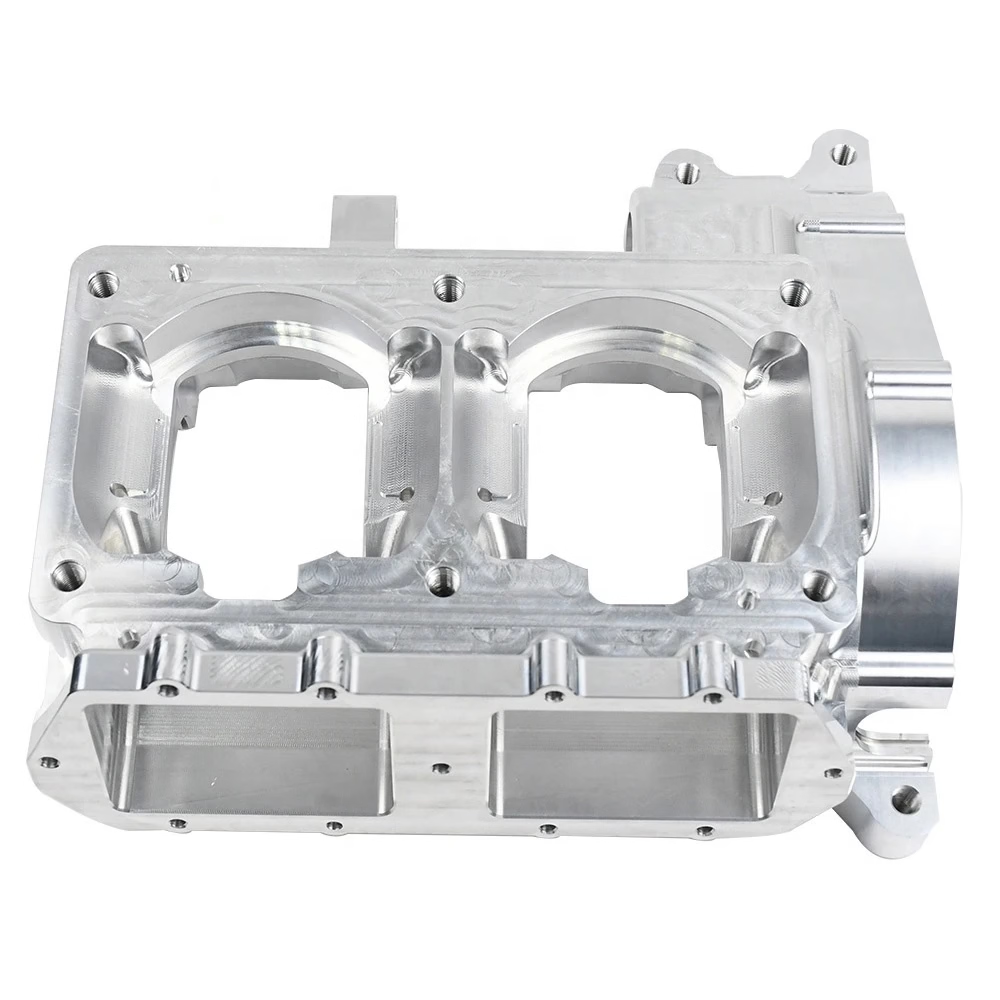
What This Page Covers
Electric spindle hardware, the rpm range that counts as high speed, which parts benefit, and where the limits sit.
What an Electric Spindle Actually Is
An electric spindle is a motor and a tool holder in one housing. The rotor sits on the same shaft as the tool taper, so no belt, no gearbox, and no separate motor bracket. Around that core you still need a few support systems: a high-frequency drive, cooling, lubrication or oil-air feed, and on some units an encoder and an automatic tool-change mechanism. Miss any one of them and the spindle will not hold speed.
This layout is why the application of high speed machining became practical on small and medium parts. A belt-driven head loses stiffness as rpm climbs. An integrated spindle keeps the load path short, so runout stays low at 20,000 rpm and above. The trade-off is heat. Nearly all the motor loss goes into the shaft, so the cooling circuit is not an accessory, it is part of the spindle.
In our shop, electric spindles run on the 5-axis and high-speed 3-axis machines. They are not used for every job. On heavy roughing in 4140 or Inconel, a geared head still removes more metal per hour.
- 1DriveHigh-frequency converter, matched to the spindle's rated curve
- 2CoolingWater jacket or oil circuit; keeps the shaft within thermal growth limits
- 3LubricationOil-air or grease-packed ceramic bearings
- 4FeedbackEncoder for rigid tapping, orientation, and speed control
Bearings Set the Real Speed Limit
The bearing set decides how fast a spindle can spin before heat or vibration takes over. Steel angular contact bearings are common up to roughly 12,000–15,000 rpm depending on size and preload. Hybrid bearings, where the balls are ceramic and the rings stay steel, push that ceiling higher and run cooler. Full ceramic sets go further still but cost more and are less forgiving of shock.
Ceramic balls are lighter than steel, so centrifugal load on the outer ring drops. They also resist welding and wear if the oil film breaks down for a moment. That matters on aluminium and graphite, where fine chips get everywhere. A hybrid set in a well-sealed spindle often lasts several times longer than an all-steel set at the same speed.
Preload is the other half of the story. Higher preload means a stiffer spindle and better surface finish, but it also means more heat. Spindle builders pick a preload for a target speed band. Running a high-preload spindle at 24,000 rpm for hours will shorten bearing life, no matter what the nameplate says.
On a 40 mm bore spindle, the DN value (bore in mm multiplied by rpm) is a useful sanity check. Grease-packed hybrid bearings usually sit below about 1.0 × 10⁶ mm·rpm. Oil-air lubrication can roughly double that. If a job needs more, you are looking at a different spindle class, not a different cutting strategy.
Spindle Speed Bands and What They Suit
Use this as a first filter when matching a part to a spindle, not as a rulebook.
| Speed band | Typical bearing set | Good fit | Watch out for |
|---|---|---|---|
| 3,000–8,000 rpm | Steel angular contact, grease | Steel and cast iron, deep pockets, heavy roughing | Low feed per tooth; heat builds in the tool |
| 8,000–15,000 rpm | Steel or hybrid, grease | Aluminium plate, stainless, general milling | Chip evacuation in deep cavities |
| 15,000–24,000 rpm | Hybrid ceramic, oil-air | Small aluminium and copper parts, thin walls | Tool balance and holder runout |
| 24,000 rpm and above | Hybrid or full ceramic, oil-air | Micro tools below Ø1 mm, graphite, finishing passes | Spindle warm-up time; short tool life |
Where the Application of High Speed Machining Fits
High speed machining is not one process. It is a set of choices that favor small chip loads, high rpm, and fast feed rates. The parts that gain the most are thin-walled, small-featured, or heat-sensitive. Heat sinks, connector housings, impellers, and medical instrument bodies are typical. The common thread is that the tool spends a lot of time in the cut relative to the volume of material removed.
Aluminium is the easiest case. At 18,000 rpm with a Ø6 mm three-flute cutter, a 6061-T6 bracket can be finished in one pass with Ra 0.8–1.6 μm on the walls. The same part on a 6,000 rpm spindle needs two passes and a spring pass, and the wall may still bow. The difference is cutting force, not just speed.
Copper and brass behave well too, though chip control needs attention. Fine copper chips pack into pockets and recut. High-pressure coolant or air blast through the spindle helps. Graphite is another good fit, but it needs a sealed spindle and dry cutting; coolant turns graphite into a paste.
Titanium and nickel alloys are the hard case. They do not conduct heat away from the edge, so the tool edge sees high temperature even at moderate speed. Some roughing passes in Ti-6Al-4V run better at 1,200–2,000 rpm with a strong tool and heavy feed than at 15,000 rpm with a light one. We test both when the geometry allows.
- 1Good fitThin walls, small tools, aluminium, copper, graphite, finishing passes
- 2ConditionalStainless and hardened steel, if the tool and holder can take the speed
- 3Poor fitHeavy roughing in Inconel or 4340 with a light-duty spindle
Tool Holding, Balance, and Runout
Above 15,000 rpm, the holder matters as much as the spindle. A standard collet chuck that runs true at 5,000 rpm can vibrate badly at 20,000 rpm. Use shrink-fit or hydraulic holders for small tools. Check runout at the tool tip, not at the holder face. On a Ø3 mm cutter, 10 μm of runout means one flute does most of the cutting.
Balance grade matters too. ISO 1940 G2.5 is a reasonable target for spindles above 15,000 rpm. A tool assembly that is balanced at the factory can go out of balance after a tool change if the collet nut is not seated correctly. Wipe the taper every time. A chip the size of a pinhead will move the tool axis.
Warm-up is not optional. A cold spindle grows as it heats, and the Z axis moves with it. Most builders publish a warm-up routine: run 25 percent speed for a few minutes, then step up. Skipping it shows up as a 0.01–0.02 mm depth error on the first parts of a batch.
Coolant strategy changes with speed. At 20,000 rpm, a flood nozzle may not reach the cut because the tool throws the coolant away. Through-spindle coolant or an air-oil mist delivers where it is needed. On aluminium, a mist can be enough. On stainless, we still use high-pressure flood.
When High Speed Machining Is the Wrong Choice
Speed does not fix a weak setup. A part held in a single vise jaw, with 150 mm of tool overhang, will chatter whether the spindle turns at 4,000 rpm or 20,000 rpm. Fix the fixture first. On long thin parts, we often add a tailstock or a support block before touching the spindle speed.
Deep pockets are another limit. A Ø2 mm tool at 22,000 rpm can only clear chips so fast. If the pocket is 40 mm deep, the tool spends most of its life recutting chips. In that case, a larger tool at lower rpm with a helical entry removes more material per minute. The application of high speed machining is about cycle time, not about rpm on the display.
Hard materials above 45 HRC are usually better on a slower, stiffer spindle with a coated carbide or CBN tool. The edge cannot survive the heat at high speed without a special setup. For tool steel cavities, we rough at moderate speed and finish with a high-speed pass only on the last 0.2 mm.
Lastly, cost. A high-speed spindle is a wear item. Bearings are replaced on a schedule, not on failure. If a job runs a few hundred parts a year, the spindle cost per part may not justify the speed. For 10,000-part runs in aluminium, it usually does.
Common Questions
What spindle speed counts as high speed machining?
There is no fixed number. In practice, most shops treat 15,000 rpm and above as high speed for small tools, and 8,000–15,000 rpm as high speed for medium tools.
The useful definition is relative to the tool diameter. When the surface speed at the cutting edge gets high enough that chip load per tooth drops below about 0.02 mm, you are in high speed territory.
Can an electric spindle do heavy roughing?
It can, but not at its top speed. Torque falls as rpm rises on most spindle curves. At 6,000–8,000 rpm, a well-built electric spindle can take a solid carbide cutter in aluminium or mild steel.
For deep cuts in 4140 or Inconel, a geared head or a larger spindle with more low-end torque is usually faster.
Why do my tools wear out faster at high rpm?
Two common causes: runout and heat. If the tool tip runs out more than 10 μm, one flute takes the load and fails early.
Heat is the other. At high surface speed, the edge temperature rises even in aluminium. Check coolant delivery, chip evacuation, and whether the feed per tooth matches the spindle speed.
Does high speed machining improve surface finish?
It can, if the setup is rigid and the tool is balanced. We hold Ra 0.8–1.6 μm on aluminium walls at high speed without a separate finishing pass.
It can also make finish worse if chatter starts. Vibration at high rpm shows up as a fine pattern on the wall. Reduce overhang or step down in rpm until it clears.
What materials should not be run at high speed?
Heavy sections of titanium, Inconel, and hardened tool steel above 45 HRC are the usual candidates for lower speed and higher feed.
Magnesium needs care for a different reason: fine chips can ignite. Speed is less the issue than chip control and coolant choice.
How do you choose between a 3-axis and a 5-axis machine for high speed work?
It comes down to how many faces need machining and how the tool can reach them. A 3-axis machine with a high-speed spindle handles flat plates and open pockets well.
When the part has undercuts, angled holes, or five-sided work, a 5-axis center saves setups. Each setup adds error and time, so fewer setups often beats higher spindle speed.
Send Us the Part and the Material
We review the geometry, pick a spindle and a tool path, and return a quote with a DFM note. Uploads stay confidential and an NDA is available.
12-hour quote100% inspection before shipmentNo minimum order quantity









