
AI Tool Creates 3D Models From Text Prompts: What Machinists Do With Them
Text-to-3D tools turn a sentence into a mesh in seconds. This page explains how that geometry is built, which parts of it survive contact with a CNC machine, and how to convert it into a drawing we can cut. Written for engineers and buyers who need to decide whether an AI mesh is worth quoting or worth rebuilding.
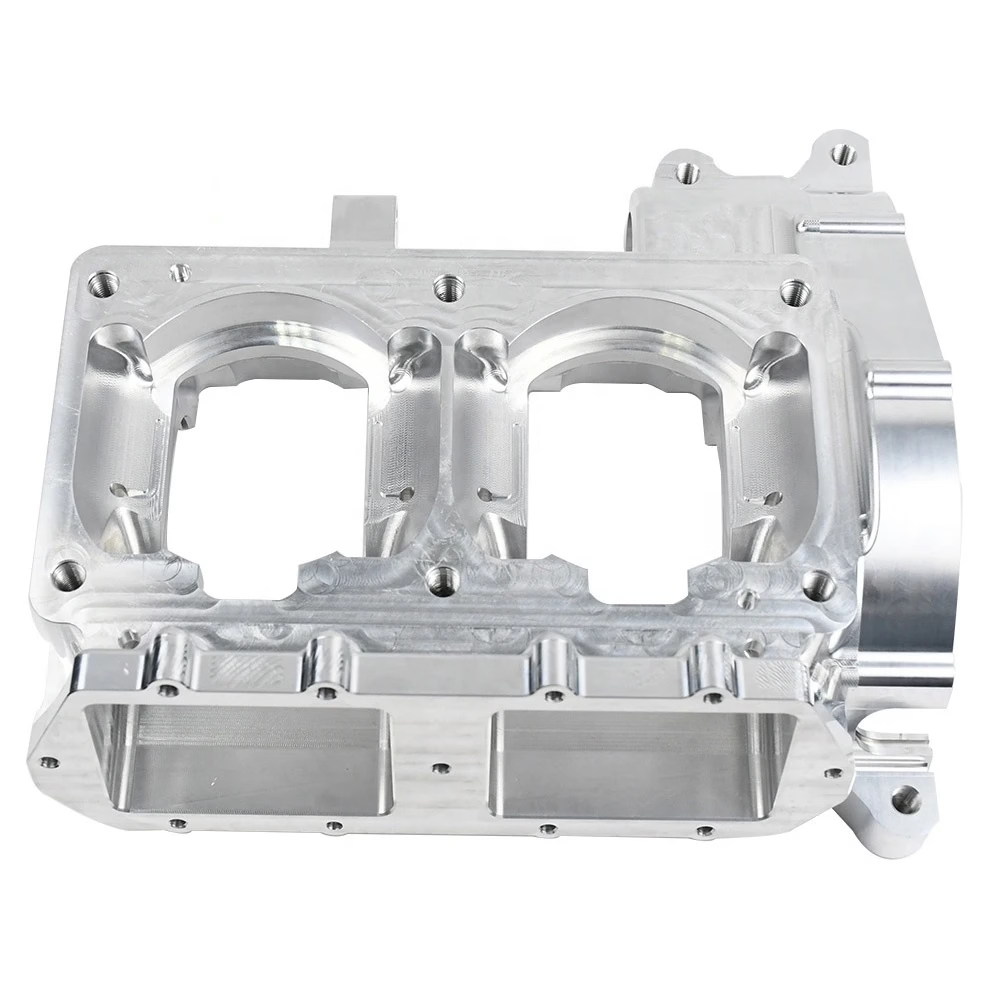
From a Sentence to a Solid, and Then to a Part
Text-to-3D is fast. Machining is not forgiving. The gap between them is where most projects lose a week.
What Happens Inside an AI Tool That Creates 3D From Text
Most text-to-3D systems train on paired data: a caption and the geometry it describes. The model learns which words correlate with which shapes. Feed it 'bracket with two bolt holes and a raised rib' and it produces a surface that usually looks like a bracket. Nothing in that pipeline knows about wall thickness, draft, or tool reach.
The output is almost always a triangle mesh, not a parametric solid. That distinction matters more than anything else on this page. A mesh stores a skin. A solid stores faces, edges, and an ordered feature tree you can edit. On the shop floor we need the second one to program a toolpath.
Speed comes from generating a plausible surface, not a manufacturable one. A prompt can return a shell in seconds. Turning that shell into a part with datums, tolerances, and a surface finish spec takes longer, and that is normal.
Some tools now export STEP or offer a solid conversion step. Treat that export as a starting point for reconstruction, not as a finished CAD model. The conversion often stitches thousands of tiny facets into a few hundred faces with bad continuity.
- 1Mesh vs. solidMeshes render well; solids machine well. Ask which one you have.
- 2No feature historyYou cannot change one hole diameter without rebuilding the region.
- 3Scale is guessworkPrompt-based models rarely carry a real unit. Always confirm before quoting.
Where AI-Generated Geometry Actually Works
Concept models and background assets are the natural home for this technology. Game environments, VR scenes, and marketing renders do not need a tolerance callout. The mesh only has to look right from the camera angle, and text-to-3D is genuinely good at that.
Early-stage form studies also benefit. An industrial designer can iterate on silhouette before committing to a shape. We see this often: three or four AI variations arrive, one gets picked, and then the real CAD begins.
The trouble starts when the mesh is asked to be a physical part with function. A generative surface usually has no flat datum to clamp on, no consistent wall thickness, and no clearance for a tool holder. Thin ribs and deep pockets appear because they look interesting, not because a Ø6 mm end mill can reach them.
There is a middle path that works well. Use the AI mesh as a reference body inside your CAD, then rebuild the functional features as solid geometry over the top. You keep the organic shape and gain machinable faces. That workflow costs half a day and saves a scrapped batch.
Deciding What to Do With an AI Mesh
Use this to sort a generated model before it reaches the quoting stage.
| Situation | Best next step | Why |
|---|---|---|
| Render or game asset only | Use the mesh as-is | No tolerance or clamping required |
| Visual prototype, unloaded | Mesh to STL, then 3D print | Fast, cheap, no tooling access limits |
| Loaded bracket or housing | Rebuild as solid, keep mesh as reference | Needs datums, wall thickness, tool reach |
| Mating faces or bores | Redraw with real tolerances | Meshes carry no GD&T or fit intent |
| Organic shape plus flat mounting | 5-axis machine the hybrid body | Curved form and flat datum in one setup |
| High-volume metal part | Solid model, then DFM review | Cycle time and tooling cost depend on it |
Preparing a Text-Prompt Model for CNC Quoting
Send the mesh and the solid if you have both. We would rather see the original than a cleaned-up version, because the original tells us which surfaces carry intent. Mark the faces that must stay organic and the faces that must be flat. A quick screenshot with arrows does the job.
Scale matters. State the overall envelope in millimeters, or attach a reference dimension. A model with no units can be interpreted as 40 mm or 400 mm, and the second one may not fit our 4,000 mm travel machines the way you expect.
Material and finish choices should come early, not after the first quote. An anodized 6061 housing with Ra 1.6–3.2 μm as-machined walls behaves very differently from a 316L part that needs Ra 0.8–1.6 μm. The finish call changes the stepover, the tool list, and the run time.
One more thing worth saying plainly. A converted mesh that still holds 200,000 triangles will slow every downstream step: CAM, simulation, and inspection. Decimate it, then heal the gaps. Ten minutes of mesh repair usually saves an hour of programming.
- 1State unitsMillimeters, with one reference dimension we can check.
- 2Flag critical facesTell us which surfaces are functional and which are cosmetic.
- 3Note the load pathBolt bosses and bearing seats drive the whole setup plan.
- 4Share the finish callRa and coating decide tooling and cycle time.
Cutting the Converted Model on Our Machines
Once the geometry is a real solid, the rest is standard work. We hold ±0.005 mm on critical features and inspect 100% before shipment. Reports are available on request, and the same process runs whether you need one prototype or a 10,000-part run.
Organic surfaces from a text prompt usually land on a 5-axis machine. Our simultaneous 5-axis centers handle contoured faces without the stepped look you get from re-fixturing on a 3-axis. For prismatic parts with a few curved pockets, a 4-axis or 3-axis setup is faster and cheaper.
Materials are not a constraint here. Aluminium 6061, 7075, and 6082 cover most AI-designed enclosures. Stainless 304 and 17-4PH handle the load-bearing brackets. Titanium TC4 and Inconel come up when weight or heat matters more than cost.
Finishing follows the model's intent. Anodizing keeps an organic form looking clean. Bead blasting hides the facets left over from a dense mesh. If your original prompt asked for a soft, matte surface, powder coating or hardcoat anodizing gets you closer than raw machined metal.
Common Questions
Can you machine a raw mesh straight from a text-to-3D tool?
Not reliably. A mesh has no solid volume, so CAM software cannot offset it into a toolpath without repair work.
We can stitch and solidify a clean mesh, but the result often has sliver faces and poor tangency. In most cases the faster route is to rebuild the functional features as solid geometry and keep the mesh as a reference body.
How do I know whether my AI model is manufacturable before I send it?
Check three things: wall thickness, tool access, and whether there is a flat face to clamp on.
If the thinnest wall is under 1 mm on a metal part, or a pocket is deeper than four times the cutter diameter you would need, the design will need changes. A DFM review catches this in hours rather than after the first setup.
Does a text-prompt model carry tolerances?
No. Generative models describe shape, not fit. There is no GD&T information in the output.
You have to add the tolerances yourself on the faces that matter: bores, mating surfaces, bolt circles. Everything else can be general tolerance. Tell us which is which and we quote accordingly.
What file formats should I send?
STEP or Parasolid if you have a converted solid. STL or OBJ if all you have is the mesh.
Include a short note on units and the critical faces. A screenshot with arrows is more useful than a long specification document at the quoting stage.
Will an organic AI shape cost more to machine than a simple block?
Usually yes, because contoured surfaces need more passes and often a 5-axis setup.
The difference narrows when the organic form replaces several assembled parts. One machined body can beat three brackets and a weldment on total cost and on tolerance stack.
Can you keep the design confidential?
Yes. Uploads are secure and confidential, and we sign an NDA on request before any file is reviewed.
We are certified to ISO 27001:2022 for information security, alongside ISO 9001:2015, IATF 16949:2016, and ISO 13485:2016 for quality and medical work.
Send Us the Model and Get a Real Answer
Share your AI-generated mesh or its converted solid. You get a quotation and a free DFM analysis within 12 hours, with the manufacturability issues called out face by face.
12-hour quote100% inspectionNo minimum orderNDA on request









