
Advantages of a CNC Double Column Machining Center
A double column machine carries the spindle on a bridge supported at both ends. This page explains what that changes for accuracy, stiffness, part size and cycle time, and when a single-column VMC is still the smarter buy. Written for engineers and buyers specifying large parts.
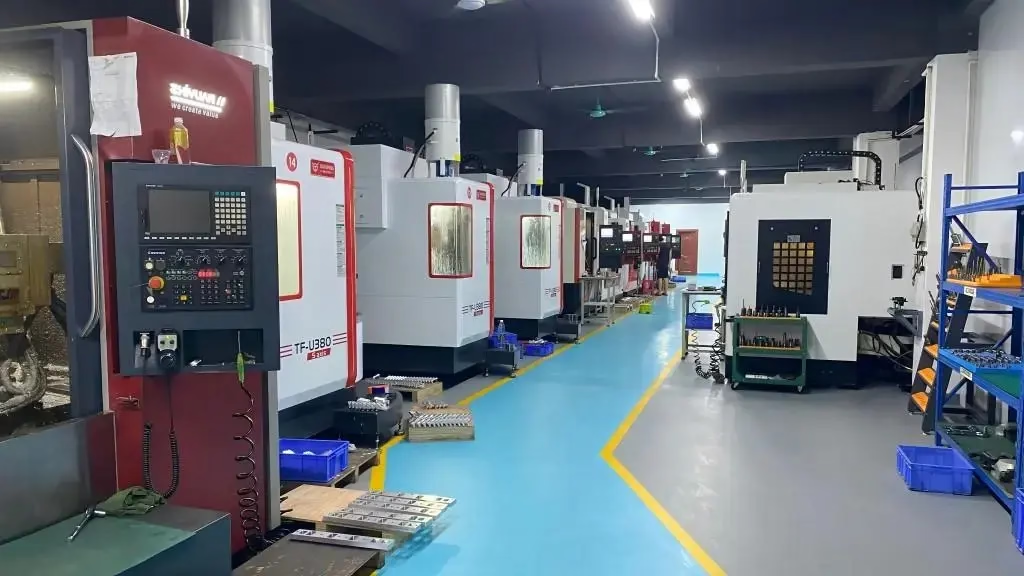
Why the frame design decides what you can machine
Part size is the first limit. Frame stiffness is the second, and it is the one that quietly drives your tolerance and finish.
What counts as a double column machining center
In a double column machine, two vertical columns sit on the bed and carry a gantry bridge. The spindle rides that bridge instead of hanging off a single vertical column, so the load path closes at both ends of the bridge.
A single-column vertical machining center is a C-frame. The column bends as the spindle pushes into the cut, and the overhang grows with part height. A gantry closes the loop. Cutting force travels down both columns and into the bed.
That difference shows up first in part size. Gantry machines we run handle workpieces up to 4,000 mm on the long axis, with travels such as 4,000 × 400 × 150 mm on the long-bed machines and 750 × 1,150 × 550 mm on the bridge-type machines. A typical C-frame VMC has no answer for a 2 m mold base.
Double column is a frame description, not a spindle description. You can have a 3-axis gantry, a 4-axis gantry with a rotary table, or a 5-axis gantry with a swivel head. What changes is stiffness and work envelope. What stays is the cutting process.
Accuracy and stiffness advantages
Accuracy on a large part is mostly a fight against deflection. When the spindle nose moves under load, the tool follows, and the error lands in the part. A closed gantry frame sends that load into two columns, so the same cut produces less tool-tip movement.
Thermal behavior matters just as much. Two symmetric columns expand and contract more evenly than one offset column, so the spindle centerline drifts less over a long roughing cycle. On a 6-hour cut, that drift is often the difference between holding size and re-cutting.
In practice, the tolerance we quote for gantry work is ±0.005 mm (±0.0002 in) on critical features, checked with in-process probing and final inspection. Reaching that on a 1.5 m aluminum frame is realistic. Reaching it on a thin wall with a long reach tool is not, and no frame design fixes that.
Stiffness also decides your tooling. A rigid gantry can push a Ø80 mm face mill in 4140 at a depth of cut that would chatter a C-frame. Fewer passes, less tool wear, and a more predictable cycle.
- 1Closed load pathCutting force goes into both columns, not one.
- 2Symmetric thermal growthSpindle centerline drifts less over long cuts.
- 3Heavier workpiecesThe bed carries the mass, not an overhung column.
- 4Fewer setupsLarge faces and bores in one fixturing.
Finish, cycle time and 5-axis capability
Vibration leaves marks. A rigid frame lets you run a higher surface speed and a lighter finishing pass without chatter, which is how we reach Ra 0.8–1.6 μm on gantry work and Ra 0.2–0.8 μm where the geometry allows a dedicated finish pass.
Cycle time drops for a simple reason: you can take deeper cuts in fewer passes, and you can machine more faces in one setup. On a large housing, moving from three setups to one often removes more time than any spindle speed change.
Add a swivel head and the same frame becomes a 5-axis gantry. That lets a single tool reach undercuts, angled bosses and compound holes without re-fixturing. For a large aerospace bracket or a mold cavity with steep walls, this is the main reason to choose a double column machine over a 3-axis bed mill.
There is a limit. A 5-axis gantry head has more moving mass than a 3-axis head, so it is not the machine for small, high-speed detail work. On parts under roughly 500 mm, a compact 5-axis machining center will usually be faster and cheaper to run.
Gantry or single-column: how to pick
Match the frame to the part, not to the budget line.
| Part condition | Better choice | Reason |
|---|---|---|
| Longer than 1,000 mm | Double column gantry | Bed supports the whole length; no table sag |
| Heavier than 2,000 kg | Double column gantry | Mass goes into the bed, not the column |
| Tight tolerance on a large face | Double column gantry | Closed frame holds tool-tip position |
| Under 500 mm, many features | Compact 5-axis VMC | Lighter head accelerates faster |
| Deep cavity in a small mold insert | 3-axis VMC plus EDM | Better reach and lower setup cost |
| Angled features on a large part | 5-axis gantry | Machined in one fixturing |
What this means for your project
We run 127 high-precision CNC machines across three plants, including 16 simultaneous 5-axis machining centers and long-travel gantry capacity up to 4,000 mm. That mix matters when a project has one large frame and a dozen small brackets: both can be quoted in the same order.
Material choice drives the cutting strategy more than the frame does. A 7075 aluminum gantry part runs fast and holds size. The same geometry in Inconel needs low surface speed, more passes and careful thermal control, and the gantry advantage becomes mostly about stiffness and heat, not speed.
If you are still choosing between processes, send the model. A DFM review within 12 hours will tell you whether the part wants a gantry, a VMC or a casting. There is no minimum order quantity, so a single prototype and a 10,000-part run go through the same first step.
Questions engineers ask about gantry machining
Is a double column machine always more accurate than a VMC?
No. On small parts a well-built C-frame VMC can be just as accurate, and it accelerates faster because the moving mass is lower.
The gantry advantage appears when part size or cutting load grows. Past roughly 1,000 mm, or with heavy stock removal in steel, the closed frame holds position better.
What is the largest part you can machine?
Our long-travel gantry machines reach 4,000 × 400 × 150 mm, and bridge-type machines cover 750 × 1,150 × 550 mm and 600 × 600 × 600 mm envelopes.
Send the bounding box and the tightest tolerance, and we will confirm which machine fits before quoting.
Can a double column machine do 5-axis work?
Yes, with a swivel or gimbal head. That is how we machine angled features and undercuts on large parts without re-fixturing.
The trade-off is head mass. For small parts with fine detail, a dedicated compact 5-axis center is usually the faster route.
How do you hold ±0.005 mm on a large part?
Through probing, thermal control and a finishing pass that keeps radial engagement low. We check raw material, monitor in process, and inspect 100% before shipment.
Tolerance is feature-dependent. A long bore is easier to hold than a thin wall far from the fixturing, and we will say so at DFM stage.
What finishes can follow gantry machining?
Anodizing in clear, color, hardcoat or conductive; electroless nickel; zinc, silver and gold plating; powder coating and black oxide; bead blasting, tumbling, brushing and polishing.
Laser marking is available with a minimum character height of 1.5 mm.
Does a large part mean a long lead time?
Not by default. Quotation and free DFM analysis come back within 12 hours, and production can start within 24 hours of approval.
Parts typically ship in 3–5 days. Our historical late-delivery probability is below 2%.
Send the model and we will tell you which frame it needs
Upload your drawing for a DFM review and quote within 12 hours. Uploads stay confidential, and an NDA is available on request.
12-hour quoteNo minimum order100% inspectionISO 9001 / IATF 16949









