
ABS CNC Machining Service: Cutting Plastic Parts to Tolerance
This page is for design engineers and buyers who need machined ABS parts, not molded ones. It covers what ABS does well on a mill, where it fights back, what tolerances and finishes are realistic, and how to judge a supplier before you send a drawing.
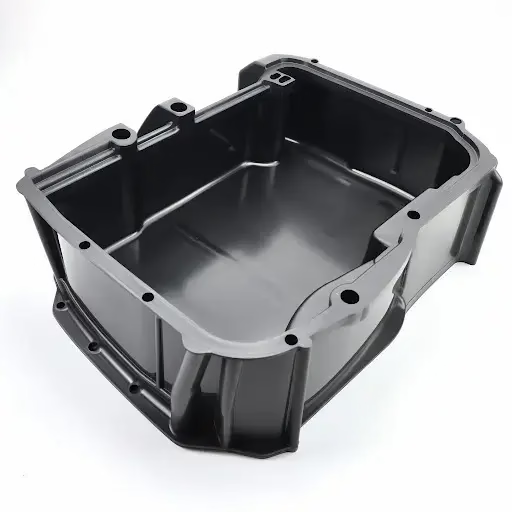
What this page covers
ABS is a thermoplastic that machines like a soft metal, but it does not behave like one. The sections below walk through material behavior, tolerances, tooling, finishing, and the questions worth asking a supplier.
Why ABS suits CNC machining, and when it does not
ABS, or acrylonitrile butadiene styrene, is a styrene terpolymer. The acrylonitrile adds rigidity and chemical resistance, butadiene adds impact toughness, and styrene keeps it easy to process. On a CNC mill it cuts clean, holds a sharp edge, and leaves a surface that needs little cleanup. That combination is why an ABS CNC machining service is often the fastest route to functional plastic prototypes and bridge production.
The material's limits matter just as much. ABS softens around 105 °C, so it is a poor fit for parts that sit near exhaust manifolds or run in hot enclosures. It also absorbs moisture from air, which means a blank that sat on a shelf for weeks can cut differently than one taken straight from a sealed bag. UV exposure yellows it over time unless the grade is stabilized.
Where ABS wins: brackets, covers, housings, jigs, and low-load fixtures that need toughness more than stiffness. The raw stock is cheaper than PC, POM, or PEEK, and it is available in sheet and bar in most thicknesses. If a part must survive repeated impact and does not see high heat, ABS is usually the sensible starting point.
- 1Good fitImpact-resistant covers, enclosures, brackets, and prototype housings.
- 2Poor fitParts above roughly 90 °C in service, or outdoor parts with long UV exposure.
- 3WatchMoisture uptake before cutting; drying blanks keeps dimensions repeatable.
Tolerances and heat control on ABS
ABS cuts easily, but it also moves easily. The material has a thermal expansion coefficient roughly six to eight times that of aluminum, so a part that measures correctly on the machine can drift as it cools. We hold ±0.005 mm on critical features in ABS when the geometry allows it, and we inspect after the part reaches room temperature, not straight off the vise.
Tool choice drives heat. Two-flute carbide end mills with a high helix clear chips fast and reduce rubbing. Sharp edges matter more in plastic than in steel; a dull cutter pushes the material instead of shearing it, and the result is a white stress mark or a melted burr. Feed rates run higher than for aluminum at the same cutter diameter, with lower spindle speed to limit friction.
Depth of cut is where most warping starts. Taking 3 mm in one pass on a thin ABS wall generates heat the material cannot shed quickly, and the wall bows. We rough with lighter passes, leave 0.3–0.5 mm for finishing, and let the part rest between operations when the wall is under 2 mm.
- 1RoughingLight depths of cut, high feed, air blast to clear chips.
- 2Finishing0.3–0.5 mm stock left; sharp two-flute cutter.
- 3CoolingAir blast preferred; flood coolant can stain some grades.
- 4InspectionMeasure after the part stabilizes at room temperature.
ABS machining parameters and realistic results
Typical values for standard ABS stock on a 3-axis or 5-axis mill. Adjust for grade and wall thickness.
| Parameter | Typical range | Notes |
|---|---|---|
| Surface finish, as machined | Ra 1.6–3.2 μm | Clean cutter, no dwell marks |
| Surface finish, fine | Ra 0.8–1.6 μm | Finishing pass, light stepover |
| Achievable tolerance | ±0.005 mm | On stable geometry, after cooling |
| Wall thickness, minimum | 0.8–1.0 mm | Thinner walls flex under cutting load |
| Spindle speed | Lower than aluminum | Limits friction and melting |
| Feed per tooth | Higher than aluminum | Shears chips instead of rubbing |
| Blank drying | Before machining | Reduces dimensional drift |
| Max part size | 4,000 mm | Larger parts split across setups |
Fixturing soft plastic without crushing it
Clamping is the quiet failure point on ABS jobs. The material dents under point loads, and a vise tightened to steel standards will leave marks that show through any finish. Soft jaws machined to the part profile spread the load. For thin plates we use vacuum fixtures or double-sided tape on a flat plate, which avoids clamping force altogether.
Datum selection deserves attention too. Plastic parts often have no natural flat face after the first operation, so we plan the setup order around a face that stays untouched until the last op. On 5-axis work, fewer setups mean fewer chances to introduce a locating error, and the part spends less time clamped.
Deburring by hand can round an edge that the drawing calls sharp. We use a controlled scraper pass or a light bead blast instead, and we confirm the edge condition against the drawing before the part ships. If an edge is functional, say so on the print.
- 1Soft jawsMachined to the part profile; prevents vise marks.
- 2Vacuum fixturingBest for thin plates and flat covers.
- 35-axis setupsFewer re-clamps, less cumulative locating error.
Surface finishing options for ABS parts
Machined ABS comes off the machine with a matte, slightly textured surface. Bead blasting evens it out and hides tool marks, which is usually enough for internal brackets and fixtures. Tumbling works for small parts in volume but can round edges, so it is a poor choice when the print calls out a sharp corner.
Painting and laser marking are common requests. ABS takes primer and paint well, and laser engraving gives a permanent mark without ink. Minimum character height for legible laser marking is 1.5 mm; below that the mark fills in and becomes hard to read. We mark after finishing, not before, so the paint does not fill the engraving.
Note what ABS cannot take. Anodizing and plating are metal processes and do not apply here. Solvent-based cleaners can attack the surface and leave a cloudy patch, so we wipe parts with isopropyl alcohol and specify the cleaner on the traveler. If a part needs a conductive or metallic look, ABS is the wrong substrate.
- 1Bead blastingEvens the surface, hides tool marks on internal parts.
- 2Laser markingPermanent, ink-free; 1.5 mm minimum character height.
- 3PaintingTakes primer and topcoat well after surface prep.
- 4Not applicableAnodizing, plating, and hardcoat are metal-only processes.
How to judge an ABS CNC machining service
Ask what the shop does about heat before you ask about price. A supplier that runs ABS at aluminum speeds will hand back parts with melted edges and warped walls, and no inspection report will catch that if the inspector only checks the drawing dimensions. The answer you want mentions light depths of cut, air blast, and sharp tooling.
Inspection practice is the second filter. Plastic parts can pass a check on the machine and fail a week later once they have absorbed moisture or relaxed. A shop that inspects at room temperature, after the part has settled, and keeps the reports on file is doing the work that matters.
Then look at capacity. A single 3-axis mill can handle flat covers and simple brackets. Parts with undercuts, angled faces, or deep pockets need 4-axis or 5-axis work, and not every shop has that on the floor. Ask which machines will run your part and how many setups it takes.
Finally, ask about material handling. ABS blanks that sit open in a humid shop cut differently from blanks kept sealed and dried. The difference shows up as a few hundredths of a millimeter on a long part, which is exactly the range that matters on a mating face.
- 1Heat controlLight passes, air blast, sharp two-flute cutters.
- 2InspectionRoom-temperature checks, reports available on request.
- 3Machine fitMatch 3, 4, or 5-axis capability to the part geometry.
- 4Material handlingSealed, dried blanks for repeatable dimensions.
Where machined ABS parts are used
Automotive and EV work uses ABS for interior brackets, sensor housings, and prototype trim pieces that need to survive vibration and a knock without cracking. The parts are usually not structural, so toughness matters more than stiffness, and ABS delivers that at a lower cost than PC blends.
Medical device enclosures are another common job. ABS is easy to clean, takes paint and marking, and can be machined into a housing that fits a PCB with tight tolerances. It is not a sterilizable material for repeated autoclave cycles, so it suits benchtop equipment and disposable fixtures rather than implantable or high-heat instruments.
Industrial jigs and fixtures use ABS where a metal fixture would scratch the workpiece. Soft jaws, locating blocks, and handling trays are typical. If the fixture sees high clamping force or heat, POM or aluminum is the better choice, and we will say so at the quote stage rather than after the parts are cut.
- 1Automotive and EVInterior brackets, sensor housings, prototype trim.
- 2Medical devicesBenchtop enclosures and cleaning-friendly housings.
- 3Industrial fixturesSoft jaws, locating blocks, handling trays.
Prototype to production runs
There is no minimum order quantity for ABS work. A single prototype and a 10,000-part run go through the same first step: a drawing review. We check wall thickness, corner radii, and whether the tolerances on the print are reachable in plastic, and we send the notes back with the quote.
For small runs, setup time dominates the price. For larger runs, fixture design and cycle time matter more, and we will suggest a soft jaw or vacuum plate that cuts handling time. Production typically starts within 24 hours of a confirmed order, and parts ship in 3–5 days for standard ABS jobs.
Uploads are treated as confidential, and an NDA is available on request. If the part is a bridge to injection molding, say so, because that changes the advice: we can leave material where the mold will need it and avoid features that only make sense in a machined part.
The 12-hour quote includes a free DFM analysis. That review catches most of the problems that would otherwise show up as scrapped parts, and it costs nothing to ask.
- 1No MOQOne prototype through 10,000+ part runs.
- 2QuotePricing and DFM notes within 12 hours.
- 3Lead timeProduction starts in 24 hours; parts ship in 3–5 days.
- 4ConfidentialitySecure uploads; NDA available on request.
Questions engineers ask about ABS machining
What tolerance can you hold on ABS parts?
We hold ±0.005 mm on critical features when the geometry is stable and the part is measured after it cools to room temperature. Thin walls and long unsupported sections are harder; expect a looser figure there.
Send the drawing and we will tell you which dimensions are reachable in ABS and which ones would be more reliable in a stiffer material.
Does ABS warp during machining?
It can, and heat is the usual cause. Light depths of cut, high feed rates, and air blast instead of flood coolant keep the temperature down and reduce movement.
For walls under 2 mm we often rough, let the part rest, then finish. That rest period lets internal stress work itself out before the final pass.
Can machined ABS parts be painted or laser marked?
Yes. ABS takes primer and paint well after surface prep, and laser engraving gives a permanent mark without ink. Minimum character height for legible marking is 1.5 mm.
We mark after finishing so paint does not fill the engraved characters.
Is ABS a good choice for parts that see heat?
Not above roughly 90 °C in service. ABS softens around 105 °C, so it is a poor fit near exhaust components or in hot enclosures.
For higher temperatures, PEEK, POM, or a metal part is the better route. We will flag this during the drawing review rather than after the parts are cut.
What is the minimum order quantity?
There is no minimum. We run single prototypes and production runs of 10,000+ parts from the same shop.
For one-off parts the setup dominates the cost. For larger runs, fixture design and cycle time drive the price, and we suggest tooling that reduces handling.
How fast can I get ABS parts?
Quotation and a free DFM analysis come back within 12 hours. Production can start within 24 hours of a confirmed order, and standard ABS jobs ship in 3–5 days.
Historical late-delivery probability across our work is below 2%. Exact dates depend on quantity and finishing, so we confirm them with the quote.
Send your ABS drawing and get a quote
Upload your files for a price and a free DFM review within 12 hours. We machine ABS from one prototype to full production runs.
12-hour quoteNo MOQ100% inspection before shipmentNDA on request









