
Where Does a CNC Machine Find the Widest Applications?
A part-by-part look at the industries that consume the most machined metal and plastic: automotive, aerospace, medical, electronics and humanoid robotics. Written for design and process engineers who need to judge whether a feature belongs on a mill, a lathe, or a different process entirely.
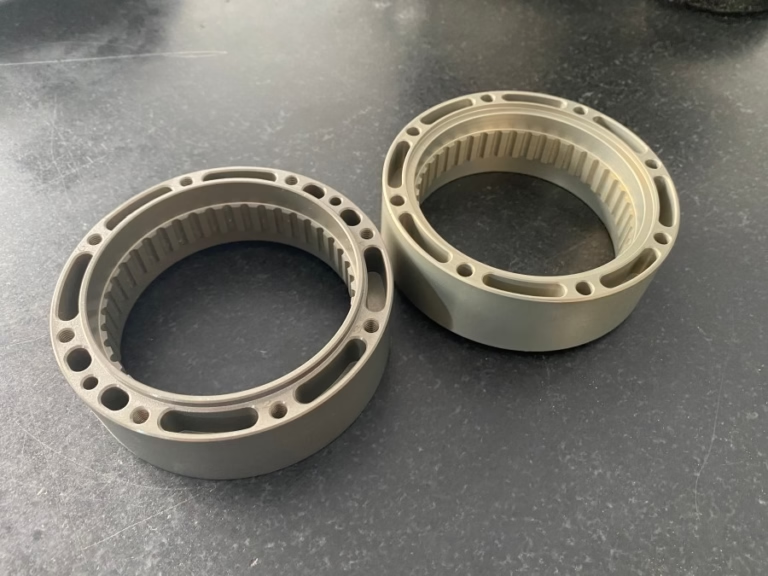
Application breadth comes from part geometry, not from industry labels
Every sector below buys the same subtractive process. What changes is the feature that decides the routing.
Automotive: engine, transmission and EV housings
Automotive is still the single largest consumer of CNC capacity. The reason is volume combined with feature count. A single transmission housing carries bearing bores, sealing faces, threaded ports and dowel holes that all have to sit in the same datum frame. If one bore drifts 0.05 mm, the shaft preload changes and the unit howls at speed.
Engine blocks and cylinder heads are the classic examples. Cylinder bore alignment, deck flatness and main bearing roundness all land on the same print. A three-axis mill handles the flat faces well. The bores are faster on a mill-turn center where the part is not re-fixtured between operations.
Battery trays, motor housings and inverter cases now pull comparable volumes. These parts are large, thin-walled and often pocketed for cooling channels. Wall thickness around 1.5 mm to 3 mm is common. Below that, chatter and distortion start to eat the tolerance budget, and the part may be better as a casting or a weldment.
Tooling and fixtures for the line itself are the quieter side of automotive CNC work. Checking fixtures, gripper fingers and end-of-arm tooling are produced in small runs, often 5 to 50 pieces. No minimum order quantity matters here, because a line down for a missing fixture costs far more than the part.
Aerospace: structural parts and turbine hardware
Aerospace pushes the process hardest. Airframe ribs, spars, brackets and engine mounts are machined from solid billet, and the buy-to-fly ratio is brutal. A part that starts as a 40 kg block of 7075 may finish at 2.5 kg. That is normal, and it is why five-axis capability decides who can quote the job.
The geometry is the problem. Pocket floors blend into drafted walls, walls blend into fillets, and the part has to be reached from five sides without losing position. A simultaneous five-axis center machines those surfaces in one setup. Repositioning on a three-axis machine introduces stack-up error at every re-clamp.
Titanium and Inconel change the cutting conditions, not the geometry. TC4 (Ti-6Al-4V) conducts heat poorly, so the heat stays in the cutting edge. Tool life drops, spindle speed drops, and cycle time rises. For thin ribs, the cutting force can deflect the wall more than the machine error does.
Not every aerospace part belongs on a mill. Large skin panels with gentle curvature are usually formed or stretched. CNC is the right answer when the part has pockets, bosses, tight hole patterns, or interfaces that must match a mating assembly within ±0.005 mm.
Medical devices and electronics: small parts, tight prints
Medical work splits into two groups. Surgical instruments are stainless, often 17-4PH or 420, and the print controls edge sharpness, surface finish and cleanability. Implant trials and drill guides run in small batches because the design changes with every surgeon review. Instrument bodies are usually turned and milled, then passivated.
Diagnostic and lab equipment parts are another story. Manifolds, pump housings and optical mounts carry fluid channels and bore patterns that must not leak. A face seal groove with the wrong floor finish will weep under pressure even when the dimensions are in tolerance. Surface finish matters as much as the size here.
Electronics is the highest-volume, smallest-feature end of the range. Heat sinks, connector shells, RF housings and camera brackets are frequently aluminium 6061 or 6063. Feature sizes drop to 0.5 mm walls and 1 mm slots. At that scale, the choice of end mill and the fixturing method decide whether the part is repeatable at all.
Anodizing and laser marking usually follow. Hardcoat anodizing adds 25 μm to 50 μm per surface, which can close a tight bore. Mark the drawing with masked areas before the finish is booked, not after.
Humanoid robots: the newest driver of five-axis work
Humanoid robotics is the fastest-growing application we see. A single unit carries 30 or more joint actuators, and each one needs a housing, a harmonic drive interface, a rotor can and a bearing seat. Multiply that by a pilot build of 50 to 200 units and the part count climbs quickly.
The parts are small but unforgiving. Actuator housings are often aluminium 7075 or 6061 with wall sections around 1.2 mm and bearing bores held to ±0.005 mm. The bore and the mounting flange must stay concentric. If they drift, the gear mesh preloads unevenly and the joint runs hot.
Magnesium AZ91D and AZ31B appear in forearm and torso links where mass matters. Machining magnesium needs chip control and a strict no-water rule on the swarf, so not every shop will quote it. Titanium is used sparingly, mostly at high-load joints.
Prototype phase dominates today. Most programs want 1 to 20 pieces first, then a jump to a few hundred. That pattern favors a shop with no minimum order quantity and a fast turnaround from prototype to low-volume production.
Which process fits which part
Use this as a first filter before requesting a quote.
| Part feature | Best routing | Watch out for |
|---|---|---|
| Deep pockets, 5-sided access | Simultaneous 5-axis mill | Fixture rigidity on thin walls |
| Round parts with axial holes | Mill-turn center | One setup beats two operations |
| Wall under 1.0 mm | Reconsider design or process | Chatter, distortion, poor finish |
| Thin ribs in titanium | 5-axis with low radial depth | Cutting force deflects the rib |
| Face seal grooves | 3-axis mill, fine finish | Floor finish controls leakage |
| Large flat panels | Forming, not milling | Billet cost and long cycle time |
| Small high-volume brackets | 3-axis mill or casting | Fixture cost per part |
| Magnesium housings | 5-axis, dry chip handling | Swarf must stay dry |
Questions engineers ask next
Which industry actually uses the most CNC capacity?
Automotive still leads by volume. Engine, transmission and EV housing work runs in the hundreds of thousands of parts, and each part carries many machined features.
Aerospace uses far fewer parts but far more machine hours per part, because billet removal is slow and the tolerances are tight. Robotics is small today but growing fast.
When is CNC the wrong choice?
When the part is a simple shell with no tight features. Large flat panels, simple covers and ducts are cheaper as formed or molded parts.
Also when wall thickness falls below roughly 1.0 mm across a large area. The part may be machinable, but the yield will be poor and the finish inconsistent.
What tolerance can we actually hold across a production run?
We work to ±0.005 mm on critical features, with 100% inspection before shipment. That covers raw material check, in-process monitoring and final inspection.
Inspection reports are available on request. The realistic number depends on part size, material and how many setups the geometry requires.
Do you handle prototype quantities for robotics and medical programs?
Yes. There is no minimum order quantity, so a single prototype and a 10,000-piece run go through the same quoting process.
Production can start within 24 hours of an approved drawing, and parts typically ship in 3–5 days.
Which materials cover most of these applications?
Aluminium 6061, 7075 and 6063 for housings and brackets. Stainless 303, 304, 316L and 17-4PH for medical and food-contact parts. TC4 titanium and Inconel for high-temperature or high-load hardware.
Plastics such as POM, PEEK and PC are also machined for insulators, manifolds and test fixtures.
How do certifications affect which shop can quote my part?
Automotive work often requires IATF 16949, medical work requires ISO 13485, and general industrial work runs under ISO 9001. We hold all three plus ISO 27001 for information security.
If your program needs an NDA before drawings are shared, that can be arranged before upload.
Send the drawing and we will tell you which process fits
Upload a STEP file and get a quotation plus a free DFM analysis within 12 hours.
12-hour quote100% inspectionNo minimum order quantity









