
9 Axis CNC Future: What Nine Axes Actually Change
This page explains how multi-axis CNC platforms are put together, what a 9 axis machine can reach that a 5-axis machine cannot, and where the limits sit. It is written for design engineers and sourcing engineers who have to decide which process a part should be quoted on.
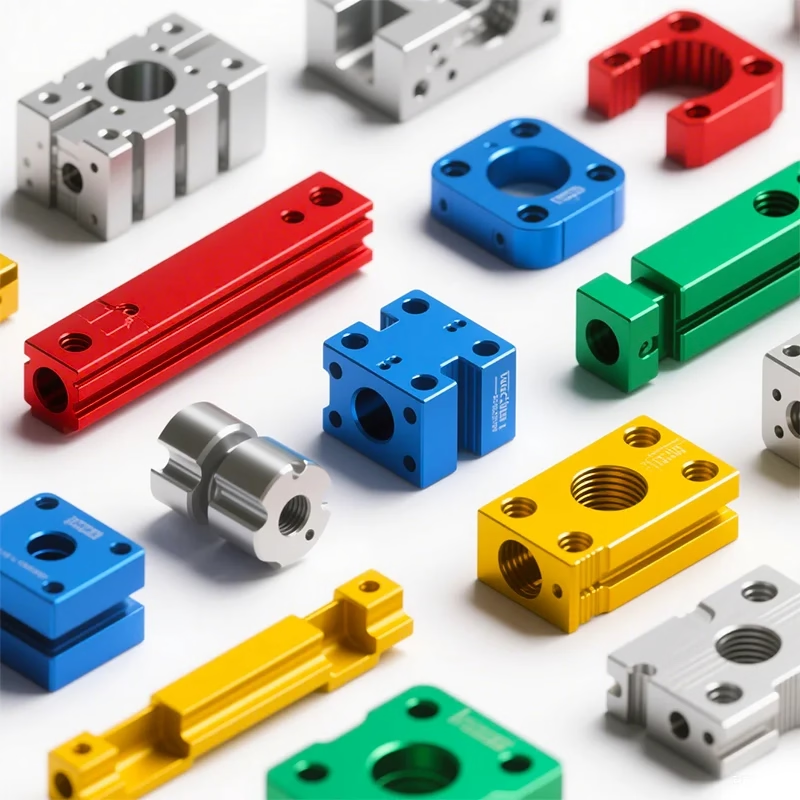
Where nine axes come from
Count the axes first. Every number after the word axis is a controlled motion, and the count says more about the machine architecture than about part complexity.
What nine axes means on a real machine
An axis is one controlled motion. A 3-axis mill moves X, Y and Z. A 5-axis machine adds two rotary motions, usually a trunnion that tilts the part and a spindle or table that rotates it. Once you add a second spindle, a subspindle, a bar feeder or a rotary table on a mill-turn center, the controlled motion count climbs past five. Nine axes on a machine tool normally describes a mill-turn or multi-spindle platform, not nine axes of simultaneous interpolation on a single spindle.
That distinction matters when you read a quote. Two shops can both advertise 9-axis capacity and mean very different things. One has a single spindle with nine programmable motions, most of them positioning axes rather than interpolating axes. Another has twin spindles and twin turrets, where nine motions run at the same time to cut two features in parallel. The part outcome is similar; the cycle time and the setup count are not.
So the useful question is never how many axes a machine has. It is which motions run simultaneously on your part, and how many setups that removes. A shop that answers that question in plain numbers is worth listening to.
- 13-axisX, Y, Z only. Flat faces, drilled holes, simple pockets.
- 24-axisAdds one rotary motion, usually around X. Cylindrical and indexed features.
- 35-axisTwo rotary motions run at the same time as the linear axes. Contoured surfaces in one setup.
- 49-axis classTwin spindle or mill-turn platforms. Nine controlled motions, not nine interpolating axes.
What the extra axes change on the shop floor
The gain is not a ninth direction of travel. It is fewer setups. A housing with features on five faces and a bore that meets an angled port can take three or four setups on 3-axis machines, each one needing a fixture, a touch-off and a re-datum. A multi-axis platform reaches most of those features from one clamping position. Every removed setup removes an alignment error and a queue slot.
Cycle time is the second effect. When two spindles cut at once, the wall-clock time per part drops even if the total cutting time is unchanged. For a 10,000-part run that matters. For a 20-piece prototype batch it usually does not, because programming and prove-out dominate the schedule.
Reach is the third effect, and the one engineers notice first. Undercuts, deep pockets with drafted walls, and intersecting bores at odd angles stop being special operations. On a 5-axis machine they are routine. On a 9-axis platform with a subspindle, you can also machine the back side of the part without unclamping it, which keeps concentricity between the front and back bores.
Accuracy follows from the same logic. Fewer clamps means less stack-up. At GreatLight we hold ±0.005 mm (±0.0002 in) on qualified features, and surfaces come off the machine at Ra 0.8–1.6 μm when the tool path and the material allow it. Those numbers depend on the feature, not on the axis count.
Which parts belong on a multi-axis platform
Multi-axis work pays off when geometry is the bottleneck. A part with features on four or more faces, a bore that intersects a curved surface at a compound angle, or a wall thin enough that a second clamp would deform it is a candidate. So is any part where the datum has to survive from the first operation to the last.
Some parts do not belong there. A flat plate with a bolt pattern and two counterbores is cheaper and faster on a 3-axis mill. A turned bushing with one cross hole is a mill-turn job, not a nine-axis job. Putting simple geometry on a complex machine adds programming hours and fixture cost without changing the part.
Volume changes the answer too. Below roughly 50 pieces, programming and first-article prove-out usually dominate. Between 50 and a few thousand, the setup savings start to show. Above that, twin-spindle cycles and bar feeders change the economics again. The part geometry sets the ceiling; the quantity sets whether you ever reach it.
Material adds a constraint. Aluminium 6061, 7075 and 6082 cut cleanly on multi-axis platforms. Titanium TC4 (Ti-6Al-4V) and Inconel put more load on a trunnion and generate more heat, so thermal drift between the two spindles has to be managed. Stainless 17-4PH sits between the two. The machine does not remove the material difficulty; it only removes the setup difficulty.
- 1Good fitFour or more machined faces, compound-angle bores, thin walls, tight datum chains.
- 2Poor fitFlat plates, single-face pockets, simple turned parts, one-off brackets.
- 3Volume sweet spotRoughly 50 to 10,000+ pieces, where setup savings survive programming cost.
- 4Material watchTitanium and Inconel need thermal control across twin spindles.
Process selection by part and quantity
Use this as a first filter before you request a quote.
| Part type | Typical axis count | Why |
|---|---|---|
| Flat plate, drilled pattern | 3-axis | One face, one setup, no rotary motion needed |
| Shaft with cross holes | 4-axis or mill-turn | Indexed rotation, single clamping |
| Housing, features on 5 faces | 5-axis simultaneous | One setup, contoured surfaces reachable |
| Angled port meets curved bore | 5-axis simultaneous | Compound angle without a special fixture |
| Part needs front and back bores | 9-axis class, twin spindle | Back side machined without unclamping |
| Small turned part, high volume | Mill-turn with bar feeder | Continuous feed, reduced handling |
| Thin-wall aerospace bracket | 5-axis, light passes | Fewer clamps means less distortion |
| Prototype bracket, 10 pieces | 3-axis or 4-axis | Programming cost outweighs setup savings |
How the 9 axis CNC future is likely to arrive
The shift will not be a wall of nine-axis machines replacing everything else. Most shops will keep a broad mix. GreatLight runs 127 high-precision CNC machines across three wholly-owned plants in Dongguan and Singapore, including 16 simultaneous 5-axis machining centers, 12 four-axis mills, 27 three-axis machines and 16 mill-turn centers. That mix exists because different jobs need different platforms, and a shop that only owns one type quotes badly.
What changes is the software layer. Tool path generation, in-process probing and thermal compensation are where multi-axis capability is won or lost. A nine-axis platform with good probing can re-datum a part after the first operation without an operator touching it. The same machine with weak probing becomes a very expensive 5-axis machine.
Tooling follows. Multi-axis work pushes toward smaller, longer-reach tools and adaptive paths that keep radial engagement steady. That is a tool path problem more than a machine problem, and it is where most cycle-time gains in the next few years will come from.
For a buyer, the practical takeaway is simple. Ask which motions run simultaneously on your part, how many setups the quote assumes, and how the shop verifies the datum between them. The axis count alone tells you very little.
Common questions
Is a 9-axis machine the same as a 5-axis machine with more axes?
No. A 5-axis machine has three linear and two rotary axes on one spindle. A nine-axis platform usually combines twin spindles, twin turrets or mill-turn motions. Some of those nine motions position the tool rather than interpolate a contour.
The practical difference is simultaneous cuts and reduced handling, not nine directions of contouring at once.
Can a 5-axis machine make the same part as a 9-axis machine?
Often yes, if the geometry is reachable from one clamping side. The 9-axis class wins when the part needs both ends machined and concentricity between them matters, or when twin-spindle cycle time changes the part cost.
If a 5-axis quote and a nine-axis quote both meet the drawing, compare setups, not axis counts.
What tolerance can we expect?
At GreatLight we hold ±0.005 mm (±0.0002 in) on qualified features, with finishes from Ra 1.6–3.2 μm as-machined down to Ra 0.2–0.8 μm after fine operations.
The achievable number depends on the feature, the material and the fixture. Send the drawing and we return a DFM analysis with the quote.
Does multi-axis machining cost more per part?
The hourly rate is higher than a 3-axis mill, so a simple part costs more on a complex machine. The comparison changes once the part needs three or four setups on a 3-axis platform, because each setup carries fixture cost, handling time and alignment risk.
We quote both routes when both are viable, so you can see the crossover.
Which materials do you machine on multi-axis platforms?
Aluminium 6061, 6061-T6, 2024, 5052, 5083, 6063, 6082, 7075 and ADC12; stainless 303, 304, 316, 316L, 420, 430, 431, 440C and 17-4PH; steel 1018, 1045, 4130, 4140, 4340 and A36; titanium TA1, TA2 and TC4; plus Inconel, magnesium AZ31B and AZ91D, copper alloys and engineering plastics including PEEK and POM.
Certifications held: ISO 9001:2015, IATF 16949:2016, ISO 13485:2016 and ISO 27001:2022.
How do you handle confidential drawings?
Uploads are secure and confidential. We sign an NDA on request before drawing review.
Every part is inspected before shipment, with raw material check, in-process monitoring and final inspection. Reports are available on request.
Send the drawing, get a process recommendation
Quotation and free DFM analysis within 12 hours. Production can start within 24 hours, and parts ship in 3–5 days.
12-hour quote±0.005 mm100% inspectionNDA on request









