
8 Axis CNC: the future of machining complex parts
This page explains how an 8 axis CNC machine is built, what the third and fourth extra axes add over 5-axis, and which part geometries actually justify the setup. It is written for design engineers, manufacturing engineers and sourcing teams who need to decide whether a part belongs on an 8-axis platform or on a 5-axis mill-turn cell.
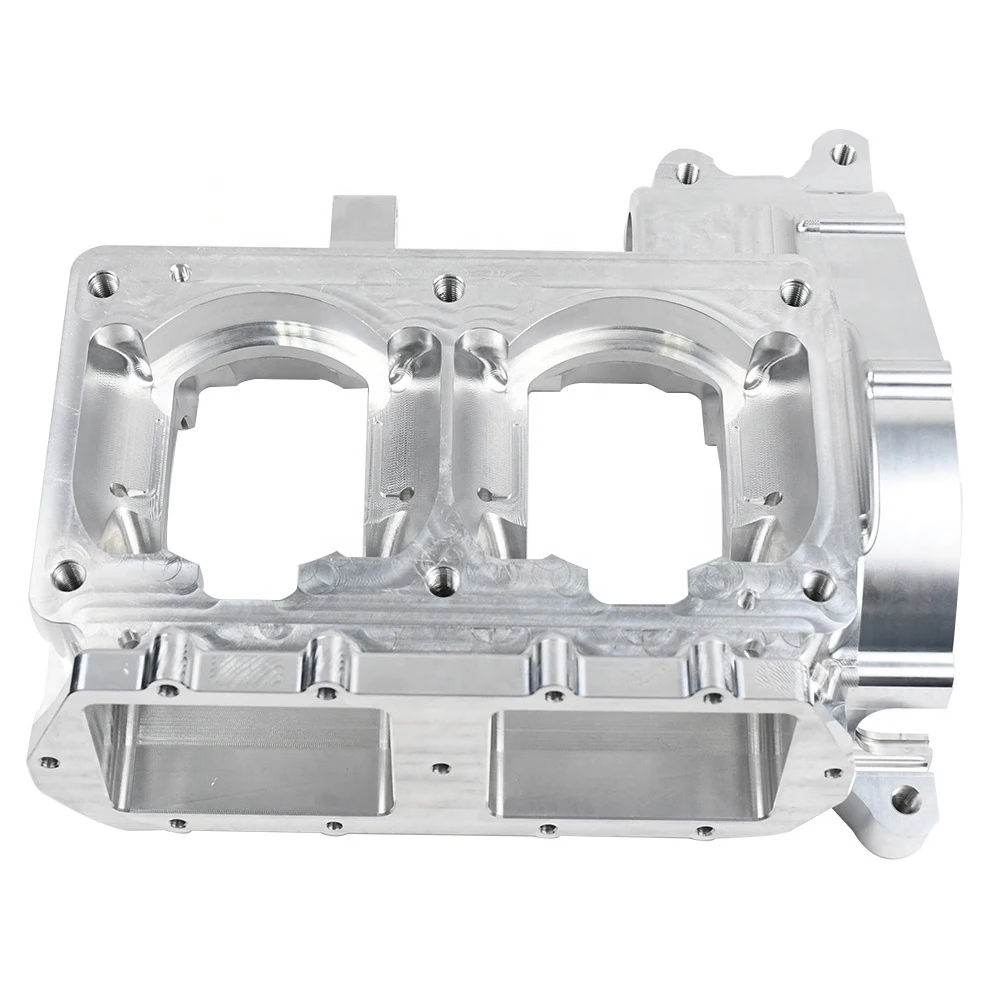
Where 8 axis machining fits in a real shop
Axis count is not a score. It is a way to describe how many motions a machine can coordinate at the same time.
What the eighth axis actually adds
A standard 3-axis mill moves the tool in X, Y and Z. A 5-axis machine adds two rotary motions, usually A and B, or A and C. That lets the tool approach a face at an angle instead of straight down. An 8-axis platform goes further: it adds a second spindle, a counter-spindle, or an independent sub-spindle, so two ends of the part can be cut in the same cycle.
On a mill-turn center, the axes are not all cutting axes. Some drive the turret, some drive the rotary table, and some drive the bar feeder or the sub-spindle. Coordinating eight motions means the control has to synchronize X, Y, Z, two rotary axes, the main spindle, the sub-spindle and the turret position at the same time.
The payoff is fewer setups. A part that would normally be milled on one machine and turned on another can be finished in a single clamping. Every re-clamp introduces a new datum and a new chance for error, so removing two or three setups usually matters more than the extra axis count itself.
Not every part needs this. A flat bracket with holes on four sides does fine on a 3-axis machine. The eighth axis earns its cost when the part is long, has features on both ends, and carries tight concentricity or angular relationships between those features.
- 15-axis millTool tilts to reach angled faces. Workpiece stays in one fixture.
- 2Mill-turn centerAdds turning to milling on one platform. Good for shafts with milled flats.
- 38-axis platformAdds a second spindle or sub-spindle. Both ends cut in one cycle.
Which parts justify the extra axes
Parts with features on both ends are the clearest case. A hydraulic manifold with ports on the front and back face, or a gearbox housing with a bore through the center and mounting pads on opposite sides, needs either two fixtures or one 8-axis setup. Two fixtures mean two datum references and a stack-up between them.
Long parts with a high length-to-diameter ratio also fit. A 400 mm shaft with a turned journal at each end and a milled keyway in the middle is awkward on a 5-axis mill because the part has to be flipped. On an 8-axis mill-turn center, the sub-spindle picks up the back end while the main spindle holds the front.
Angular relationships between features on different faces are another trigger. If a hole on one face must be square to a slot on the opposite face within 0.02 mm, doing both in one setup removes the re-clamp error entirely. The tolerance is then limited by the machine, not by the fixture.
5-axis work is still the right answer for a part that is compact and has all its features on one side. A 200 mm housing with five angled faces does not need a sub-spindle. Adding axes to that job only adds setup time for the operator and does not improve the part.
When to choose which platform
Use this as a first filter before you request a quote.
| Part characteristic | Best platform | Why |
|---|---|---|
| Features on one face only | 3-axis | No rotary motion needed. Lowest cost per part. |
| Angled faces, one side | 5-axis | Tool tilt reaches the angle without a second fixture. |
| Shaft with milled flats | Mill-turn | Turning and milling in one cycle. No flip. |
| Features on both ends | 8-axis | Sub-spindle cuts the back end in the same setup. |
| Concentric bores, two ends | 8-axis | Concentricity set by the machine, not by two fixtures. |
| Thin-wall, long part | Mill-turn or 8-axis | One clamp reduces distortion from repeated holding. |
| Prototype, one piece | 3-axis or 5-axis | Setup cost of 8-axis rarely pays back on one part. |
| Run of 500+ parts | 8-axis | Cycle time savings spread across the batch. |
What changes in tolerance and surface finish
The main tolerance gain from 8-axis work is not a tighter single feature. It is the relationship between features. A bore held to ±0.005 mm is achievable on a 5-axis machine too. The difference shows up when that bore must be concentric with a second bore 300 mm away, cut from the other end.
Surface finish follows the same logic. We hold Ra 0.8–1.6 μm on most milled and turned faces, and Ra 0.2–0.8 μm on sealing faces and bearing journals. Cutting both ends in one setup avoids the mismatch that appears when a finish pass is interrupted by a re-clamp.
Tool access is the constraint that decides most jobs. An 8-axis machine can reach features a 5-axis machine cannot, but the tool still has to fit. A 6 mm end mill in a deep pocket needs a long reach, and long tools deflect. If the feature is smaller than the tool can reach, no axis count helps.
Thermal drift matters on long cycles. An 8-axis cycle can run 40 minutes or more without an operator touching the part. We monitor in-process and check the first article against the drawing before the run continues.
Where 8-axis is not the right call
Programming and setup time are real. An 8-axis program takes longer to prove out than a 5-axis program because there are more collision cases to check. For a one-off prototype, that time is hard to recover. For a 500-piece run, it disappears into the cycle time.
Machine availability is finite. A shop with a handful of 8-axis platforms cannot put every job on them. The right question is not whether 8 axis is the future of machining in general. It is whether this part, at this quantity, on this machine, beats the alternative.
Small parts with simple geometry are cheaper on a 3-axis machine. That has not changed. The 8 axis CNC future is about specific part families, not about replacing every machine on the floor.
Operators need a different skill set. Setting up a sub-spindle, synchronizing two spindles and managing the hand-off between them takes training. A shop that runs 8-axis machines without that training will lose the tolerance advantage in the first week.
Common questions
Is 8-axis the same as 5-axis plus a sub-spindle?
Not exactly. A sub-spindle is one common way to reach eight coordinated motions, but the count depends on the machine. Some platforms use two rotary axes on the tool side, two on the work side, plus a sub-spindle.
The number that matters for your part is how many of those motions can cut at the same time, not the total on the spec sheet.
What tolerance can you hold on an 8-axis part?
We work to ±0.005 mm (±0.0002 in) on critical features. The practical limit depends on part size, material and tool reach rather than on the axis count.
On a long part, the relationship between features at opposite ends is usually the tightest requirement, and that is where one-setup machining helps most.
Which materials run well on 8-axis machines?
Aluminium 6061, 7075 and 6082 are straightforward. Stainless 303, 304 and 17-4PH run well with the right feeds. Titanium TC4 and Inconel need slower cycles and more tool changes.
Plastics like POM and PEEK are fine for mill-turn work but need care on the sub-spindle hand-off because the part can mark easily.
Do I need 8-axis for a part with holes on both ends?
Only if the holes have a tight positional or concentric relationship, or if the quantity justifies the setup time.
A loose ±0.1 mm relationship between two ends can often be done on a 3-axis machine with a flip, at lower cost.
How do you handle inspection on an 8-axis run?
We inspect 100% of parts before shipment. That includes a raw material check, in-process monitoring during the cycle, and a final dimensional inspection.
Inspection reports are available on request, and the first article is checked against the drawing before the run continues.
Can you quote an 8-axis job from a STEP file?
Yes. Upload the STEP file and we return a quotation with a free DFM analysis within 12 hours.
The DFM note will tell you if the part is a better fit for 3-axis, 5-axis or mill-turn, so you are not paying for axes the part does not need.
Send your part file and get a process recommendation
We review the geometry, pick the platform that fits, and return a quote with DFM notes within 12 hours.
12-hour quote100% inspectionNo minimum order quantityNDA on request









