
7 Reasons the Mazak V414 Vertical Machining Center Suits Precision Manufacturing
This page lists the reasons mazak v414 vertical capacity shows up in precision shops, written for engineers and buyers who compare spindle torque, thermal behavior and part geometry before committing a job. Read it to judge which parts belong on a V414, which belong on a five-axis machine, and what to ask before you quote.
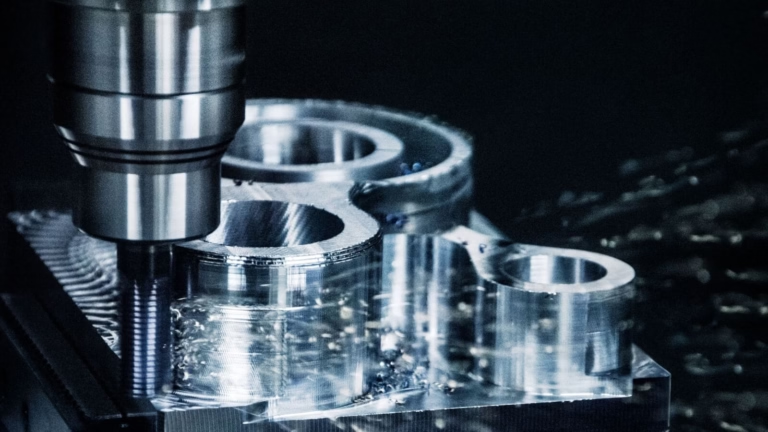
Rigidity and Thermal Behavior Decide the Tolerance You Can Hold
A vertical machining center only holds ±0.005 mm if the frame stops moving while the cutter is in the cut. This machine sits on a ribbed cast iron bed with a column sized by finite element analysis, so the structure resists deflection during roughing and keeps that stiffness when you switch straight to a finishing pass. On 17-4PH or 4140 parts, that stiffness is what keeps a deep pocket wall parallel after a heavy axial cut.
Thermal drift is the quieter problem. Spindle, ballscrew and ambient heat all push the column and headstock around, and a machine that starts the shift cold will not match one that ran all morning. Mazak builds the headstock, column and bed symmetrically so expansion moves in a predictable direction instead of tilting the spindle. Temperature-controlled coolant circuits then pull that heat back out.
In our Dongguan plant, summer shop temperatures pass 35 °C and humidity stays high. Machines with asymmetric frames need warm-up cycles before the first good part. Symmetric castings cut that warm-up to a short idle run, and the compensation values stay stable through the afternoon. For titanium airframe brackets, the first part of the morning and the hundredth of the day measure the same.
Control Response and Spindle Torque Set the Cutting Window
The Smooth CNC control runs the servo loop fast enough that the machine follows the programmed path at feed rates where lighter controls start rounding corners. That matters on mold inserts and electrode work, where a 0.5 mm corner radius has to stay 0.5 mm at 8,000 mm/min. Look-ahead block processing keeps the tool from overshooting into a thin wall.
Spindle choice drives what you can cut, not just how fast. A 40-taper spindle at 12,000 rpm with a few tens of Nm of torque handles 6061 and 7075 all day, and it will take a light pass in Ti-6Al-4V or Inconel if you keep radial engagement low. Push a deep axial cut in 316L and the same spindle runs out of torque before it runs out of rpm.
So the decision is geometric. Aluminum housings, brass fittings, plastic fixtures and most stainless brackets fit the high-speed side of the window. Large-diameter face milling in steel, or hogging out a 60 mm deep pocket in titanium, wants more torque per revolution and often a bigger taper. Neither spindle wins everywhere.
Axis Configuration and Machine Intelligence Cut Setup Risk
A three-axis V414 with a rotary table becomes a four-axis machine for parts with features on several faces. Add a trunnion and you get positioned five-face work without repositioning the part. It is not simultaneous five-axis contouring, and we do not sell it as such. For a part that needs one angled hole pattern, the rotary table is faster and cheaper than a full five-axis cycle.
Where the configuration earns its keep is the middle band of work: manifolds, valve bodies, gearbox covers, brackets with holes on four sides. One setup, one datum, tight true position between faces. Parts with free-form surfaces, deep undercuts or five-sided blending still go to our 16 simultaneous five-axis centers.
Machine-side intelligence is the unglamorous reason scrap stays low. Load monitoring, tool-life tracking and interference checks stop a broken tool before it ruins the rest of the pocket. Collision avoidance on the rotary table is worth real money when a fixture is 200 mm tall and the operator is on the second shift.
Which Work Belongs on a V414 and Which Does Not
Use this as a first filter before you send a drawing.
| Part or feature | V414 fit | Why |
|---|---|---|
| Aluminum housing, 3 faces, 400 mm | Good fit | Rigid setup, high spindle speed, light load |
| Stainless bracket, many holes | Good fit | Rotary table gives true position in one setup |
| Mold insert, 0.3 mm corner | Good fit | Control look-ahead holds the radius |
| Titanium bulkhead, deep pockets | Marginal | Torque limit, low radial engagement needed |
| Impeller, blended surfaces | Not suitable | Needs simultaneous five-axis contouring |
| 4,000 mm frame rail | Not suitable | Exceeds machine travel, use large gantry |
| Hardened tool steel, 55 HRC | Marginal | Light finishing passes only, no heavy roughing |
Support, Metrology and What That Means for Your Order
The seventh reason is less about iron. Service response, spare spindle availability and a technician who knows the control matter when a machine stops mid-run. A VMC that sits for a week waiting on a part costs more than the tolerance it was bought to hold.
Metrology closes the loop. A machine that holds ±0.005 mm is only useful if you can prove it on the part. We inspect 100% of parts before shipment, with raw material checks, in-process monitoring and a final report on request. On a V414 that means CMM reports on the critical bores and true position callouts, not just a pass stamp.
For buyers outsourcing rather than buying, the practical question is whether the shop can match the machine to the job. We run 127 CNC machines, including 27 three-axis and 12 four-axis mills, across 7,600 m² in Dongguan and a plant in Singapore. Material ranges from 6061 and 7075 to 17-4PH, Ti-6Al-4V and PEEK. Finish options run from as-machined Ra 1.6–3.2 μm to fine Ra 0.2–0.8 μm.
Certifications matter too. ISO 9001:2015 covers general work, IATF 16949:2016 covers automotive, ISO 13485:2016 covers medical devices and ISO 27001:2022 covers data handling. If your drawing needs one of those paper trails, say so at quote stage rather than after the first article.
Questions Engineers Ask Before Booking a V414 Slot
Can the V414 hold ±0.005 mm on a production run?
Yes, within its travel envelope and on a rigid setup with the right cutter and coolant. The tolerance applies to the finished part, not the machine alone, so fixture stiffness and thermal warm-up both count.
Is a rotary table enough, or do I need five-axis?
A rotary table handles positioned work: holes, slots and faces on several sides of a prismatic part. It cannot blend a free-form surface or reach an undercut. If your part has continuous curvature across faces, it belongs on a simultaneous five-axis machine.
What part size fits?
The V414 class covers travel around 750 × 1,150 × 550 mm and 600 × 600 × 600 mm. For larger frames we use machines with 4,000 × 400 × 150 mm travel. Send the envelope with the drawing and we will confirm the machine before quoting.
Which materials cut well on it?
Aluminum 6061, 7075 and 6082, brass C36000, most 300-series stainless, and plastics like POM and PEEK. Titanium and Inconel run with reduced radial engagement. Hardened tool steel above roughly 45 HRC is limited to light finishing passes.
How do you check the parts?
Raw material verification, in-process monitoring and a full final inspection before shipment. Reports are available on request, including CMM data for critical dimensions and true position.
What is the lead time?
Quotation and free DFM analysis come back within 12 hours. Production can start within 24 hours and parts ship in 3–5 days. No minimum order quantity, from one prototype to 10,000+ parts.
Send the Drawing and We Will Pick the Machine
Upload a STEP file and get a quote with a DFM analysis inside 12 hours. If a part does not belong on a V414, we will say so and route it to the right machine.
12-hour quote100% inspection±0.005 mmNDA on request









