
7 Key Advantages of Machining Brass Parts
Brass is the alloy most shops reach for when a part has to be turned fast, hold tight tolerance, and look right off the machine. This page covers seven advantages of machining brass parts, the grades that behave well, and the cases where you should pick something else. Written for design engineers and buyers specifying production parts.
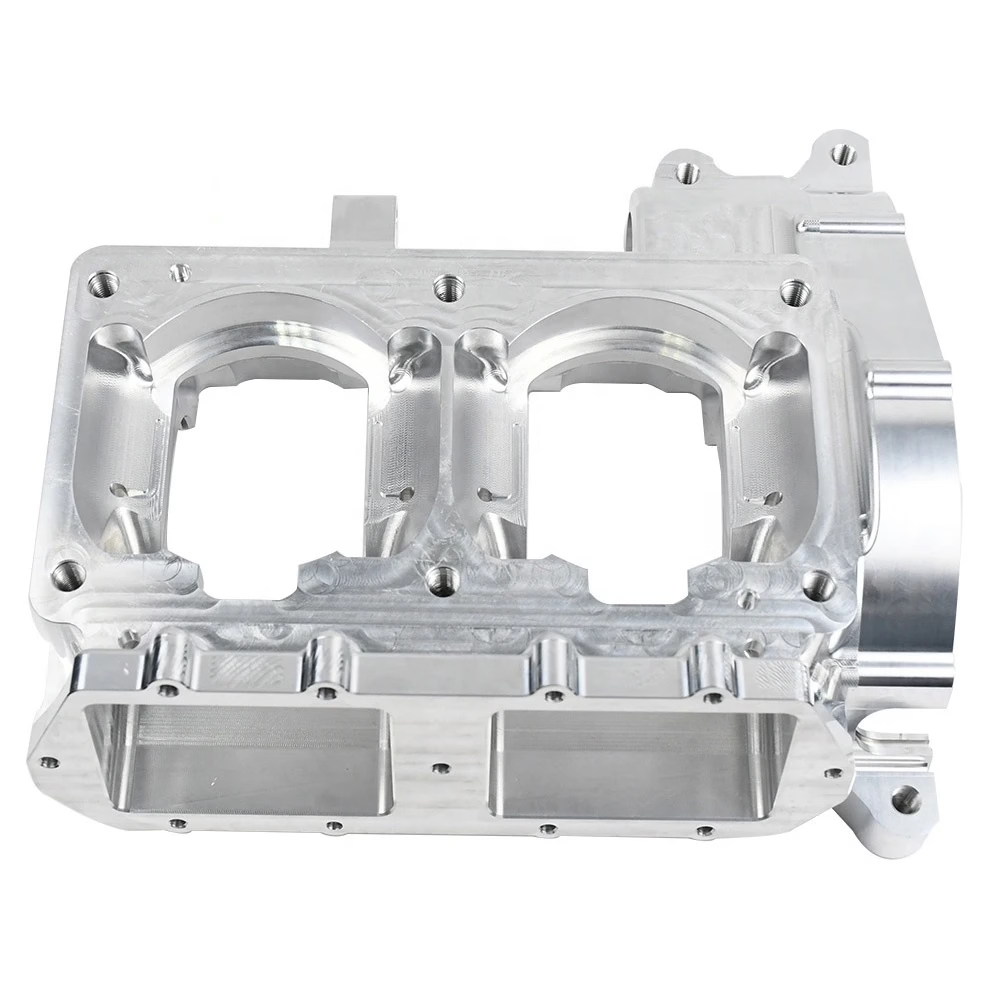
What makes brass different on a CNC
Seven advantages, one material family, and a short list of reasons to say no.
Machining speed and tool life
Brass cuts fast. On a screw machine or a CNC lathe, C36000 runs at surface speeds that would burn a carbide insert in steel, and the chips break short instead of snarling around the tool. That combination is the main reason brass parts come off the machine quickly and with fewer interruptions for chip clearing.
Tool wear stays low because the alloy is soft compared to stainless or tool steel. A finishing insert that lasts a few hundred parts in 304 stainless will often run several thousand brass parts before it needs indexing. Fewer tool changes means less scrap from insert transitions and more predictable cycle times.
The practical result is a lower cost per part. Setup time is similar to any other material, but cycle time and tooling cost drop, and that gap widens as volume grows. For turned fittings, bushings, and connector bodies, brass is usually the cheapest route that still holds a tight tolerance.
- 1Chips break cleanShort chips clear the cut without pecking or dwell.
- 2Low cutting forcesThin walls and small diameters survive turning.
Tolerance and surface finish
Brass holds tolerance well. We routinely hold ±0.005 mm on turned diameters and bores, and the material does not spring back the way some plastics and thin aluminium walls do. The cut is stable, so the first part and the thousandth part measure the same.
Surface finish comes off the tool at Ra 0.8–1.6 μm on a normal finishing pass, and Ra 0.2–0.8 μm is reachable with a light finish cut and a sharp insert. That matters for sealing faces, bearing bores, and any surface that will be mated without a gasket.
Brass also takes threads well. Fine threads down to M2 and unified sizes hold their form, and there is little tearing at the thread flank. For pneumatic and hydraulic fittings, this is often the deciding factor.
Corrosion behavior and where brass stops working
Brass resists fresh water, most industrial atmospheres, and mild chemical exposure. It forms a thin oxide layer that slows further attack, so parts used indoors or in humid plants do not need a coating to survive. That is a real cost saving on high-volume parts.
Seawater is a different story. Plain C36000 is not the right grade for constant salt exposure; dezincification can pull zinc out of the alloy and leave a porous copper sponge. Naval brass and other inhibited grades are the correct pick there, and the part usually needs a defined alloy callout rather than a generic brass note.
Ammonia and ammonium compounds are another limit. Stress corrosion cracking shows up in brass that is under load and exposed to ammonia, so parts near refrigeration lines or certain cleaning chemicals should be stress-relieved or moved to a different alloy.
- 1GoodHumidity, fresh water, oils, mild solvents.
- 2CautionSeawater, ammonia, high-chloride environments.
Electrical and thermal conductivity
Brass conducts both current and heat, though less than pure copper. C11000 copper is the benchmark; C36000 runs roughly a quarter of that, which is still far above stainless steel. For connectors, terminals, and busbar components, that is often enough to avoid a plating step.
Thermal conductivity helps in two ways. Heat leaves the cutting zone during machining, which keeps the part cool and reduces thermal growth on tight-tolerance features. In service, brass heat sinks and sensor housings spread heat away from sensitive components.
If the application needs maximum conductivity, we will steer you toward C101 or C110 copper instead. Brass is the compromise when you want conductivity plus machinability and corrosion resistance in the same part.
Antimicrobial behavior in medical and food contact
Copper alloys kill bacteria on contact. This is a material property, not a coating, so it does not wear off. Brass door hardware, fittings, and touch surfaces in hospitals and food plants stay cleaner between manual wipe-downs.
For medical devices and food processing equipment, brass parts are often specified where a surface sees repeated hand contact or product contact. The alloy must still meet the cleaning and sterilization regime, and some grades discolour under repeated autoclave cycles. We check that before quoting.
This is not a substitute for a validated cleaning process. It is one more barrier. Engineers should treat antimicrobial behavior as a secondary control, not the primary one.
Common brass grades and where they fit
Grade callouts matter more than the word brass on a drawing.
| Grade | Machinability | Typical use | Watch out for |
|---|---|---|---|
| C36000 | Excellent | Fittings, bushings, connectors | Dezincification in salt water |
| C27400 | Good | Valve bodies, hardware | Lower strength than C36000 |
| C28000 | Moderate | Tubes, heat exchanger parts | Harder to finish to tight tolerance |
| C11000 copper | Fair | Busbars, high-current parts | Gummy chips, slower cycle |
| Beryllium copper | Good | Spring contacts, non-sparking tools | Beryllium dust controls required |
Appearance and finishing
Brass has a warm gold colour that reads as quality on instrument panels, marine hardware, and architectural trim. The as-machined surface already looks finished for many parts, which removes a plating step and its cost.
When a different look is needed, brass takes plating and coating well. Electroless nickel, silver, and gold plating all bond reliably, and clear lacquer protects the polished surface from tarnish. Laser marking works cleanly at a minimum character height of 1.5 mm.
One caution on polishing. Brass is soft, so a heavy polish can round edges and erase a sharp corner that the design needs. If a chamfer or edge break is functional, say so on the drawing so finishing does not remove it.
Recyclability and total cost
Brass scrap has real value. Chips and rejected parts go back into the melt, and that recovery offsets part of the material cost. It is one of the few materials where the shop can quote a genuinely lower net cost at volume.
The alloy is also stable over time. Brass parts do not degrade in storage the way some plated steel does, so long shelf life is not a problem for service parts or spares held for years.
Taken together, the advantages of machining brass parts come down to speed, tolerance, and finish in one material. That is why it stays on the short list for turned and milled industrial components, even as aluminium and engineering plastics take over other jobs.
Brass machining questions engineers ask
Is brass suitable for parts that see outdoor weather?
It depends on the exposure. Brass handles humidity and rain fine, and it develops a patina that slows further attack. Constant salt spray or marine immersion needs an inhibited grade such as naval brass, not C36000.
Can brass parts be anodized?
No. Anodizing is an aluminium process. Brass can be plated with electroless nickel, silver, or gold, or protected with a clear lacquer. Bead blasting, tumbling, brushing, and polishing all work on brass as well.
What tolerance can you hold on a turned brass part?
We hold ±0.005 mm on turned features under normal production conditions. Very slender parts or long unsupported bores may need a looser callout, and we flag that during DFM review before cutting metal.
Does brass work for electrical contacts?
Yes, for moderate-current parts. Brass conductivity is lower than pure copper but well above stainless. If the design is current-limited or heat-sensitive, we usually recommend C101 or C110 copper instead.
Is there a minimum order quantity for brass parts?
No minimum. We run from a single prototype to 10,000+ part runs. Uploads are secure and confidential, and an NDA is available on request.
How fast can brass parts ship?
Quotation and free DFM analysis come back within 12 hours, and production can start within 24 hours. Standard parts ship in 3–5 days. Historical late-delivery probability is under 2%.
Send us your brass part drawing
Upload a STEP file and we will return a quote with DFM notes within 12 hours. No minimum order, from one prototype to full production runs.
12-hour quote100% inspectionISO 9001:2015NDA on request









