
In the rapidly evolving world of product development, 5 Ways 3D Printing Transforms Consumer Goods Design stands as a critical framework for understanding how additive manufacturing is reshaping the industry. It’s no longer a niche prototyping tool reserved for aerospace or medical labs; it has become a mainstream force driving innovation in everything from eyewear to kitchen appliances. At GreatLight CNC Machining, we’ve witnessed firsthand how this technology bridges the gap between digital design and physical reality, and how it complements traditional precision machining methods. Whether you’re a startup refining a concept or a multinational launching a new product line, understanding these five transformative shifts is essential for staying competitive.
5 Ways 3D Printing Transforms Consumer Goods Design
Let’s dive deep into each of these transformations, not just from a theoretical perspective, but with practical insights that engineers, product managers, and procurement specialists can immediately apply. As a manufacturer with over a decade of experience in both subtractive and additive processes, I’ll share what works, what doesn’t, and how to avoid the pitfalls that plague many development cycles.
1. Accelerating Iteration: From Weeks to Days
The most immediate and visible impact of 3D printing on consumer goods design is the dramatic compression of the iteration loop. Traditional manufacturing, whether injection molding or CNC machining, often requires expensive tooling and lengthy setup times. A design change meant weeks of waiting for a new mold or a complete re-fixturing of a machining center. For consumer goods companies running tight launch calendars, this time lag could mean missing a critical market window.
With additive technologies like SLA (stereolithography) and SLS (selective laser sintering), a revised CAD file can be printed overnight. Designers can hold a physical part in their hands the next morning, test its ergonomics, verify fit with mating components, and immediately spot flaws that a computer screen simply cannot reveal. This rapid iteration cycle is not just about speed; it enables a culture of experimentation. Instead of freezing a design early due to cost constraints, teams can explore multiple variations in parallel, testing everything from surface texture to structural rigidity.
At GreatLight, we often tell clients that the best way to use 3D printing is to “fail fast, then succeed sooner.” Our in-house fleet of SLA, SLS, and SLM printers allows us to produce functional prototypes that mimic the final production material, not just visual mock-ups. For example, a consumer electronics housing printed in a UL-certified flame-retardant material can be drop-tested and thermal-cycled long before committing to a steel mold. This capability is a game-changer, especially when combined with our 3D printing{:target=”_blank”} services that range from low-volume pilot runs to bridge production.
But here’s the nuance: 3D printing doesn’t always replace CNC machining for prototypes. For parts that require tight tolerances or specific mechanical properties, a machined prototype made from aluminum or PEEK may be more representative. That’s why at GreatLight, we advocate a hybrid approach: use 3D printing for rapid form-and-fit iterations, then switch to CNC machining for the final validation prototypes that need to be produced under production-equivalent conditions. This pragmatic blend ensures you’re not sacrificing accuracy for speed, nor speed for accuracy.
2. Unlocking Complex Geometries: Design Freedom Meets Functionality
Consumer goods designers have historically been constrained by the limitations of traditional manufacturing. Injection-molded parts need draft angles to release from the mold; CNC machining requires tool access; and both processes struggle with internal channels, undercuts, or lattice structures. 3D printing tears down these walls. With additive manufacturing, complexity is essentially free. A part with intricate internal cooling channels, organic topology-optimized structures, or multi-material assemblies can be fabricated as a single monolithic component.
This design freedom translates directly into better-performing consumer products. Consider a high-end hairdryer nozzle. With traditional manufacturing, an aerodynamically optimized shape with internal baffles might be impossible to mold or machine. Via SLS or SLM, that same nozzle can be printed in nylon or aluminum, improving airflow efficiency while reducing weight. Or think about a custom-fit earphone shell. Using a 3D scan of a user’s ear, a designer can create a lattice structure that offers superior acoustic isolation and comfort, something that would be unthinkable with injection molding.
For GreatLight, this means we’re not just a supplier of parts; we’re an engineering partner that helps clients redesign their products to exploit additive capabilities. Our five-axis CNC machining centers handle the high-tolerance mating surfaces, while our SLM printers produce the complex internal structures. We’ve seen cases where a part originally designed for six-piece assembly was consolidated into a single 3D printed component, reducing assembly labor, eliminating potential failure points, and cutting total cost by 30%. That’s the power of geometry liberation.
However, there’s a counterargument worth mentioning: not every complex geometry is manufacturable or cost-effective in 3D printing. Post-processing challenges like support removal, surface finishing, and residual stress management remain. At GreatLight, we pair our additive capabilities with rigorous design-for-additive-manufacturing (DfAM) reviews. We don’t just print your file; we optimize it. Our engineers analyze wall thickness, overhang angles, and powder removal paths to ensure that the printed part is both functional and economically viable. This is where an experienced partner like GreatLight Metal differentiates itself from a generic online 3D printing service that simply processes STL files blindly.
3. Enabling Mass Customization: From One-Size-Fits-All to Tailored for You
Consumer goods have always been a battleground between economy of scale and individuality. Traditional factories thrive on producing millions of identical parts. Mass customization was a marketing buzzword, but rarely a manufacturing reality. 3D printing changes that equation by making unit cost relatively insensitive to complexity and batch size. You can print one thousand slightly different variations of a product, each tailored to an individual customer’s measurements, aesthetic preferences, or functional requirements, without any additional tooling cost.
The eyewear industry is a perfect example. Companies now offer 3D-printed glasses frames that are perfectly matched to the wearer’s facial scan. In the orthotics and consumer goods sectors, custom insoles, toothbrushes, and even shaver handles are being produced on demand. This isn’t just about comfort; it’s about creating a deep emotional connection with the product. When a customer knows that a product was literally made for them, their brand loyalty skyrockets.
GreatLight’s facility is well-equipped to support such projects. Our SLS printers produce durable nylon parts, while our SLA printers achieve high-resolution surfaces for cosmetic items. We also integrate these parts with our 5-axis CNC machining for components that require post-printed machining, such as threaded inserts or precise mounting bosses. Our location in Dongguan, the heart of China’s hardware and mold capital, gives us access to a vast supply chain for secondary operations like anodizing, electroplating, and painting—all critical for consumer-grade finishes.
But let’s be objective: mass customization via 3D printing is not always the right answer. For volume production of simple parts, injection molding will still be cheaper. The key is finding the right product categories where customization adds real value, and then designing the product so that only the customized portion is 3D printed, while the rest is conventionally manufactured. At GreatLight, we help clients identify these “hybrid strategies.” For instance, a smartwatch band could have a 3D-printed personalized clasp while the main body is CNC-machined from aluminum. This approach balances cost, performance, and personalization.
4. Material Innovation and Functional Integration: Pushing Beyond Prototypes
Too often, 3D printing is dismissed as a “plastic prototype toy.” That perception is outdated. Today’s industrial-grade 3D printers can process a stunning array of materials, including carbon-fiber-filled nylon, glass-filled polyamide, flexible TPU, medical-grade resin, and even metal alloys like stainless steel, aluminum, and titanium. These materials exhibit real engineering properties: high heat resistance, chemical resistance, tensile strength, and even biocompatibility. Designers can now print end-use parts that are not just test pieces but final products capable of withstanding years of abuse.
The concept of functional integration takes this a step further. In traditional manufacturing, you’d build a housing, then install a separate hinge, then add a gasket, and perhaps a strain-relief feature. With 3D printing, you can combine all those features into one printed piece. Hinges are printed as living hinges; gaskets are overmolded via multi-material jetting; strain-relief is achieved through lattice structures that flex exactly where needed. The result is fewer parts, faster assembly, and often a more robust product.
At GreatLight, we’ve seen great success with SLM (Selective Laser Melting) for metal consumer goods. For example, a custom fishing reel component in titanium, or a high-end watch case in aluminum, printed and then machined to achieve precise tolerances. We also offer CNC machining services to finish these printed parts, which is essential because as-printed surfaces have roughness that may not meet consumer expectations. Our ability to combine SLM with precision 5-axis machining is a unique selling point. While many 3D printing bureaus only print, GreatLight can take the printed part, subtractively machine critical surfaces, apply heat treatment, and provide a finished component ready for assembly.
Of course, material innovation brings challenges in quality control. Powder quality, process parameters, and post-processing heat treatments all affect the final material properties. That’s why our ISO 9001-certified processes include rigorous incoming material checks, in-process monitoring, and tensile testing on printed coupons. We’ve invested heavily in both equipment and training to ensure that our printed parts are consistent, not just visually but mechanically, batch after batch.
5. Streamlining Supply Chains: On-Demand Manufacturing and Digital Inventory
The last transformative way is perhaps the most strategic. 3D printing enables on-demand manufacturing, which means you no longer need to hold large inventories of slow-moving spare parts or replenish products that have unpredictable demand. Instead of stocking a warehouse with thousands of molded components, you maintain a digital inventory of CAD files. When a customer orders a part, you print it, ship it, and the cycle is complete. This dramatically reduces storage costs, eliminates obsolescence, and shortens lead times for aftermarket support.
For consumer goods, this is a boon for limited edition products, seasonal items, and legacy support. Imagine a vacuum cleaner manufacturer that sold millions of units a decade ago. Traditionally, they’d need to store or retool for a spare motor mount that breaks occasionally. With 3D printing, they can produce that mount on demand, even 20 years after the product was discontinued. This not only improves customer satisfaction but also aligns with sustainability goals by reducing waste.
GreatLight has the infrastructure to be your distributed manufacturing partner. Our facility in Chang’an, Dongguan, houses multiple 3D printing technologies alongside our machining capabilities. We can handle production runs ranging from one to a few thousand pieces, and we’ve built a robust digital order management system to streamline file upload, pricing, and production scheduling. We’re not a broker; we’re the factory. This means we control the entire process, ensuring that the quality you get is exactly what we promised.
But let’s not ignore the limitations. For high-volume standard parts, injection molding or CNC machining will still be more cost-effective per unit. 3D printing’s strengths are in lower volumes, higher variability, and urgent demand. The smart strategy is to segment your product portfolio: identify which items are stable and high-volume, and which are variable or low-volume. The former are candidates for traditional manufacturing; the latter are perfect for an on-demand 3D printing partner. At GreatLight, we often consult our clients on this segmentation, offering a mix of services that optimize total cost of ownership. We’re not just a 3D printing company; we’re a full-service precision manufacturing partner.
The Role of a Partner Who Masters Both Worlds
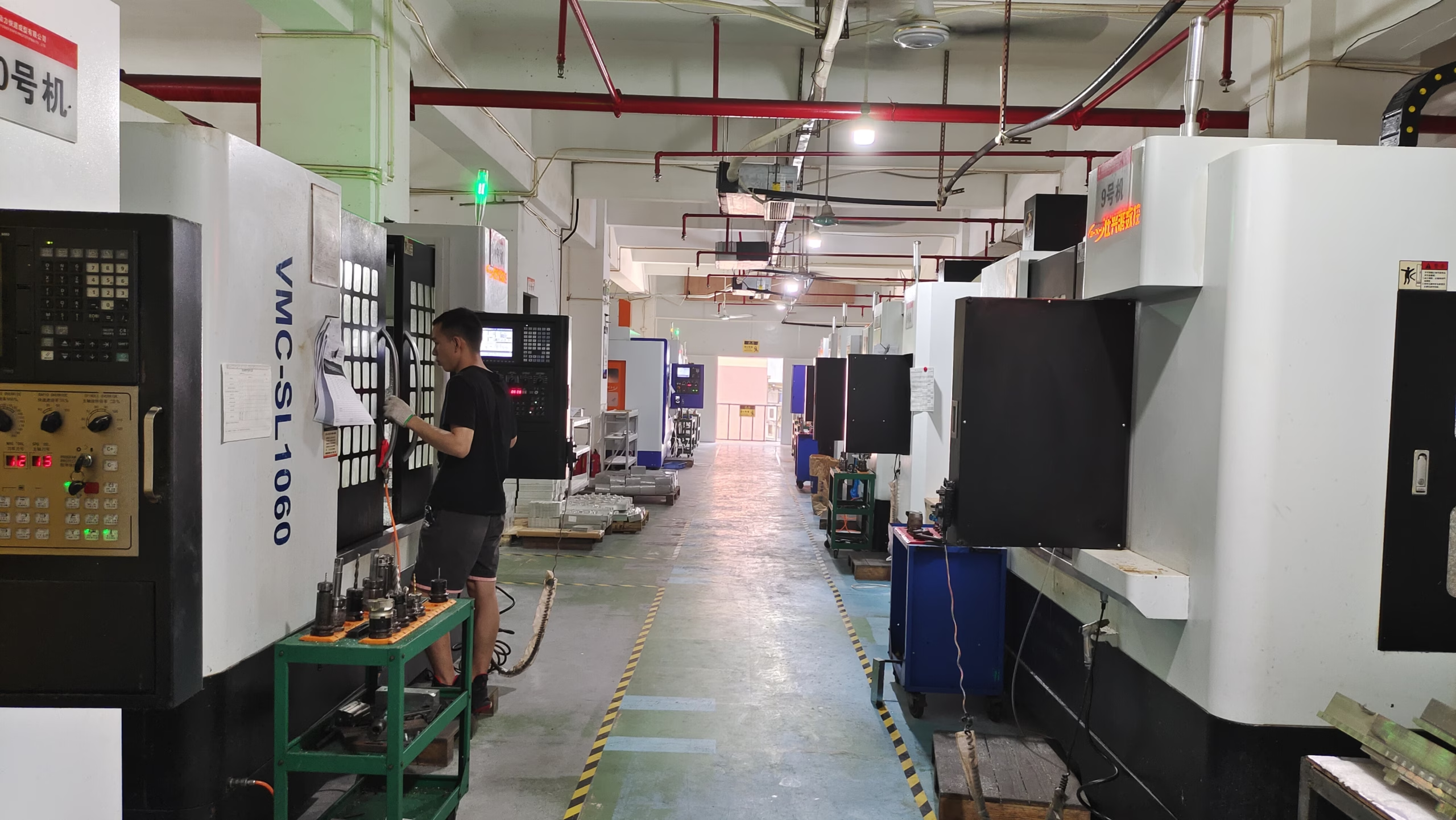
You might have noticed that these five ways are not mutually exclusive. They often overlap. Rapid iteration leads to complex geometries, which enable mass customization, which demands material innovation, which then simplifies supply chains. To truly capitalize on these synergies, you need a manufacturing partner who understands both additive and subtractive processes. GreatLight Metal Tech Co., LTD. has spent over a decade refining our expertise in both arenas. Our five-axis CNC machining centers are world-class, but we’ve also invested heavily in a 3D printing department that includes SLM, SLA, and SLS machines. This dual capability allows us to be objective in recommending the right process for each part, rather than pushing you toward a single technology because it’s all we have.
When you compare us to other service providers like Protolabs, Xometry, or Fictiv, you’ll find that many of them offer 3D printing and CNC machining as well. However, GreatLight differentiates itself with a truly integrated approach under one roof. We own three manufacturing plants, covering 76,000 square feet, and we don’t outsource your parts to a network of unknown subcontractors. This gives us tighter control over quality, lead times, and communication. Our engineers speak fluent “design” and “manufacturing,” and they can provide real-time feedback on your DFM whether you’re printing in nylon, machining in aluminum, or combining both.
Moreover, we’re not a siloed factory. We have internal testing capabilities, including CMM, OGP, and surface roughness testers, to ensure that every part—printed or machined—meets your intended specifications. We’re certified ISO 9001:2015, and we operate with the rigor that the automotive, medical, and aerospace industries demand, even though we often serve consumer goods brands. That level of discipline might seem overkill for a toaster knob, but it’s exactly what prevents embarrassing product failures and costly recalls.
Bridging the Gap: When to Choose 3D Printing vs. CNC Machining
A common question we get from consumer goods engineers is: “Should I use 3D printing or CNC machining for my parts?” The honest answer is: it depends. The table below summarizes the key decision factors.
| Factor | 3D Printing (SLA/SLS/SLM) | CNC Machining |
|---|---|---|
| Ideal Volume | 1-1,000 parts, especially low volume | 1-100,000+ parts, especially high volume |
| Geometric Complexity | High (lattices, channels, undercuts) | Moderate (needs tool access) |
| Materials | Plastics (nylon, resin) & some metals | Broad range (aluminum, steel, POM, PEEK) |
| Tolerances | Practical: ±0.1 mm (metal ±0.05 mm) | High: ±0.005 mm achievable |
| Surface Finish | Requires post-processing for smoothness | Good as-machined finish, can be polished |
| Speed for low volume | Fast (same day to few days) | Slower due to setup, but fast per part |
| Unit Cost at scale | Flat, not volume-efficient | Declines significantly with volume |
As you can see, there’s a huge overlap for low-volume runs. A common winning strategy is to use 3D printing for the initial design validation and medium-volume pilot production, then transition to CNC machining for higher volumes where tighter tolerances and lower per-unit costs become necessary. GreatLight excels at managing this transition because we offer both technologies in-house, and we can shift production smoothly without transferring files to a different vendor.
For consumer goods like a premium mechanical pencil, the barrel might be ideally turned on a CNC lathe for a smooth, metallic feel, while the clip—which needs a complex spring-like geometry—might be 3D printed in a flexible material. This combination leverages the best of both worlds. Our engineers are experts at these hybrid designs, and we’ve successfully delivered many such projects where we print a component, machine another, and then assemble them into a finished product.
The GreatLight Advantage: More Than Just a 3D Printing Service
Choosing a manufacturing partner is a strategic decision. When you work with GreatLight, you get more than just a purchase order fulfillment. You get a team that understands the entire lifecycle of consumer goods design. We start by reviewing your CAD files and offering a manufacturability analysis. We identify potential issues with wall thickness, support structures, and tolerances. We suggest alternative materials if your specified resin isn’t ideal for the application. We don’t just quote your parts; we help you make them better.
Our combined capabilities include:
SLM 3D Printing: For robust, end-use metal parts in aluminum, steel, or titanium, primarily for functional components.
SLA 3D Printing: For high-resolution, smooth-surface parts with small features, suitable for visual prototypes and fine details.
SLS 3D Printing: For durable nylon parts with good mechanical properties, often used in snap-fit assemblies.
Precision CNC Machining: Our core business since 2011, with 3-axis, 4-axis, and 5-axis centers capable of tolerances down to ±0.001 mm.
Post-Processing: A one-stop service including heat treatment, anodizing, electroplating, painting, and assembly.
We are not the cheapest option in the market, and we don’t try to be. What we offer is predictability. Our ISO-certified processes, advanced equipment, and experienced engineers reduce your risk of discovering defects late in the game. We deliver what we promise, and we back it up with a quality guarantee—if there’s an issue due to our workmanship, we rework or refund. That’s the trust we’ve built with clients ranging from humanoid robot developers to automotive OEMs.
In an industry where many “3D printing services” are just cloud-based brokers who outsource to random shops, GreatLight stands out as a real, hands-on manufacturer. When you send us a file, you know exactly which machine it will run on, which engineer will oversee it, and what quality checks it will pass. This visibility is invaluable.
Putting it Together: The Future of Consumer Goods Design
As we look ahead, the line between 3D printing and traditional manufacturing will continue to blur. New materials with enhanced properties are entering the market every month. Multi-material printing is advancing rapidly. Automated post-processing systems are becoming more common. At GreatLight, we invest continuously in upgrading our equipment and training our staff. We recently expanded our 3D printing capacity to meet the growing demand from consumers who want personalized, high-quality products delivered faster than ever before.
The five ways we’ve discussed are not just trends; they are the new pillars of innovative consumer goods design. Designers who embrace them will redefine what’s possible. Engineers who exploit them will create products that are lighter, stronger, and more beautiful. Brands that adopt them will capture market share by delighting customers with personalized and sustainable goods.
But embracing these methods requires a manufacturing partner who is equally forward-thinking. A partner who can handle the complexity of a topology-optimized bracket, but also machine a threaded hole that fits perfectly. A partner who can print a custom-fit earbud tip in biocompatible resin, but also CNC-turn a metal housing to a mirror finish. That partner exists: it’s GreatLight Metal Tech Co., LTD.
Conclusion: Embrace the Transformation
In summary, 5 Ways 3D Printing Transforms Consumer Goods Design is a roadmap for any company aiming to innovate in today’s fast-paced market. From accelerating iteration cycles, unlocking complex geometries, enabling mass customization, pushing material boundaries, and streamlining supply chains, 3D printing is not merely an alternative manufacturing process—it is a strategic weapon. The companies that succeed will not be those who buy a printer, but those who integrate additive thinking into their product development culture. And to do that, you need a reliable partner who can guide you through the technical complexities and production realities.
At GreatLight, we are proud to be at the forefront of this transformation. Our history began with precision machining, but we’ve evolved into a comprehensive manufacturing solution provider. We invite you to bring us your most challenging consumer product idea, the one that seems impossible to make. Let us show you how the combination of our additive and subtractive capabilities can turn that impossibility into your next best-selling product. Whether you’re looking for a few custom parts for a trade show or preparing for a complex production launch, we have the expertise and the equipment to support you. After all, the future of manufacturing isn’t just about making better parts—it’s about making better products and better experiences. And that’s precisely why we embrace the power of 3D printing in consumer goods design. For any brand ready to take that leap, consider how a partnership with an experienced global manufacturer like GreatLight{:target=”_blank”} can elevate your project from concept to market with confidence.



















