
5 axis machining center: how accuracy is actually held
This page explains how a 5 axis machining center holds accuracy, where the two rotary axes help, and which parts genuinely need it. It is written for design engineers and sourcing engineers who have to choose between 3-axis, 4-axis and full 5-axis work before a drawing goes out for quote.
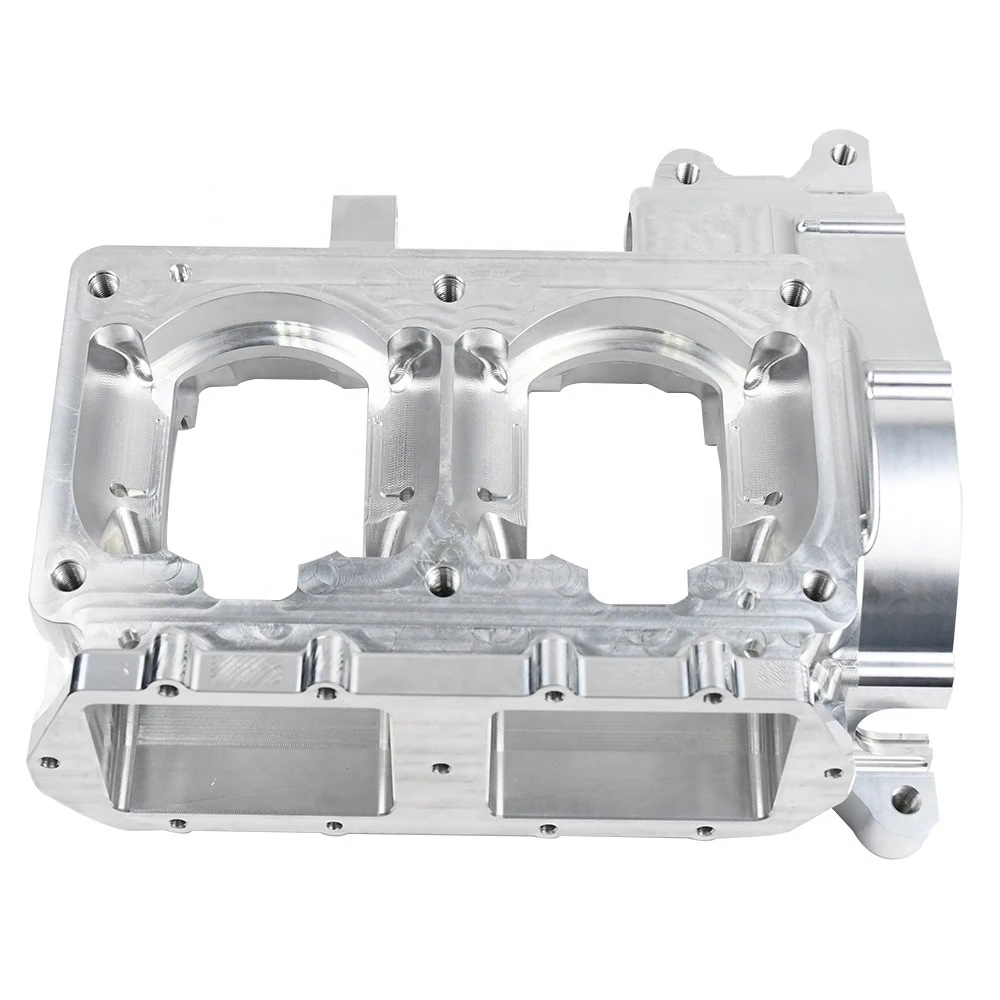
What this page covers
A 5 axis machining center is a CNC machine that moves the tool or the workpiece across three linear axes and two rotary axes at the same time. What that arrangement does for accuracy, and where it does nothing at all, is worth spelling out.
What a 5 axis machining center actually is
A 5 axis machining center carries three linear axes, X, Y and Z, plus two rotary axes. Those rotary axes are usually A and B, or A and C, depending on how the spindle and the table are built. The machine can position all five at once, so the cutting tool approaches the workpiece from an angle instead of only from the top.
Simultaneous motion is the difference between indexed 3+2 positioning and true 5-axis contouring. On indexed work the table tilts to a new orientation and locks, then the cut runs in three axes. On simultaneous work the rotary axes move while the tool is in the material, which is what allows a continuous curved surface to come off in one pass.
The configuration matters more than the label. A trunnion machine with a tilting rotary table suits parts that fit inside the swing. A swivel-head machine keeps heavy parts flat on the table and swings the spindle instead, which helps when the workpiece weighs more than the table can index quickly.
GreatLight runs 16 simultaneous 5-axis machining centers alongside 12 four-axis mills and 27 three-axis machines. The rotary tables on the compact and medium platforms are Ø400 mm, and the largest platform reaches a 4,000 mm processing envelope. Machine choice follows part geometry, not the other way around.
Where the accuracy gain comes from
The accuracy advantage of a 5 axis machining center is mostly about setups, not about the axes themselves. Every time a part is unclamped and turned to reach a new face, the operator introduces a small repositioning error. Holding five faces in one setup removes those errors from the stack.
On a bracket that needs four faces machined, a 3-axis route may need three or four setups, each with its own datum re-establishment. Fixture wear, chip packing under a locator, and clamping distortion all creep in. Run the same part on a 5-axis machine and the datums stay where they were set.
Thermal behavior sets the floor. Spindle growth, ballscrew expansion and rotary table heat all move the tool relative to the part over a long cut. We hold ±0.005 mm (±0.0002 in) on features that suit the process, and we inspect 100% of parts before shipment rather than sampling. Surface finish lands between Ra 0.2–0.8 μm on a fine finish and Ra 1.6–3.2 μm as machined.
Short tools help too. Because the head can tilt, a 5-axis machine reaches a deep pocket wall with a stubby tool instead of a long slender one. Less tool deflection means a straighter wall and a more predictable size.
Choosing the axis count for the part
Use this as a first filter before requesting a quote.
| Part feature | 3-axis | 5-axis |
|---|---|---|
| Prismatic plate, one face | Good fit | Overkill |
| Four faces, tight true position | Extra setups needed | One setup |
| Deep pocket with drafted walls | Long tool, deflection risk | Short tool, tilted head |
| Impeller or turbine blade | Not practical | Contouring required |
| Ø400 mm round flange, bolt circle | Rotary table helps | Indexed 3+2 works |
| 4,000 mm long extrusion | Limited travel | Large platform available |
How the five axes work together
The controller keeps the tool tip on the programmed path while the rotary axes turn. That is the whole trick. If the table tilts 30° and the tool tip is supposed to stay on a curve, the linear axes have to compensate continuously, and they have to do it fast enough that the feed rate stays constant through the move.
Post-processor quality decides whether the machine can use its own accuracy. A CAM toolpath that looks correct on screen can produce a faceted surface if the post does not output the rotary moves in the right format, or if the machine does not support the rotary feed mode the post assumes. We verify the post against the machine before a first article runs.
Tool length and gauge line offsets are checked at the start of a run. A rotary axis amplifies a wrong offset because the error swings with the table, so a 0.02 mm offset mistake on a tilted face can read as a much larger position error once the part is measured flat.
In-process probing catches drift on long runs. For a 10,000+ part order we can probe a datum between operations and let the controller shift the work offset, which keeps the first part and the last part in the same place.
Materials and finishes that suit 5-axis work
Aluminium is the easy case. Grades such as 6061-T6, 7075 and 6082 cut fast, hold size well, and take a fine finish without much fuss. Thin ribs on an aluminium housing are where a tilted head pays off, since the tool can approach the rib wall at an angle and keep the radial load low.
Stainless and titanium change the picture. 17-4PH, 316L and Ti-6Al-4V push cutting temperatures up and tool life down, so the cycle has to be planned around heat rather than around axis count. Inconel is worse still. On these materials the 5-axis advantage is fewer setups, not faster removal.
Copper and beryllium copper appear in RF housings and electrode work. They cut cleanly but move with temperature, so a warm part measured straight off the table can read undersize once it cools. Plastics such as PEEK and POM are usually run on the smaller platforms where the rotary table is easier to control.
Finishing options cover anodizing in clear, colour, hardcoat and conductive grades, electroless nickel, zinc, silver and gold plating, powder coating, black oxide, bead blasting, brushing and laser marking with a minimum character height of 1.5 mm.
When not to use a 5 axis machining center
Quite often, a 3-axis machine is the right answer. A flat plate with holes and a single machined face does not gain anything from two rotary axes, and the hourly rate is higher. Putting that part on a 5-axis machine adds cost without adding capability.
A 4-axis mill covers a large middle ground. If the part needs work on three or four sides around one axis of rotation, a horizontal or a 4-axis vertical with an indexer does the job with a simpler setup and a shorter program.
Five axes also struggle with parts that are very long and very thin. A 4,000 mm extrusion can be machined on our large platform, but the limiting factor becomes how the part is supported, not how many axes are available.
The honest test is this: count the faces that need machining, count how many of them are at an angle to each other, and check whether a single datum can survive to the last cut. If the answer is one face, keep it on 3-axis.
From drawing to first article
Quotation and a DFM analysis come back within 12 hours, and production can start within 24 hours of a released order. We run no minimum order quantity, so a single prototype and a 10,000+ part run go through the same setup discipline.
The DFM step is where most accuracy problems get caught. If a wall is too thin to hold without a support, or a hole sits on a face the tool cannot reach at the programmed angle, that is cheaper to fix in the model than on the machine.
Inspection covers a raw material check, in-process monitoring and a final inspection, with reports on request. Certifications held are ISO 9001:2015, IATF 16949:2016, ISO 13485:2016 and ISO 27001:2022. Uploads stay confidential and an NDA is available on request.
Parts typically ship in 3–5 days, and the historical late-delivery probability sits below 2%.
Questions engineers ask
Does a 5 axis machining center always hold tighter tolerance than a 3-axis machine?
No. The machine itself is not automatically more accurate. The gain comes from cutting more faces in one setup, which removes repositioning error.
If a part only needs one face machined, a well-maintained 3-axis machine can hold the same tolerance at a lower cost.
Is simultaneous 5-axis motion always better than indexed 3+2?
No. Indexed 3+2 is stiffer because the rotary axes lock before the cut, and it is easier to program and verify.
Simultaneous motion is needed when the surface is curved and the tool has to stay tangent to it, such as an impeller or a blade.
What part size fits your 5-axis platforms?
We run several envelopes. The compact platforms are 500 × 500 × 450 mm and 500 × 310 × 200 mm. The medium platforms are 750 × 1,150 × 550 mm and 600 × 600 × 600 mm.
The largest reaches 4,000 × 400 × 150 mm, and the rotary table on the standard platforms is Ø400 mm.
Which materials can be run on a 5 axis machining center?
Aluminium grades including 6061, 7075 and 6082; stainless such as 303, 316L and 17-4PH; steels including 1045, 4140 and 4340; copper and brass; titanium TA2 and TC4; Inconel; magnesium; and plastics including PEEK, POM and PC.
Material choice affects feeds, tool life and heat management more than it affects the axis count.
How do you verify a tilted face is in the right place?
We check tool length and gauge line offsets before the run, and we can probe a datum between operations on longer orders.
Final inspection happens before shipment, and dimensional reports are available on request.
Can you handle a single prototype on a 5-axis machine?
Yes. There is no minimum order quantity, so one prototype and a 10,000+ part run both go through quoting, DFM and first-article checks.
A one-piece job still gets the same setup verification as a production run.
Send the drawing and get a process answer
Tell us the faces that need machining and the tolerance that matters. We will come back with a quote and a DFM note within 12 hours.
12-hour quote100% inspectionNo minimum order quantity









