
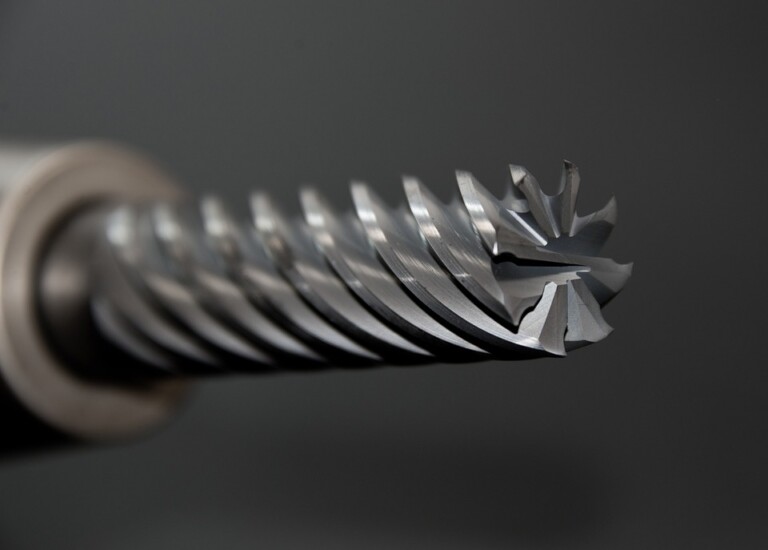
Master complexity: the transformative capability of 5-axis CNC milling
Innovative ruthless drives in manufacturing require machining solutions that can translate complex designs into flawless functional reality. This is 5-axis CNC milling Go beyond traditional machining capabilities and become the gold standard for precision, efficiency and complex parts production.
Unlike traditional 3-axis machines, limited to moving the cutting tool along a straight line (X, Y, Z), 5-axis CNC machining introduces two additional axes of rotation (usually A and B/C). Consider in this way: While 3-axis machining is indicated from the north, south, east and west, 5-axis machining increases the ability to actually get close to the workpiece Any angle Above it – like a tool head with infinite positions.
How it works: Engineering accuracy
- The axis explains: Next to linear X (left and right), Y (front and back) and Z (upper and down) movements, the two rotation axes allow tilting and rotating the tool and/or workpiece:
- A-axis: Rotate about the X-axis.
- B-axis: Rotate about the y-axis.
- (Sometimes use C axis, rotate around Z, with tilt and in.
- Machine configuration:
- desktop: Both rotation axes are on the worksheet.
- Head: Both rotation axes are on the spindle head.
- Desktop (most common): A rotation axis on the table and a rotation axis on the head. This provides great flexibility.
- At the same time with index: True 5 axis at the same time The machining enables all five axes to move continuously during the cutting process, enabling smooth complex contours and undercuts in a single setup. index The 5-axis positioning workpiece is best suited for 3-axis operation at different angles.
Why 5-axis machining is a technical leap:
- Unparalleled complexity: Machine organic shapes, contoured surfaces, deep cavity, undercuts, intricate details and thin walls – geometric shapes are impossible, or geometric with fewer axes or too expensive.
- Highest precision and finish: Maintain optimal tool orientation to minimize tool deflection, vibration and scallops on the workpiece surface. result? Nearly perfect accuracy, the upper surface is instantly completed on the machine and reduces hand-finished finishes.
- Rapid process efficiency: One setting, not multiple re-fixes. This will reduce the setup time, eliminate cumulative positioning errors, reduce waste of materials, and greatly speed up the production cycle.
- Enhanced tool life and performance: With the correct positioning tool, short and rigid tools can be used effectively, allowing for better access to coolant, higher feed rates and less tool wear.
- Reduce costs: While machines are a huge investment, savings in time, material efficiency, reduced complexity of fixtures, reduced labor costs, and final part quality often lead to lower Total cost per part For complex projects.
5-axis dominant – Real-world applications:
- Aerospace and Defense: Lightweight structural components, turbine blades and discs, engine housing, complex wings, satellite parts (materials usually include titanium, inconel, high-strength aluminum).
- Medical Implants and Equipment: Patient-specific implants (knee, hip, cranial plate), complex surgical instruments, diagnostic equipment components (biocompatible titanium, stainless steel, PEEK).
- Cars and Motorsports: Lightweight components, complex structural parts, cylinder head, intake manifold, custom suspension components, prototype molds.
- vitality: The precise components of turbines (gas, wind), complex manifolds, valve bodies, heat exchangers.
- Industrial automation: Exquisite fixtures, fixtures and robotic final results require extremely high accuracy.
- Molds and Molds: High precision molds for injection molding, pressure casting and composite materials with complex cooling channels.
Why choose Greatlime for 5-axis CNC machining requirements?
At Greatlight, we not only provide 5-axis machining; we work precisely on life and breathing. We are committed to solving your most challenging metal parts manufacturing problems:
- Advanced Equipment Technology: Our state-of-the-art 5-axis CNC machining center features cutting-edge control system with stiffness, speed and tolerances up to ±0.0005" (0.0127mm) or tighter.
- Deep expertise: Our experienced engineers have mastery in programming complex tool paths, optimizing workflows, selecting the ideal tools and controlling thermal effects to deliver excellent results on the most demanding geometry and materials.
- A true one-stop solution: In addition to processing, Greatlight offers comprehensive post-treatment under one roof – precision grinding, heat treatment, anodizing, electroplating, painting, lacquering, electropolishing, assembly, and more. Easily simplify your supply chain.
- Matter agnosticism: We skillfully refuel the huge material portfolio: aluminum alloy, stainless steel (303, 304, 316, 17-4ph, etc.), titanium (grades 1-5, 6AL4V grade), Inconel, Hastelloy, Hastelloy, Copper Alloys, tool steel, tool steel and engineering plastics.
- Market speed and cost efficiency: We quickly deliver customized precision parts without damaging quality by leveraging the inherent efficiency of a simplified 5-axis process and optimized workflow. We are committed to providing Best Value – Competitive prices supported by uncompromising standards.
- Habits are standard: No work is too complicated. From a single prototype to a complete production run, our focus is on providing tailor-made solutions for your unique needs.
Conclusion: Embrace the future of precision manufacturing
5-axis CNC milling is not only a machining process; it is a paradigm shift that achieves unprecedented design freedom, manufacturing efficiency and partial performance. As industry requirements become increasingly complex, lightweight and high-performance components, mastering this technology is not only advantageous, but also essential.
Greglight is at the forefront of this revolution. We combine the original capabilities of advanced 5-axis machines with deep technical expertise and commitment to comprehensive service. Whether you are developing the most advanced aerospace hardware, life-saving medical devices, or pushing the boundaries of automotive performance, delegate your most critical precision machining components to Greatphield-complexity conforms to mastery. Customize your precision parts now and experience the Greatlime difference.
Frequently Asked Questions about 5-axis CNC machining (FAQ)
Q1: Is 5-axis machining always better than 3-axis?
one: For tight tolerances, multiple settings or complex functions such as undercut, the quality, speed and cost of 5 axes are significantly better than For that particular part. For simpler prismatic parts, 3-axis is still effective and cost-effective. Greglight can provide the best process for your project.
Q2: How fast is 5-axis machining compared to other methods?
one: Although individual speeds vary, the principle advantage is Throughput per section. By greatly reducing the setup (usually only one) and minimizing processing time, the total production time for complex parts is often much faster. With a simplified 5-axis process, complexity that can take several days can be accomplished in a matter of hours.
Q3: Are 5-axis machining parts more expensive?
one: Machine investment and programming are more complex. However, when decomposition reduces labor (setup), less fixture, reduces waste, minimal secondary operations and faster overall delivery time, Total cost per part For complex components, using 5-axis machining is usually lower. Greatligh’s focus is to leverage these efficiencies to provide good value.
Question 4: What tolerances can be achieved in 5-axis machining?
one: We often have ±0.0005" (0.0127mm) Or higher-level 5-axis equipment that is tighter depending on the part size, complexity and material functions. Our experience and process control ensure consistent accuracy.
Q5: Can Greatlight handle prototypes and production with 5-axis?
one: Absolutely! Our flexible manufacturing methods are ideal for low-capacity, rapid prototyping, for design verification and mass production. The single setting of 5-axis is ideal for fast tracking prototypes and seamless scaling to production.
Q6: Which file formats do you accept for 5-axis programming?
one: We accept all standard CAD formats including steps, IGES, Parasolid, SLDPRT and native files from major CAD platforms (SolidWorks, Catia, NX, Creo). Our expert engineers handle complex CAM programming.
Question 7: Do you provide designs with manufacturability (DFM) feedback?
one: Yes! Early cooperation is key. Our engineering team conducts proactive DFM analysis of your 5-axis part design to optimize manufacturing, reduce costs and ensure optimal results. We help design real manufacturing advantages.
Question 8: Which materials are most suitable for 5-axis processing?
one: While 5-axis is challenging metals such as titanium, inconel and hardened steel because of its ability to effectively use shorter tools, it handles almost any processable material – aluminum alloy, stainless steel, plastic, plastic, copper, copper, brass, you can name it. Greatlight selects the best materials based on your application and feature requirements.



















