
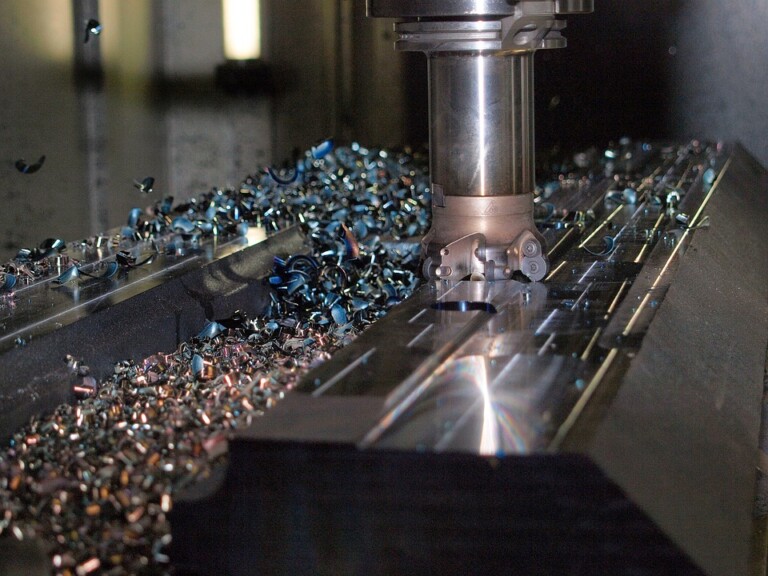
Unlocking Accuracy: Your Final Guide to 4-axis CNC Milling
In the ever-evolving manufacturing world, 4-axis CNC milling It is the bridge between the basic 3-axis function and the advanced versatility of the 5-axis system. For engineers, designers and manufacturers, mastering this technology unlocks new dimensions of efficiency, complexity, and cost savings. This guide delves into the mechanisms, advantages and strategic applications of 4-axis CNC milling, allowing you to leverage its full potential.
What is 4-axis CNC milling?
4-axis CNC mill runs along three linear axes (x, y, z) and adds one Fourth axis of rotation (usually A-axis), rotates the workpiece about the X-axis. This rotation allows the cutting tool to approach the part from multiple angles without manual repositioning. Unlike a 3-axis machine, it requires frequent fixed changes to complex geometry, and a 4-axis system can continuously process curves, undercuts and multilateral functions in a single setup.
Key Advantages of 4-axis machining
Improve efficiency:
- Eliminates 90% of manual repositioning, reduces setup time and accelerates production.
- Ideal for large batches when consistency and speed are critical.
Priority accuracy:
- Reduced part handling minimizes human errors and improves dimensional accuracy, especially for cylindrical or asymmetric designs.
Complex geometric shapes make it simple:
- A machine spiral path, radial hole and 3D profile in operation. Think of aerospace turbine blades, automotive cams or medical prosthetics.
- Save costs:
- Less setup means lower labor costs, less material waste and faster time to market.
Transformative applications across industries
- aerospace: Engine mount, actuator housing and pipe with complex internal channels.
- car: Transmission components, cylinder heads and custom brackets require multi-angle machining.
- Medical: Bone implants and surgical tools with biocompatible materials (e.g., titanium, peep).
- Consumer Electronics: Radiator and ergonomic housing with seamless curves.
Why choose Greatlime for 4-axis CNC project?
exist Greatwe have lifted 4-axis machining beyond the conventional limit. As a leader Five-axis CNC manufacturingour expertise ensures the perfect execution of your most demanding projects:
- Advanced technology: Our seminar house’s highest room and 5-axis CNC mill, equipped with real-time tools and high-speed spindles with tolerances of ±0.01mm.
- Material mastery: Craft stainless steel, aluminum, brass, titanium, engineering plastics and appearances such as Inconel (including Inconel) – all under one roof.
- End-to-end solution: From prototype to post-treatment (anodization, powder coating, assembly), we process every detail to provide ready-made parts.
- No compromise on speed: Use our agile workflow for quick custom machining – 80% of quotes completed in 24 hours.
Whether you need prototypes or full-scale production, Greatlight’s precisely driven approach ensures quality, affordability, and on-time delivery.
Conclusion: The strategic edge of 4-axis machining
4-axis CNC milling is not just a technical upgrade. It’s one The necessity of competition Used for modern manufacturing. It bridges the gap between simplicity and complexity by enabling complex designs, reducing operational costs and ensuring repeatable accuracy. Working with experts like Greatlight ensures you make the most of this technology – turning concepts into high-performance components with unparalleled precision.
Ready to innovate? Contact Greatlight today for a custom quote and experience redefine precise machining.
FAQ: Mystery Veil 4-axis CNC Milling
Q1: What is the difference between 4-axis and 3-axis CNC milling?
Answer: The 3-axis machine moves linearly (X/Y/Z), limiting it to unilateral processing. The 4-axis increases rotational motion, thereby rotating the workpiece, simplifying multi-angle cutting without re-climbing.
Q2: When should I use 4-axis instead of 5-axis machining?
Answer: Choose 4 axes or "Radial Symmetry" Parts (e.g., camshaft, flange). Select 5 axes for super-complex geometry (e.g., impeller, aviation blade) that requires multiple directions to be cut simultaneously.
Q3: Which materials can be used to strengthen the process with 4-axis CNC?
A: Almost all metals (aluminum, steel, titanium), plastics (ABS, PEEK) and composites. We specialize in challenging materials such as hard alloys or superalloys.
Question 4: How to ensure quality in complex 4-axis projects?
A: Our ISO certified workflow combines precise tools, real-time monitoring and post-phone CMM inspection to ensure micron-level accuracy.
Question 5: Is the prototype 4-axis service cost-effective?
Answer: Absolutely! Fewer settings reduce labor costs. Greatlight offers scalable pricing – ideal for validating prototypes before mass production.
Q6: Which file format do you accept?
A: We use steps, IGES, SOLIDWORKS and other industry standard CAD formats.
Question 7: Can Greatlight assist in design optimization?
A: Yes. Our engineering team provides free designs for manufacturability (DFM) feedback to improve partial viability and reduce costs.
Improve manufacturing with Greatlime – Innovation meets precision. Request a quote or call +xxx-xxxx-xxxx-xxxx to discuss your project!



















