
5 Axis CNC: Complex Machining Explained
This page explains how 5 axis CNC complex machining actually works, what it can and cannot hold, and how to tell whether your part needs it. Written for design engineers and sourcing engineers who have to quote, tolerance and inspect the result. By the end you should be able to read a part print and decide between 3 axis and 5 axis.
What this page covers
Rotary axes, tool vectors, CAM strategy, tolerances, and the parts that are cheaper on 3 axis.
What 5 axis CNC actually adds to a 3 axis machine
A 3 axis mill moves the tool in X, Y and Z. The workpiece stays fixed to the table. That is enough for a large share of prismatic parts: plates, housings, brackets. Add two rotary axes and the tool can tilt and spin around the part while it cuts. Five faces become reachable in one setup, and the sixth needs only a flip.
The two extra axes are usually named A, B or C. A trunnion machine tilts the table on one axis and rotates it on another. A swivel-head machine keeps the table flat and moves the spindle instead. Both are called 5 axis, but they behave differently when you talk about part size, rigidity and reach.
Simultaneous motion is the part that matters for 5 axis CNC complex work. All five axes move at the same time, so the tool tip follows a curved path instead of stopping and indexing between orientations. Indexed 3+2 machining is easier to program and more rigid, but it cannot cut a true ruled surface in one pass.
How the rotary axes, tool vector and CAM work together
The CAM system reads your 3D CAD model and generates a tool path as a series of tool tip positions plus a tool axis vector for each point. The post-processor converts that into machine coordinates for X, Y, Z, A and B. If the post is wrong, the machine will cut the right shape in the wrong place.
Tool length matters more here than on a 3 axis job. A long tool reaches deep pockets but deflects. On a tilted surface the deflection pushes sideways, not straight up, so the error shows up as a taper or a witness mark. Keep the tool as short as the geometry allows, and rough with a stubby tool before finishing with a long one.
Collision checking runs on the whole assembly: holder, tool, fixture, table and part. A 5 axis path that looks clean in the CAM window can still hit the trunnion when the table tilts. We simulate the full machine model before the first cut, which is why a new complex part usually needs a prove-out pass on the machine.
- 1Post-processorMust match the exact machine kinematics, or every tilted cut drifts.
- 2Tool vectorControls the angle of attack; small changes shift the contact point on the surface.
- 3Stock modelAccurate rest material avoids air cuts and reduces cycle time.
- 4Prove-outFirst article is checked before the run continues.
Which parts belong on 5 axis and which do not
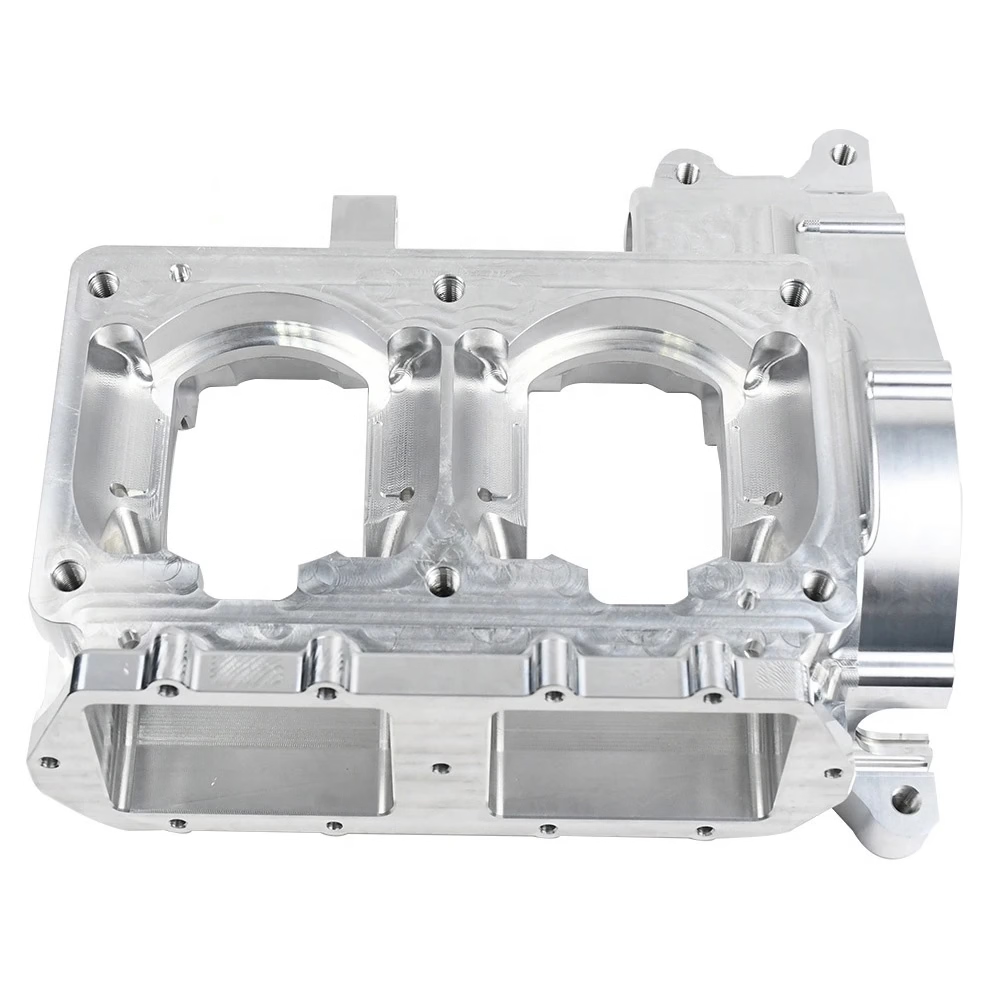
Good candidates share a few traits: features on several faces, undercuts or deep cavities, contoured surfaces that must blend, or a tolerance stack that breaks if the part is re-fixtured four times. Aerospace brackets, impellers, medical instrument bodies and EV motor housings are typical. So are parts where one datum must survive every operation.
Simple prismatic parts do not belong here. A plate with holes on two faces is faster and cheaper on a 3 axis mill with a vise and a stop. A part that needs only a chamfer on a curved edge can often be done on a 3 axis machine with a ball tool and a tilting fixture.
The real cost driver is not the machine hour rate. It is setup count, fixture cost and scrap risk. Removing three setups can beat the hourly premium, especially at medium volume. That is the trade to run when you compare quotes.
3 axis vs 3+2 indexed vs simultaneous 5 axis
Pick the lowest capability that still holds the print.
| Method | Best for | Typical limit | Setup count |
|---|---|---|---|
| 3 axis | Plates, pockets, flat faces | One face per setup | 2–4 |
| 3+2 indexed | Angled holes, five-face access | No continuous contoured cut | 1–2 |
| Simultaneous 5 axis | Impellers, contoured blends, undercuts | Needs CAM prove-out | 1 |
| Mill-turn | Shafts with cross features | Bar stock size limits | 1 |
Tolerances, surface finish and inspection on complex parts
Rotary axes add stack-up. Each axis has its own positioning error, and they combine with thermal drift over a long cycle. We hold ±0.005 mm (±0.0002 in) on critical features, but that number assumes the part is not hanging 300 mm off the table center. Reach and mass both move the error.
Surface finish follows the tool path. A scallop height of a few microns gives Ra 0.2–0.8 μm on aluminum; a rougher stepover lands at Ra 1.6–3.2 μm. If a print calls for a fine finish on a contoured face, the CAM stepover, not the spindle speed, is the first thing to change.
Inspection is where complex parts get expensive. A CMM needs a datum scheme that matches the machining setup, or the numbers will not agree with the print. We check 100% of parts before shipment and can supply reports on request. For first articles, dimension the critical features and leave the rest to the general tolerance block.
Common questions about 5 axis CNC complex work
Does 5 axis always cost more than 3 axis?
Not always. The hourly rate is higher, but fewer setups, less fixturing and lower scrap can offset it.
For parts with features on four or more faces, 5 axis often comes in lower at medium and high volume. For a simple plate, 3 axis wins.
What part size can you handle?
Our largest 5 axis travel is 4,000 × 400 × 150 mm. Other centers run 750 × 1,150 × 550 mm, 600 × 600 × 600 mm and smaller.
A Ø400 mm rotary table covers most round and trunnion work. Parts larger than the table envelope need a different setup plan.
Can you hold ±0.005 mm on a contoured surface?
Yes, on features within reasonable reach of the rotary center and with a rigid setup. The tolerance applies to the machined feature, not to the raw stock.
Deep cavities cut with a long tool will open up. We flag those features during DFM review so you can adjust the print or accept a wider band.
What materials do you run on 5 axis?
Aluminum 6061, 7075 and 2024, stainless 304, 316L and 17-4PH, steels 4130, 4140 and 4340, titanium Ti-6Al-4V, Inconel, copper and brass alloys.
Plastics such as POM, PEEK and PC also run on the same centers with different feeds and coolant.
How does the quoting process work?
Send the 3D model and 2D print. We return a quotation and a free DFM analysis within 12 hours. No minimum order quantity, from one prototype to 10,000+ parts.
Uploads stay confidential and we can sign an NDA on request.
Do you program from our model or redraw the part?
We program from your STEP or native CAD file. If the model and the print disagree, we ask before cutting.
Redrawing is only done when the model is unusable, and any change is confirmed with you first.
Send a complex part and get a real answer
Upload your model and print. We return a quote with DFM notes within 12 hours, and parts ship in 3–5 days once production starts.
12-hour quoteFree DFM analysis±0.005 mm100% inspection









