
3D Printing Suppressor Legality for Engineers and Buyers
This page explains how US law treats 3D printed suppressor parts, where the line sits between prototyping and manufacturing, and which questions to settle before a drawing reaches a machine. It is written for design engineers, product managers and sourcing teams who need a clear read on risk.
What this page covers
Law first, then process. The two are hard to separate on this topic.
What the NFA actually regulates
In the United States, a device designed to reduce the report of a firearm is regulated under the National Firearms Act. The legal term in the statute is firearm muffler or firearm silencer. The word suppressor is industry shorthand and has no separate legal meaning. If a part is designed to attach to a firearm and reduce its sound signature, it is treated as an NFA item.
That definition is functional, not material-based. A printed polymer tube with internal baffles that threads onto a barrel is legally in the same category as a machined titanium can. The production method changes nothing about the classification. Engineers sometimes assume that a non-metallic part escapes the rule. It does not.
Possession, manufacture and transfer of an NFA item each carry separate requirements. Making one without the correct registration is a federal offense, and the penalties are serious. This is why the question of 3d printing suppressor legality is not really a technology question at all. It is a question of who is allowed to make the part, and under what paperwork.
- 1Functional testDoes the part attach and reduce report? Then it is likely an NFA item.
- 2Material is irrelevantPolymer, aluminum and titanium fall under the same rule.
- 3Three separate actsMaking, possessing and transferring each carry their own requirements.
DIY printing versus licensed manufacturing
A private individual cannot lawfully print a working suppressor at home just because the file is easy to download. The relevant federal approvals apply to the person or entity, not to the file. Without the proper registration and, where required, a federal firearms license and a special occupational taxpayer status, production is unlawful regardless of how the part is made.
A licensed manufacturer operates under a different framework. The business holds the required federal licenses and registrations, keeps records, and can legally produce and transfer NFA items to authorized buyers. When we machine parts for that customer base, we work to their drawings and specifications, under their license, and we do not need to hold the item ourselves beyond the contracted scope.
There is a practical split here that engineers should understand. A prototype that never becomes a functional sound-reducing device is a mechanical part. The moment a design is intended to function as a suppressor, it enters a regulated category. Intent and function both matter, and neither is decided by the printer or the mill.
- 1License attaches to the entityNot to the design file or the machine.
- 2Record keeping is part of the buildLicensed shops document material, quantity and serialization.
- 3Intent is a legal factA part built to reduce report is treated as such.
Why metal printing is not a shortcut around the rules
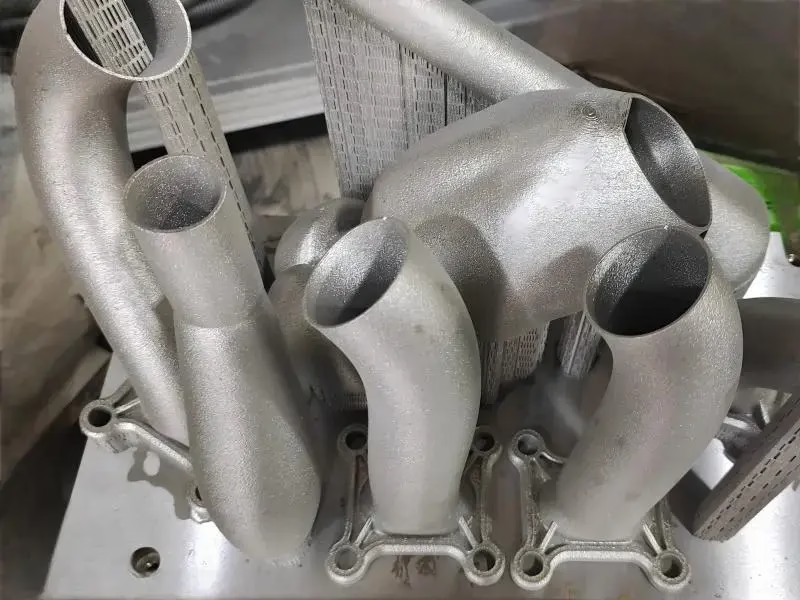
Metal additive processes such as laser powder bed fusion can produce thin-walled, internally baffled geometry that is difficult to reach with a cutter. That capability is real, and it is why some licensed manufacturers evaluate printed components. But the legal status of the finished item is identical to a machined one. A better process does not lower the regulatory bar.
There is also a technical argument for keeping printed parts inside a controlled shop. Printed suppressor geometry needs post-processing: stress relief, internal surface finishing, thread cutting and inspection. Those steps are done on CNC equipment. A build that leaves the printer as a near-net shape is not a finished part, and the finishing operations are where tolerances and bore alignment are actually set.
For a licensed customer, the practical route is a hybrid. Print the complex internal geometry, then machine the thread, the mount interface and any sealing faces. We handle the machining side of that workflow, including the fixtures and inspection plans that keep concentricity in check.
- 1Printing changes geometry, not lawThe finished item is regulated the same way.
- 2Post-processing decides functionThreads, bore alignment and surface finish come off the mill.
- 3Hybrid workflowPrint the core, machine the interfaces.
Printed and machined suppressor components side by side
Typical engineering trade-offs, not legal advice.
| Factor | Metal printing (LPBF) | CNC machining |
|---|---|---|
| Internal baffle geometry | Complex, near-net, hard to reach | Requires multi-axis access |
| Wall thickness control | Limited by melt pool and support | Set by tooling and fixturing |
| Thread and mount fit | Must be machined after printing | Cut in one setup |
| Surface finish (as-built) | Rough, needs finishing | Ra 0.8–1.6 μm typical |
| Lead time | Build plus post-processing | 3–5 days after drawing release |
| Best use | Low-volume complex cores | Interfaces, mounts, production parts |
Where printed designs usually fail
The first failure mode is geometry that cannot be finished. A baffle stack with internal cavities that no tool can reach will hold onto support material and loose powder. That debris is a functional and a safety problem. If the drawing cannot be cleaned and inspected, it should not go to production.
The second is thread and mount accuracy. Suppressor interfaces are usually fine-pitch threads with tight concentricity to the bore. Printing these features to final size rarely holds tolerance. The workable approach is to print undersize and cut the thread on a lathe or mill, then verify with a gauge. We hold ±0.005 mm on critical diameters when the setup allows it.
The third is material choice. Polymer and some printed alloys do not tolerate the pressure and heat of repeated use. Engineers sometimes specify a material because it prints easily, not because it suits the load case. That decision belongs with the pressure and thermal analysis, not with the printer's material list.
The fourth is documentation. A licensed manufacturer needs traceable material lots, process records and serialization. A print farm with no material certificates cannot support that requirement, and the gap surfaces during an audit or a transfer.
- 1Trapped support and powderIf it cannot be cleaned, it cannot be inspected.
- 2Printed threadsPrint undersize, cut to size, gauge the result.
- 3Material by load casePressure and heat drive the choice, not printability.
- 4TraceabilityMaterial lots and process records are part of the deliverable.
Questions to settle before a drawing goes to a machine
Before any work starts, the customer should be able to state who holds the license and what the part is intended to do. If the answer is unclear, the job should stop. We ask this on regulated work because it determines whether we can accept the project at all. Our position is simple: we machine parts for licensed entities, and we decline work that has no lawful path.
The second question is documentation scope. Does the customer need material certificates, dimensional reports and inspection records? For regulated parts, the answer is usually yes. We provide inspection reports on request and inspect 100% of parts before shipment, covering incoming material, in-process checks and final verification.
The third is confidentiality. Drawings for regulated components are sensitive. Uploads are handled as confidential, and we sign an NDA on request. If your program requires a named point of contact and restricted file access, say so early so the workflow is set up correctly.
The fourth is volume and repeatability. A single prototype and a 10,000-part run need different fixtures and different process control. There is no minimum order quantity here, but the inspection plan should match the run size from the start.
- 1State the license holderNo clear answer, no project.
- 2Define the report packageCertificates, dimensional data, serialization.
- 3Set up confidentiality earlyNDA and restricted access on request.
- 4Match inspection to volumePrototype and production need different plans.
Common questions
Can I legally 3D print a suppressor at home in the US?
Not without the federal registration and licensing that apply to making an NFA item. The rule follows the device's function, not the production method, so printing does not create an exception.
A private build that is intended to reduce a firearm's report falls into the same regulated category as a commercially made unit. Penalties for unregistered manufacture are serious, and intent is part of how a case is evaluated.
Does a polymer or plastic suppressor avoid NFA rules?
No. The classification is based on what the part does, not what it is made from. A printed polymer device designed to attach to a firearm and reduce its report is treated as an NFA item.
Material choice affects durability and heat resistance. It does not change the legal category.
What paperwork does a licensed manufacturer need?
The entity needs the federal firearms license and the special occupational taxpayer status that covers NFA production, plus registration of the items it makes. Records must cover manufacture, transfer and possession.
When we machine components for that customer, we work under their program and provide the inspection and material documentation their records require.
Can GreatLight machine suppressor components?
We machine parts for licensed manufacturers and licensed entities, to their drawings and specifications. We do not hold NFA items and we do not produce for unlicensed buyers.
If a project has no clear license holder, we decline it. That rule is firm.
How tight can you hold the thread and bore tolerances?
We hold ±0.005 mm (±0.0002 in) on critical diameters when the setup and material allow. Surface finish for machined interfaces is typically Ra 0.8–1.6 μm.
Threads are cut, not printed, and checked with gauges. Concentricity between the mount and the bore is verified as part of final inspection.
What is the lead time for a machined component?
Quotation and DFM feedback come back within 12 hours. Production can start within 24 hours of approval, and parts typically ship in 3–5 days.
These are typical figures for machined parts. Printed parts depend on build time and post-processing, which we quote per project.
Send drawings for a confidential review
Upload your files for a DFM check and a quote within 12 hours. NDA available on request.
12-hour quote100% inspectionNDA on request









