
3D Printing Healthcare Forecast 2023: Where Additive Fits
This page is for engineers and sourcing teams weighing additive against subtractive for medical parts. It covers what the 2023 3D printing healthcare forecast actually changed on the shop floor, which part families suit printing, and when a CNC cut is the better call.
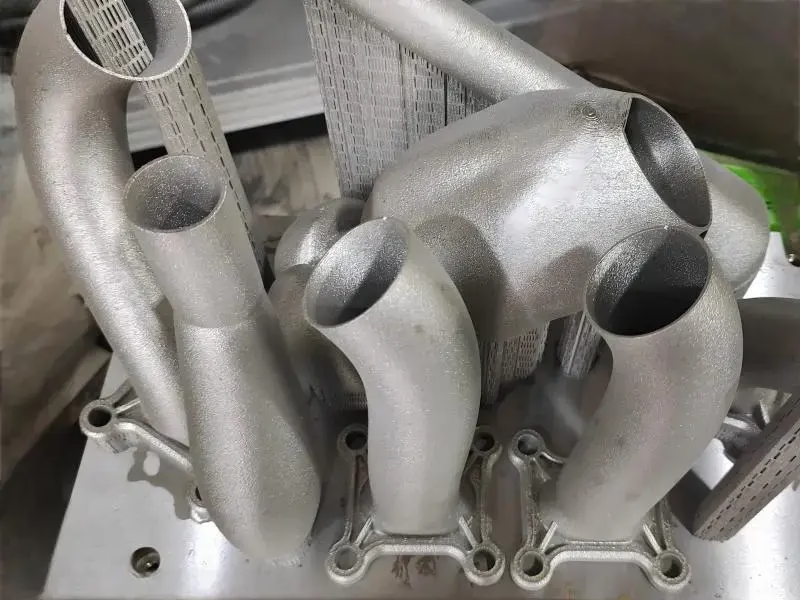
How to read this forecast
A forecast is only useful if it tells you which process to book. That is what we focus on here.
What the 2023 numbers mean for a real project
Every year brings a new 3D printing healthcare forecast. The 2023 editions pointed the same direction: more additive capacity, more approved materials, and more hospitals running printers in-house. For a design engineer, that headline matters less than the split behind it. Printing grew fastest where geometry is complex and volume is low. It grew slowly where a part must hold a bore to ±0.005 mm or survive 10,000 cycles.
So the practical question is not whether additive is growing. It is whether your part belongs in a printer or on a mill. A surgical guide that follows a patient's jaw curve is a printing job. A stainless instrument hub with a press-fit bore is not.
We see both sides in the same week. A customer sends an STL for a lattice implant trial, then a STEP file for a titanium bracket. Same program, two processes. Knowing which is which saves weeks.
Part families where printing wins
Additive earns its place when the shape is the hard part. Patient-specific guides, drill templates, anatomical models for pre-op planning, and lattice structures for lightweight bone contact all fit. Internal channels that cannot be reached by a cutter are another clear case. If a design has a helix inside a solid block, no 5-axis setup will cut it.
Low volume matters too. One to fifty units of a complex housing is a natural print run. Tooling cost never enters the picture, and design changes between units cost only a re-slice.
Printing also helps early verification. A resin model of a device housing lets a clinician check grip and clearance before anyone cuts metal. That feedback loop is short.
- 1Patient-matched geometryGuides, templates and models sized to one anatomy.
- 2Internal channelsConformal cooling or fluid paths a cutter cannot reach.
- 3Lattice and porous zonesBone-ingrowth surfaces built in one piece.
- 4Single-digit quantitiesComplex parts where tooling never pays back.
Where printing still falls short
As-printed surfaces are rough. A metal laser-melted part typically lands around Ra 8–12 μm before any post-process. If a mating face needs Ra 0.8–1.6 μm, someone still has to machine it. That step is not optional and it changes the drawing.
Tolerances are the second wall. Printing holds general dimensions, but a ±0.005 mm bore is a machining tolerance. The usual fix is hybrid: print the blank, then finish the critical features on a 5-axis center. The printer builds the near-net shape; the mill makes the interface.
Material choice is narrower than the CNC list. There is no printed equivalent of 17-4PH or 7075 with the same certified properties. For a load-bearing medical part, that gap decides the process.
Printing vs CNC for common medical parts
Use this as a first pass, then confirm with a DFM review.
| Part or feature | Better process | Why |
|---|---|---|
| Patient-specific surgical guide | 3D printing | One-off curved geometry |
| Anatomical planning model | 3D printing | Visual only, no load |
| Lattice bone-contact surface | 3D printing | Porous shape, hard to cut |
| Instrument hub, press-fit bore | CNC | Bore to ±0.005 mm |
| Titanium bracket, load path | CNC | Certified alloy properties |
| Housing with internal channel | Print then finish | Print shape, mill interfaces |
| Small batch of 20 enclosures | CNC or vacuum casting | Cost per part falls |
| Mating face at Ra 0.8 μm | CNC finishing | Printed surface too rough |
Materials and post-processing that decide the outcome
On the polymer side, medical work leans on resins and engineering plastics. On the metal side, titanium Ti-6Al-4V and cobalt-chrome cover most implants, with 316L for instruments. Each has a validated print route, and each needs its own heat treat and stress relief before it is dimensionally stable.
Post-processing is where a printed part becomes a usable part. Support removal, bead blasting, tumble finishing and machining of critical faces all sit in the same chain. A printed bracket that never sees a cutter will have rough seats. A printed bracket that gets one 5-axis pass on the mounting face will drop straight into an assembly.
We finish printed and machined parts under the same roof. Anodizing, electroless nickel, passivation and laser marking all apply to both routes. That matters when a single device mixes a printed shell with a machined latch. One finish spec, one inspection report.
What each route can hold
Figures below are the machining capability we quote on drawings.
| Requirement | Printed part | Machined part |
|---|---|---|
| General tolerance | Process dependent | ±0.005 mm |
| Mating bore | Needs reaming | Cut in one setup |
| Surface as-built | Ra 8–12 μm typical | Ra 1.6–3.2 μm |
| Fine finish | Requires polishing | Ra 0.2–0.8 μm |
| Internal channel | Built as designed | Only if reachable |
| Max part size | Build chamber limit | 4,000 mm travel |
A short checklist before you commit
Ask three things. Does the part have geometry a cutter cannot reach? Is the quantity low enough that tooling never pays back? Can the critical surfaces be finished after printing? Three yes answers point to additive. Two or fewer usually point to CNC.
Then check the interface. Most hybrid parts fail at the joint between printed body and machined seat. Give the machined face enough stock, at least 0.5 mm, so the cutter has material to remove. A printed surface that is already at final size cannot be cleaned up.
Finally, confirm the documentation. A medical part needs material certs, inspection reports and a traceable route. Both printing and machining can supply that, but only if it is requested at quote time.
Questions engineers ask about the forecast
Does the 3D printing healthcare forecast mean CNC work is shrinking?
No. Additive and subtractive grew together in medical. Printing took the complex, low-volume shapes. Machining kept the tight-tolerance interfaces, the load-bearing parts and the higher volumes.
Most programs we see use both.
Can a printed part hold a ±0.005 mm tolerance?
Not as-printed. That number comes from a machined cut. The common route is to print near-net and finish the critical features on a 5-axis center.
We quote the finish pass separately so the cost is visible.
Which medical materials can you machine that printing cannot match?
17-4PH stainless, 316L, 7075 aluminium, Ti-6Al-4V and cobalt alloys are all in our machining list with certified properties.
If the part carries load or needs a certified alloy, that list decides the process.
How do you handle surface finish on hybrid parts?
Printed surfaces get bead blasting, tumbling or polishing. Machined faces get the finish called out on the drawing, from Ra 1.6–3.2 μm down to Ra 0.2–0.8 μm.
We inspect both before shipment.
What is the minimum order quantity?
There is no minimum. We run one prototype or 10,000+ parts.
For printed parts the economics favor low volume. For machined parts the cost per unit falls as quantity rises.
Do you sign an NDA for medical projects?
Yes. Uploads are kept secure and confidential, and an NDA is available on request before you send files.
Inspection reports and material certs can be attached to the shipment.
Send the drawing and we will tell you which route fits
Quotation and free DFM analysis within 12 hours. One prototype or a 10,000-part run.
12-hour quote100% inspectionISO 13485:2016NDA on request









