
How 3D Printing Helps Environmental Protection
Three real projects show where additive manufacturing cuts waste and material use, and where it does not. Written for engineers and buyers who need to judge whether a part should be printed, machined, or both.
What This Page Covers
Three published projects, the material logic behind each, and the limits you hit on the shop floor.
A Wool Comb Made From One Recyclable Material
Batch.Works worked with a carbon negative knitwear brand to design a 3D printed wool comb. The part is built from a PLA compound with a lower carbon footprint than standard PLA. The design decision that matters most is single-material construction: no metal pins, no glued inserts, no mixed polymers.
Single-material parts are far easier to recycle. A comb with steel teeth bonded into a plastic handle has to be disassembled before it can go back into a filament stream, and most of it never does. Printing the teeth and the handle in one pass removes that step entirely.
This is the clearest case of 3d printing helps environmental goals at the product level. The gain is not the printer itself. It is the bill of materials. One polymer, one recycling stream, and a part that can be dropped into a collection bin without instructions.
- 1Single polymerNo adhesive or insert to separate before recycling
- 2Lower-carbon PLAFeedstock chosen for a smaller footprint than standard PLA
- 3Printed in one passTeeth and handle formed together, no assembly step
Date Pits Turned Into a Printable Composite
Nawa, a design studio based in Oman, developed a printing material from date pits, a by-product of local date production. The composite blends crushed pits with local clay and palm fiber. The mix resembles traditional Saruji, a clay and limestone construction material, so it already reads as a building material to local fabricators.
The studio used CAD to design decorative tiles with corrugated textures, then extruded them on 3D printers and glazed the green parts for a finished surface. The team is now working on a repeatable filament for fused filament fabrication printers, which would move the material from a studio process to something a normal FFF machine can run.
What makes this project worth studying is the input. Agricultural waste that would otherwise be burned or landfilled becomes the bulk of the material. The clay and fiber are local, so shipping distance stays short. For low-load architectural and decorative parts, that trade is usually favorable.
It is not a structural material. Tiles and cladding carry almost no load, and moisture behavior of an organic-filled composite needs testing before any exterior use. Treat it as a decorative and non-critical part family.
- 1Waste inputCrushed date pits replace virgin polymer or cement
- 2Local sourcingClay and palm fiber from the same region
- 3FFF pathFilament development for standard printers
Matching Process to Part and Volume
Use this to decide whether a part belongs on a printer, a mill, or both.
| Part case | Better fit | Why |
|---|---|---|
| One-piece consumer goods, no load | FFF or MJF printing | Single material, no assembly, easy to recycle |
| Decorative or low-load panels | FFF with filled composite | Waste feedstock works when strength is not critical |
| On-demand small batches, 60+ countries | Print on demand near the point of sale | Stock levels drop, short-term demand waste drops |
| Tight-tolerance metal interfaces | CNC machining to ±0.005 mm | Printed metal needs post-machining anyway |
| Large frames, 4,000 mm envelope | 5-axis CNC | Print bed size and distortion rule printing out |
| Sealed, high-cycle parts | CNC, then print only the cover | Functional surfaces need homogeneous metal |
| Prototype before tooling | Print for form, CNC for function | Print validates shape, machining validates fit |
Phone Cases Printed Where They Are Sold
Red Wolf Technologies, a US company, sells customizable phone cases and screen protectors on demand instead of holding deep inventory. Its Primo Print3D office system prints a phone case in under an hour, and Primo Protect cuts screen protectors at the counter. The company supports phone retailers and stores in more than 60 countries.
The environmental argument here is inventory, not material. A case printed after the customer picks a color and model never sits in a warehouse waiting for a phone generation to pass. Design changes such as screen size and camera position are handled in the file, so a new model does not require a new mold and a pallet of obsolete stock.
Red Wolf also runs a recycling program and uses Precious Plastic thermoplastic recycling equipment, which closes part of the loop on returned and rejected cases. That combination, distributed printing plus local take-back, is what makes 3d printing helps environmental outcomes measurable at retail scale.
The trade-off is unit cost. Printing one case at a time costs more per part than injection molding at volume. The saving comes from avoided stock, avoided shipping, and avoided write-offs. If your product has stable demand and a two-year life, molding still wins on cost and on carbon per part.
- 1Under one hourCase printed at the retail counter
- 260+ countriesRetail and store coverage reported by the company
- 3Take-backThermoplastic recycling on returned cases
- 4No moldDesign changes handled in the print file
Where Printing Stops and Machining Starts
Additive processes win when geometry is complex, volume is low, or the part is one material with no fasteners. They lose when the part has to hold a tolerance, seal against a mating face, or survive repeated load. Printed polymer also has layer direction, so strength depends on build orientation, and that is hard to certify for a safety-critical part.
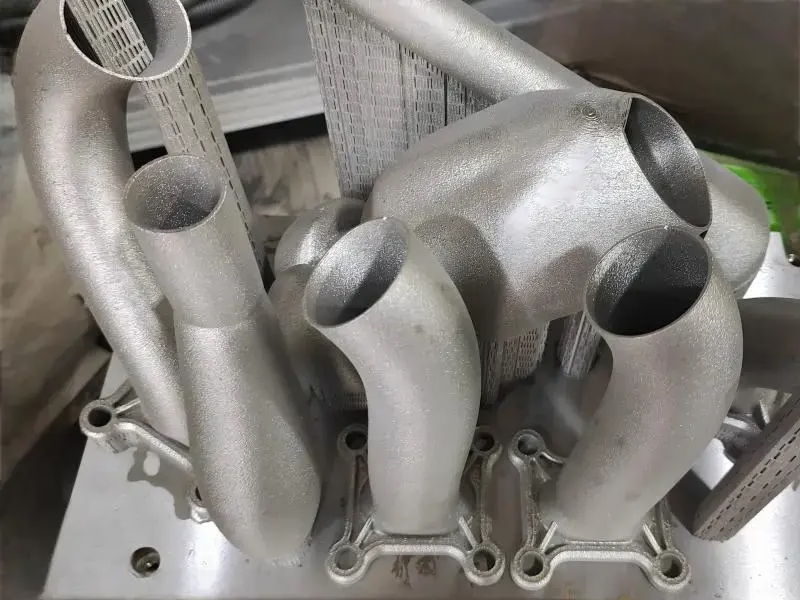
For metal parts that must be printed, the printed shape is usually not the final shape. Interfaces, bores, threads, and sealing faces get machined afterward. That is normal and it is why a print supplier and a machine shop under one roof shortens the loop. A printed blank can be fixtured and cut without a second supplier quoting it from scratch.
At GreatLight we run 127 high-precision CNC machines across three plants, including 16 simultaneous 5-axis machining centers, with a maximum processing size of 4,000 mm. Parts ship in 3–5 days after production starts, and tolerance holds at ±0.005 mm with finishes from Ra 0.2–0.8 μm. When a printed prototype has to become a functional metal part, that is the step where it happens.
The practical test is simple. If the part carries load, seals, or fits another part to a tight number, machine it. If it is a cover, a bracket in a low-load frame, a jig, or a one-off form study, print it. Most projects use both, and the split is decided part by part.
- 1Print for formShape, fit checks, and early user trials
- 2Machine for functionTolerances, threads, seals, and load paths
- 3One supplierPrinting and CNC under the same roof
Common Questions
Does 3D printing actually reduce waste, or just move it?
It depends on the part. For a one-piece consumer item, printing removes assembly and mixed materials, which is a real recycling gain.
For a high-volume part that would otherwise be injection molded, printing usually uses more energy and material per unit. The waste saving there comes from not holding stock, not from the process itself.
Can recycled or waste-derived filament hold engineering tolerances?
Not usually. Filled composites made from agricultural waste vary batch to batch, so shrinkage and surface finish move with the mix.
Use them for decorative, low-load, or non-critical parts. If a dimension has to hold at ±0.005 mm, use a machined metal or a controlled engineering polymer.
When should a printed prototype be machined instead?
As soon as the part has to seal, thread, bear load, or fit a mating part to a tight number. Printed polymer and printed metal both behave differently from wrought stock.
A common path is to print for form and fit review, then machine the same geometry in aluminium or stainless for functional testing.
What file do you need to quote a printed or machined part?
A STEP or native CAD file plus a 2D drawing for any toleranced feature. Tell us the material, surface finish, and quantity.
We return a quotation and a free DFM analysis within 12 hours. There is no minimum order quantity, from one prototype to 10,000+ part runs.
How do you handle confidentiality on a new product?
Uploads are secure and confidential, and we can sign an NDA before files are shared.
That matters most during the print-versus-machine decision, when the design is still moving.
Can you finish a printed part the same way as a machined one?
Yes for most decorative and protective finishes. We offer anodizing, plating, powder coating, bead blasting, and laser marking.
Laser marking has a minimum character height of 1.5 mm. Deep wear surfaces on printed metal still need machining before finishing.
Send the Part, Get a Process Recommendation
Upload your file and we will tell you whether printing, machining, or both fits the part, with a quotation and free DFM analysis within 12 hours.
12-hour quoteNo minimum order quantityNDA on request









