
10 Most Common Products Production by CNC Machines
This page is for engineers and buyers deciding whether a part belongs on a CNC machine. We list the ten product groups that show up most often in most common products production, give the tolerances and materials each one usually needs, and say where CNC is the wrong call.
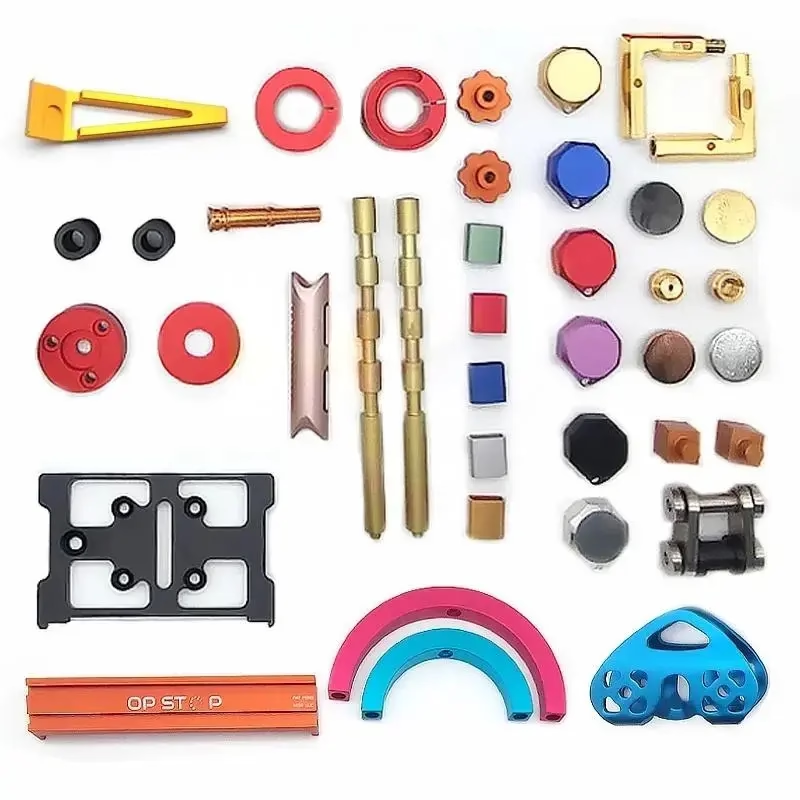
What makes a part a typical CNC job
Ten product groups, sorted by how often they run on our 127 machines.
Aerospace brackets and automotive powertrain parts
Aerospace work is where the tolerance budget decides the process. Wing ribs, seat tracks, actuator housings, drone airframes and engine mounts usually land in the ±0.005 mm range on critical bores, with wall thicknesses thin enough that chatter becomes the main risk. For these parts we run 5-axis centers so the part stays on one fixture and hole-to-hole position error does not stack up. Titanium TC4 (Ti-6Al-4V) and 7075 aluminium are common here. Both cut well when the toolpath keeps radial engagement steady.
Automotive and EV parts are a different animal. Volume is higher, but the geometry is often simpler. Engine covers, transmission housings, suspension knuckles, battery tray inserts, motor end plates and gearbox components are the usual suspects. Tolerances sit around ±0.01 to ±0.05 mm on fits, with Ra 1.6–3.2 μm finishes on sealing faces. IATF 16949:2016 matters for this group because the paperwork trail has to survive an audit, not just the parts.
One judgement call: if an automotive part is a thin-walled casting with no machined features beyond a few bolt holes, die casting with a finish pass may beat machining from billet. Ask before you assume 100 percent from solid.
Medical instruments and robotics components
Surgical instruments, implant trials, bone plates, catheter molds and diagnostic equipment housings are the medical jobs we see most. The materials are usually 316L stainless, titanium, or PEEK. Surface finish is the spec that drives cost here, not the geometry. A bone plate at Ra 0.2–0.8 μm needs a different toolpath and a longer cycle than the same plate at Ra 1.6 μm. ISO 13485:2016 governs the process control, and we keep material certs traceable per lot.
Robotics and automation parts are a mix of precision and abuse resistance. Robot arm links, joint housings, harmonic drive adapters, servo motor mounts and end-effector plates. Aluminium 6061-T6 and 7075 dominate, with steel 4140 for high-load joints. Positional tolerance on mounting faces is often tighter than the drawing suggests, because the assembly stack-up eats the margin. If you can send the assembly drawing, we can flag which faces actually need the tight callout.
Small batch is normal here. One to fifty units for a new cell, then repeat orders. No minimum order quantity helps: prototype and production run on the same setup.
Gearbox parts and oil and gas hardware
Gearbox and transmission components are a repeat business for us: gear blanks, shafts, bearing caps, differential cases and pump housings. The critical features are bore roundness, gear face runout and shaft concentricity. Hardened steel 4140 and 4340 need a pre-heat-treat rough and a post-heat-treat finish pass to hold size. Mill-turn centers handle shaft work in one setup, which removes the re-chucking error that shows up when a shaft is turned, then milled on a second machine.
Oil and gas parts are built for pressure and corrosion. Valve bodies, pump impellers, manifolds, connector housings and downhole tool components. Materials are 17-4PH stainless, Inconel, and duplex grades. The machining challenge is usually deep pockets and cross-drilled passages. Inconel work-hardens fast, so we keep feeds high and never let the tool rub. Cycle times are long; the payoff is a part that holds dimension after heat treat.
Not every oil and gas part is a CNC job. Large cast valve bodies with simple bores may be cheaper as castings with a machined flange face. We say so when the drawing points that way.
Typical tolerance and finish by product group
Starting points from past jobs. Your drawing overrides these.
| Product group | Common material | Typical tolerance | Typical finish |
|---|---|---|---|
| Aerospace brackets | 7075, TC4 titanium | ±0.005 mm | Ra 0.8–1.6 μm |
| Automotive housings | ADC12, 6061-T6 | ±0.01–0.05 mm | Ra 1.6–3.2 μm |
| Medical instruments | 316L, PEEK, titanium | ±0.005 mm | Ra 0.2–0.8 μm |
| Robotics links | 6061-T6, 7075, 4140 | ±0.01 mm | Ra 0.8–1.6 μm |
| Gearbox shafts | 4140, 4340 | ±0.005 mm | Ra 0.8–1.6 μm |
| Oil and gas valves | 17-4PH, Inconel | ±0.01 mm | Ra 1.6–3.2 μm |
| Consumer enclosures | 6063, ABS, PC | ±0.05 mm | Ra 1.6–3.2 μm |
| Electronic heat sinks | 6061, C110 copper | ±0.05 mm | Ra 1.6–3.2 μm |
| Industrial pump parts | 316, 1045, cast iron | ±0.01 mm | Ra 0.8–1.6 μm |
| New energy busbars | C110, 6061 | ±0.05 mm | Ra 1.6–3.2 μm |
Electronics hardware and industrial machinery parts
Electronics work is usually small and flat. Heat sinks, RF shields, connector shells, chassis panels and mounting plates. Aluminium 6061 and copper C110 are the main materials. The feature sizes are small, so 3-axis machines with a fine-pitch tool do most of the work. Tolerance is often ±0.05 mm, but flatness on a heat sink mating face matters more than the general callout. Anodizing is a common finish, and we mask the ground contact areas so the coating does not block conductivity.
Industrial machinery covers a wide net: pump housings, valve blocks, conveyor brackets, bearing housings, sprockets and custom fixtures. Materials range from 1018 steel to 316 stainless to cast iron. The parts are often large. Our 4,000 × 400 × 150 mm travel handles long base plates and rails in one setup, which avoids splicing two smaller parts. For anything with a big bore, we check whether a mill-turn center is faster than a mill plus a lathe.
A note on quantity. Industrial machinery buyers often want five units now and fifty later. We hold the setup and the program, so the second order runs faster and at a lower unit cost without a new DFM cycle.
Consumer product enclosures and new energy parts
Consumer product enclosures are the parts people see. Camera bodies, drone frames, wearable housings, speaker grilles, and tool casings. Aluminium 6063 and plastics like ABS, PC and PMMA are common. The geometry is often cosmetic, so bead blasting, brushing or powder coating follow the machining. Tolerance is looser, around ±0.05 mm, but a visible scratch is a reject. We handle that with soft jaws and a protective film on finished faces.
New energy parts are growing fast in our shop. Battery module end plates, busbars, cooling plates, inverter housings and charging connector bodies. Copper C110 and aluminium 6061 are the workhorses. The specs are driven by electrical contact and thermal path, so flatness and surface cleanliness matter more than a tight general tolerance. Laser marking with a minimum character height of 1.5 mm is often required for traceability.
If a new energy part is a thin flat plate with simple holes, sheet metal fabrication may be cheaper. If it has a sealed pocket or a machined cooling channel, CNC is the right process.
Common questions from engineers and buyers
Which of these product groups is not a good fit for CNC machining?
High-volume parts with simple geometry, such as a flat bracket with two holes, are usually cheaper as stampings or die castings. Very large parts beyond our 4,000 mm travel also fall outside our range.
If a part needs a material that machines poorly, like certain filled plastics or hardened tool steel above 55 HRC, we will say so during DFM review.
Can you hold ±0.005 mm on all ten product groups?
No. That tolerance applies to specific features on specific materials. Aerospace brackets, medical instruments and gearbox shafts routinely reach it. Consumer enclosures and busbars usually sit at ±0.05 mm.
We flag which features can hold the tight callout and which cannot, before you place an order.
What is the smallest and largest part you run?
We run parts from a few millimeters up to 4,000 mm in the longest dimension. The 4,000 × 400 × 150 mm travel handles long rails and base plates. Compact work goes on 500 × 500 × 450 mm and 500 × 310 × 200 mm machines.
A Ø400 mm rotary table covers round parts that need milling on multiple faces.
How do you handle material traceability for medical and automotive parts?
We keep material certificates per lot and record the heat number against the job. For ISO 13485:2016 and IATF 16949:2016 work, inspection reports are available on request.
Every part gets a raw material check, in-process monitoring and a final inspection before shipment.
Can you start production from a prototype without a new setup?
Yes. We keep the program, fixture and tooling records. A prototype run and a 10,000-part run use the same process, so the second order does not need a fresh DFM cycle.
There is no minimum order quantity. One part or ten thousand, the flow is the same.
What finishes are available for these product groups?
Anodizing in clear, colour, hardcoat and conductive versions; electroless nickel, zinc, silver and gold plating; powder coating and black oxide; bead blasting, tumbling, brushing and polishing.
Laser marking and engraving are available with a minimum character height of 1.5 mm.
Send your drawing and get a process recommendation
We review the geometry, material and tolerance, then tell you which of these product groups your part belongs to and whether CNC is the right process. Quotation and free DFM analysis within 12 hours.
12-hour quoteDFM analysis included100% inspection before shipmentNDA on request









