
Which CNC Machine Is Best for Your Part?
There is no single best machine, only the best match for a given geometry, tolerance and batch size. This page compares 3-axis, 4-axis, 5-axis and mill-turn options so engineers and buyers can pick a process before requesting a quote. Read the table first, then the sections that match your part.
In this article
- 1
- 2
- 3
- 4
- 5
- 6
- 7
Which CNC machine is best: process comparison
Match the process to the part, not the other way around.
| Process | Typical part shape | Tolerance and finish | When it is not the right choice |
|---|---|---|---|
| 3-axis milling | Prismatic parts, open pockets, flat faces | ±0.01 mm, Ra 1.6–3.2 μm | Five-sided features that need refixturing |
| 4-axis milling | Shafts, cams, parts with holes on several faces | ±0.01 mm, Ra 0.8–1.6 μm | Freeform contouring on curved surfaces |
| 5-axis simultaneous | Impellers, housings, undercut and angled ports | ±0.005 mm, Ra 0.8–1.6 μm | Simple plates where cost per part dominates |
| 3+2 positioning | Pockets and faces at compound angles | ±0.005 mm, Ra 0.8–1.6 μm | Continuous surface blending across faces |
| Mill-turn | Turned bodies with milled flats and cross holes | ±0.005 mm, Ra 0.8–1.6 μm | Long thin shafts with no milling features |
| Large-travel milling | Frames, plates up to 4,000 mm long | ±0.01 mm, Ra 1.6–3.2 μm | Small tight-tolerance batches under 50 mm |
Five checks that decide which CNC machine is best
The question which CNC machine is best has no universal answer. A 3-axis mill that holds ±0.01 mm all day on an aluminum bracket is the wrong tool for a titanium impeller with twisted blades. Ask instead what the part needs from the machine: how many faces must be cut in one setup, how tight the tolerance is, and how many parts you actually need.
Start with geometry. Count the surfaces that must be machined and the angles between them. If every feature can be reached from the top, a 3-axis machine with good workholding will beat a 5-axis machine on cost and cycle time. If features sit on four or five sides, each refixturing adds setup error and labor.
Next look at tolerance. Standard machining holds ±0.01 mm without drama. Below that, thermal drift, tool wear and fixture stiffness dominate, so the machine, the spindle and the shop climate all matter more than the badge on the door. A well-managed 3-axis process beats a neglected 5-axis machine on real parts.
Then consider volume and material. One prototype and a 10,000-part run rarely want the same process. Hard alloys such as Inconel or Ti-6Al-4V cut slower and push more heat into the tool, so rigidity and coolant strategy matter more than axis count. Plastics and aluminum forgive more.
Finally, check the shop behind the machine. CAM strategy, toolpath choice, workholding design and in-process inspection decide the result as much as the spindle does. A machine is one link in the chain, not the whole chain.
When a 3-axis machine is the right pick
A 3-axis mill cuts from one direction. The part sits on a fixture or vise, the spindle moves in X, Y and Z, and every feature has to be reachable from above. That sounds limiting. In practice it covers a large share of machined parts: mounting plates, brackets, housings with open pockets, heat sinks, and most enclosures.
The strength of 3-axis work is repeatability and cost. Setup is simple, so cycle time is predictable and the fixture is cheap. On a 500 × 500 × 450 mm travel machine, a batch of aluminum brackets can run with ±0.01 mm flatness and Ra 1.6–3.2 μm finish without any special tooling. For a part like that, adding axes only adds cost.
The limit shows up when features sit on multiple sides. Each extra face means a new fixture, a new zero, and a chance to lose 0.02 mm or more. Deep pockets with small corner radii also push tool length up, which invites chatter. If your drawing has four tapped holes on the bottom of a closed housing, 3-axis is not the answer.
Choose 3-axis when the part is prismatic, tolerances sit at ±0.01 mm or looser, and quantity is high enough that a simple fixture pays for itself. It is the default, and the default is often right.
Where 4-axis and 3+2 positioning fit
A 4-axis mill adds a rotary table, usually around the X or Y axis. The part can index to a new face between cuts, or rotate slowly while the tool moves along the profile. That covers shafts with milled flats, cams, and parts with holes on several faces around a common centerline.
On a Ø400 mm rotary table, one setup can reach four sides of a part. The payoff is fewer setups, which means fewer datum shifts. A job that would need three fixtures on a 3-axis machine becomes one program on a 4-axis machine, and the ±0.01 mm stack-up error from re-clamping goes away.
3+2 is different from simultaneous 5-axis. The two rotary axes index to a fixed angle, then the machine cuts in three axes. It is cheaper than full simultaneous control and often accurate enough for pockets and faces at compound angles. What it cannot do is keep a tool normal to a continuously curved surface.
Pick 4-axis or 3+2 when your features are directional, not freeform. Angular ports, cross holes, and parts built around a bore are typical. Pick it also when setup count is the real cost driver in your batch.
When only simultaneous 5-axis will do
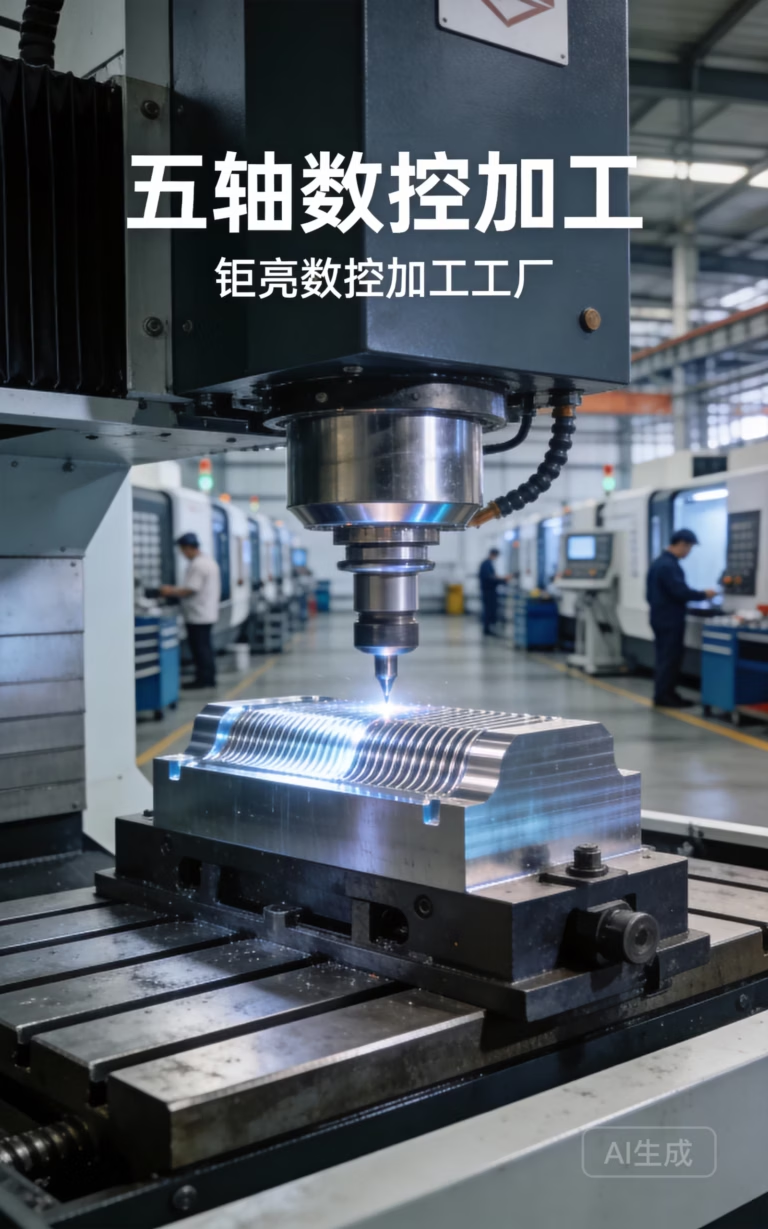
Simultaneous 5-axis moves all axes at once, keeping the tool normal to the surface and reaching undercuts that no other process can touch. Impellers, turbine blades, orthopedic implants, and fluid-dynamics housings with swept passages fall into this group. So do parts that must be finished in a single setup to protect a tight tolerance.
The gain is not just reach. Short, rigid tools can be used because the machine tilts the part into the tool instead of reaching in with a long end mill. That reduces chatter and improves surface finish. On a titanium or Inconel part, that difference decides whether the wall thickness holds at ±0.005 mm.
The cost is real. Programming takes longer, simulation is mandatory, and machine time is more expensive. For a flat plate with six holes, 5-axis is money burned. For a closed impeller with 14 blades, it is the only route that avoids splitting the part and welding it back.
Use simultaneous 5-axis when the geometry demands it: freeform surfaces, deep undercuts, angled features that cannot be reached from a fixed direction, or a tolerance stack that collapses if the part moves between setups.
Mill-turn centers and when size rules the choice
A mill-turn center combines a lathe spindle with milling capability. Turned bodies with milled flats, cross holes, or slots come off in one setup instead of two. For a hydraulic manifold or a motor housing, that removes the concentricity error you get when a part is moved from lathe to mill.
The trade-off is access. Mill-turn machines usually have less Y-axis travel and fewer tool positions than a dedicated machining center. If the part is mostly milling with a little turning, a 4-axis mill is often faster. If it is mostly turning with a few milled features, mill-turn wins.
Size is the other hard filter. Our largest travel is 4,000 × 400 × 150 mm, which covers long frames and rails. Medium machines run 750 × 1,150 × 550 mm and 600 × 600 × 600 mm. Compact machines at 500 × 500 × 450 mm and 500 × 310 × 200 mm handle small, high-volume parts more efficiently.
A part that fits on a compact machine should not tie up a large one. Matching the envelope to the part keeps cycle time and cost down. It also leaves the big machines free for the work that actually needs them.
How material and batch size shift the answer
Aluminum 6061, 7075 and 6082 cut fast and hold tolerance well, so almost any machine in the shop can run them. Stainless 304 and 17-4PH work-harden and need sharp tools, stable feed, and plenty of coolant. Titanium TC4 and Inconel 718 cut slowly and generate heat at the edge, so spindle rigidity and thermal control matter more than axis count.
Plastics such as POM, PEEK and ABS behave differently again. They move with temperature, so a part that measures ±0.005 mm on the machine may not measure that after it cools. For those jobs, fixturing and inspection timing decide the result, not the machine model.
Batch size changes the math too. One prototype can be machined on a 3-axis mill with a soft jaw and hand deburring. A 10,000-part run wants dedicated fixtures, probing, and often a machine chosen for cycle time rather than flexibility. We run from one prototype to 10,000+ parts with no minimum order quantity.
The honest answer to which CNC machine is best is: the one that matches geometry, tolerance, material and volume at the same time. Get one of those wrong and a better machine will not save the job.
The verdict
If the part is prismatic and tolerances are ±0.01 mm or looser, choose 3-axis. If features wrap around the part, choose 4-axis or 3+2. If surfaces are freeform, undercut, or the tolerance stack breaks with a second setup, choose simultaneous 5-axis. If the part is mostly turned, choose mill-turn.
Frequently asked questions
Is a 5-axis machine always more accurate than a 3-axis machine?
No. Accuracy comes from the whole system: spindle, thermal stability, fixture, toolpath and inspection. A 5-axis machine with a weak fixture or a hot spindle can hold looser tolerances than a well-run 3-axis job.
The real advantage of 5-axis is fewer setups and better tool access. If your part needs neither, the extra axes add cost without adding accuracy.
How do I know if my part needs simultaneous 5-axis or just 3+2?
Look at the surfaces. If they are flat or cylindrical and can be reached from fixed angles, 3+2 is enough. If the tool must stay normal to a continuously changing surface, or reach under a lip, you need simultaneous motion.
Swept blades, impeller passages and organic housings are the usual giveaways.
What tolerance can I expect from each process?
Standard 3-axis and 4-axis work holds about ±0.01 mm on well-fixtured parts. Simultaneous 5-axis and mill-turn work can reach ±0.005 mm when the material, tooling and shop temperature cooperate.
Surface finish follows a similar pattern: Ra 1.6–3.2 μm as-machined, Ra 0.8–1.6 μm with a finishing pass, and Ra 0.2–0.8 μm on fine-finish work.
Does batch size change which machine you use?
Yes. A single prototype is usually machined for flexibility, not cycle time. A 10,000-part run is machined for repeatability and speed, which often means dedicated fixtures and a machine chosen for its envelope and spindle.
We quote both from the same drawing, so you can see the difference before committing.
Can you machine parts up to 4,000 mm long?
Yes. Our largest travel is 4,000 × 400 × 150 mm. Long frames, rails and base plates fit on that machine.
Smaller parts run on compact machines with 500 × 500 × 450 mm or 500 × 310 × 200 mm travel, which keeps cycle time and cost lower.
What information do you need to recommend a process?
Send the 3D model or 2D drawing with tolerances, the material, the quantity, and any surface finish or certification requirements. A short note on how the part functions helps too.
We return a quotation and a free DFM analysis within 12 hours, and production can start within 24 hours of approval.
Send the drawing, get a process recommendation
Upload your model and we will tell you which machine fits, what tolerance we can hold, and what it costs. Quotation and free DFM analysis within 12 hours.
12-hour quote100% inspectionNo MOQNDA on request
More from the shop floor
We publish setup notes, tooling trials and inspection data from the factory floor.











