
Where Are Hurco CNC Machines Made?
Engineers ask where are Hurco CNC machines made because machine origin shapes spare parts, service response and control support. This page breaks down the build sites, the control architecture and the boundary conditions that matter when you specify work for a Hurco mill or lathe.
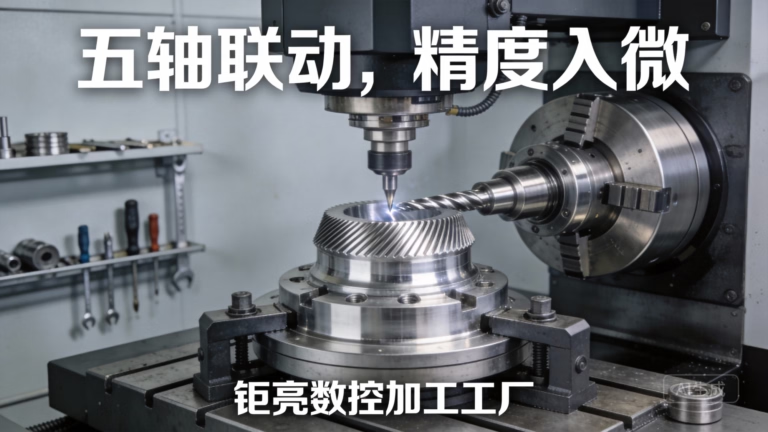
Where are Hurco CNC machines made: the two main plants
Hurco Companies, Inc. is headquartered in Indianapolis, Indiana. That site is the main manufacturing hub, where the company designs, assembles and tests the majority of its machining centers and lathes. If you order a VM or TM series mill for the North American market, the machine is most likely built and run off in Indianapolis before it ships.
For European customers, Hurco operates a plant in Nürtingen, Germany. That facility assembles and configures machines for European buyers and holds the same quality benchmarks as the US site. A German-built Hurco mill and a US-built one of the same model share the same castings, spindle cartridges and control hardware.
There are sales and support offices in Asia and other regions, but those are not the primary assembly plants. Do not assume every Hurco machine is built in the US. Ask your dealer for the country of final assembly on the specific serial number you are buying.
Machine origin matters for two practical reasons. First, spare parts and service contracts follow the plant that built the machine. Second, lead time on a new machine depends on which plant has open build slots. A US-built machine and a German-built machine of the same model can sit weeks apart on delivery.
What the WinMax control tells you about the build
Hurco designs its own control, WinMax. That is the part most engineers recognize. The control is developed in-house and integrated with the machine at the plant, so the motion tuning, servo pairing and tool-change logic are set before the machine leaves the floor.
A shop-floor consequence: the control is not a generic PC bolted onto a third-party mill. It is a matched set. When you buy a used Hurco, the control version and the machine build year need to line up. A mismatched control board from a different build batch can create axis tuning problems that look like mechanical faults.
WinMax supports both conversational programming and standard G-code. For job shops running small batches, the conversational side cuts setup time. For shops with CAM-generated toolpaths, the G-code path works the same as any Fanuc-style control, but post-processor settings need to match the Hurco kinematics.
This integration is the main reason Hurco machines hold tolerance well on long runs. The control compensates for thermal drift and backlash based on the specific machine's calibration file. Swap the control and you lose that compensation data.
How machine origin changes what you can quote
Origin affects the tolerance band you can hold, but it is not the only factor. A US-built Hurco VM series mill and a German-built one of the same size class will hit similar numbers on aluminum and mild steel. The bigger variable is spindle hours, way condition and how often the machine was re-calibrated.
When we quote a job that will run on a Hurco-class machine, we look at three things: the tightest tolerance on the drawing, the material, and the feature count. A part with ±0.005 mm true position on six holes is a different risk than a bracket with ±0.1 mm on two holes.
For most production work, a Hurco mill in good condition holds ±0.005 mm on position and Ra 0.8–1.6 μm on milled faces. Finer finishes, down to Ra 0.2–0.8 μm, need a separate finishing pass and a clean setup, not a different machine origin.
If your drawing calls for a feature that depends on five-axis simultaneous motion, origin still does not change the kinematics. What changes is the post-processor and the operator's familiarity with the control. That is a training issue, not a plant-location issue.
When machine origin should not drive your decision
Origin is a buying criterion, not a machining criterion. Once a machine is in a shop and running, the part quality comes from the setup, the tooling and the inspection plan. A well-maintained machine from either plant beats a neglected one from the other.
Do not reject a quote because the shop runs a mix of machine brands. Most precision shops run several control types because different jobs suit different machines. What matters is whether the shop can hold your tolerance on your material, and whether they inspect it.
If you are buying a machine rather than a part, origin matters more. Service response, spare parts stock and dealer support all follow the plant and the regional distributor. For a machine purchase, ask for the build plant, the control version and the calibration record.
For part buyers, the useful question is not where the machine was made. It is what tolerance the shop can hold and prove. Ask for inspection reports on the first article and a clear statement of the measurement method.
US vs German build: what changes for the buyer
Same model, different plant
| Factor | US plant (Indianapolis) | German plant (Nürtingen) |
|---|---|---|
| Primary market | North America | Europe |
| Core castings and spindle | Same design spec | Same design spec |
| Control hardware | WinMax, in-house | WinMax, in-house |
| Motion calibration | Set at build plant | Set at build plant |
| Spare parts path | US distributor network | EU distributor network |
| Typical delivery lead | Depends on build slot | Depends on build slot |
| Best for | US-based machine owners | EU-based machine owners |
The practical answer for part buyers
If you are buying a machine, match the build plant to your service region so parts and support stay close. If you are buying machined parts, ignore the machine's country of origin and judge the shop on tolerance, inspection data and lead time. A Hurco-class mill in any plant can hold ±0.005 mm when it is maintained and the setup is right.
Common questions
Are all Hurco CNC machines made in the United States?
No. The main plant is in Indianapolis, Indiana, but Hurco also assembles machines at its Nürtingen, Germany facility for the European market. Sales and support offices exist in other regions, but those are not the primary assembly sites.
The country of final assembly can vary by model and by market. Ask your dealer for the build plant tied to the specific serial number.
Does the build plant change the machine's accuracy?
The core design, castings and control hardware are shared across plants, so the nominal accuracy class is the same. What differs is the calibration record and the local service path.
In practice, a machine's condition and maintenance history affect the tolerance it holds more than the plant that assembled it.
What tolerance can a Hurco-class mill hold in production?
For most production work on aluminum and mild steel, a well-maintained machine holds ±0.005 mm on position and Ra 0.8–1.6 μm on milled faces.
Finer finishes, down to Ra 0.2–0.8 μm, need a dedicated finishing pass, sharp tooling and a clean setup. The machine origin does not change that requirement.
Should I specify a machine origin when I quote a machining job?
For part buyers, no. Specify the tolerance, the material and the inspection method. Let the shop choose the machine that fits the job.
If you are buying the machine itself, match the build plant to your service region so spare parts and dealer support stay close to where the machine runs.
What should I verify before buying a used Hurco machine?
Check the control version against the build year, ask for the calibration record, and inspect the way surfaces and spindle for wear. A mismatched control board can cause axis tuning faults that look mechanical.
Also confirm which plant built the machine, so you know which distributor network handles parts and service.
Send us your drawing
We run 5-axis, 4-axis and 3-axis CNC machines and quote within 12 hours with a free DFM analysis.
12-hour quote100% inspectionNo minimum order
More from the shop floor
We publish setup notes, tooling trials and inspection data from the factory floor.











