
What Machines Can CNC Operate?
CNC is a control layer, not one machine. The same controller logic drives milling centers, lathes, EDM, grinders, press brakes, and printers. This page covers the six families we run, the axes and tolerances each one holds, and the part features that tell you which one to pick.
In this article
- 1
- 2
- 3
- 4
- 5
- 6
What machines can CNC operate, and why the answer is not one machine
CNC stands for computer numerical control. It is a control layer that sits on top of a machine tool and replaces handwheels with servo commands and feedback loops. The controller reads G-code, drives each axis to a coordinate, and corrects for tool wear, backlash, and thermal drift while the cut is running.
Because the control layer is separate from the mechanical frame, the same logic drives many machine types. A three-axis mill, a Swiss-type lathe, a wire EDM, and a press brake all run on position commands. What changes is the kinematics: which axes move, and how the tool meets the material.
That is why two shops with the same machine count can quote very different parts. The machines matter less than the match between the machine family and the geometry of your part.
The table further down summarizes the six families we run. The sections before it explain the mechanism behind each one, so you can judge a quote instead of just accepting it.
- 1Control layerServo, encoder, and interpolator shared across machine types
- 2KinematicsHow many axes move, and whether the work or the tool spins
- 3MatchMachine family is chosen from part geometry, not from habit
CNC machining centers: milling with 3, 4, or 5 axes
A machining center spins a cutting tool and moves it through the workpiece. The number of axes decides which faces you can reach in one setup. A three-axis machine moves X, Y, and Z only, so the part has to be refixtured for each new face.
A four-axis machine adds a rotary table, usually around X or Y. That lets the spindle cut around a cylindrical part without stopping. We run 12 four-axis mills and 27 three-axis machines, plus 16 simultaneous five-axis centers on our floor.
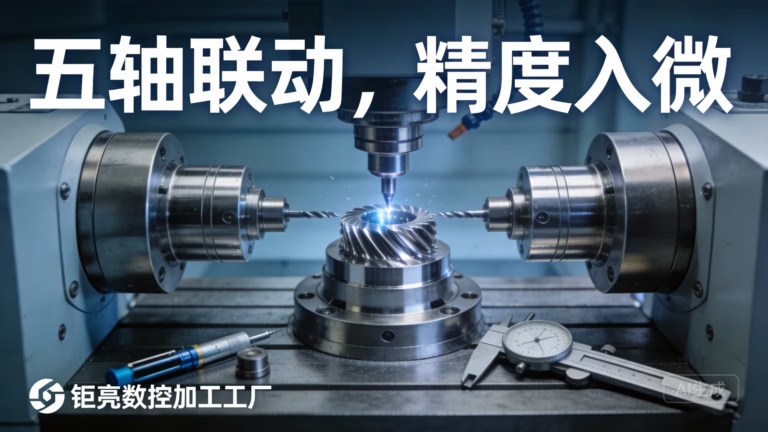
Five-axis machines tilt the tool or the table on two extra rotary axes at the same time. A Ø400 mm rotary table on a simultaneous machine can keep the tool normal to a curved surface for the whole pass. That single capability removes most refixturing error on organic shapes, deep pockets with undercuts, and impeller blades.
The trade-off is cost. Five-axis programming takes longer, and the machine has to be verified on a test cut. For a flat bracket with two holes, a three-axis machine is faster and cheaper. Reach for five-axis when the part has compound angles or features on five faces that must stay in one datum.
- 13-axisPrismatic parts, one setup per face, lowest cost
- 24-axisCylindrical parts, slots and flats indexed around an axis
- 35-axisCompound angles, undercuts, curved surfaces in one setup
CNC lathes, turning centers, and EDM: round parts and hard metal
A CNC lathe spins the workpiece and feeds a single-point tool along X and Z. Anything with rotational symmetry belongs here: shafts, bushings, connectors, valve bodies. A mill-turn center combines both functions, so a part with a turned body and milled flats comes off one machine. We run 16 mill-turn centers.
Swiss-type lathes push bar stock through a guide bushing, so the cutting zone stays within a few millimeters of the support. That keeps deflection near zero on small-diameter parts. It is the right process for parts under roughly 20 mm in diameter with tight concentricity.
EDM removes material with controlled electrical sparks instead of a cutting edge. Wire EDM pulls a thin wire through the part, which suits hardened tool steel, tungsten carbide, and sharp internal corners that a rotating tool cannot reach. Sinker EDM burns a shaped electrode into a cavity.
EDM has no cutting force, so it will not distort a thin wall. It is slower than milling and leaves a recast layer that may need a light finishing pass. Use it when hardness, corner radius, or geometry blocks every other process.
- 1TurningRotational parts, threads, grooves, bores on the axis
- 2Swiss-typeSmall diameter, high concentricity, low deflection
- 3Wire EDMHardened steel, sharp internal corners, through profiles
- 4Sinker EDMCavities and blind shapes cut into hard material
CNC grinders and sheet metal machines: finish and flat stock
Grinding uses an abrasive wheel to remove a small amount of material at high surface speed. It is the process for final size and finish after hardening. Because the wheel takes tiny depths of cut, the machine holds tight roundness and low Ra without loading the part.
Surface grinders flatten faces and shoulders. Cylindrical grinders true up shafts and bores. On our finishing side we hold Ra 0.8–1.6 μm as a standard machined finish and Ra 0.2–0.8 μm when the drawing calls for it.
Sheet metal machines work from flat stock. A CNC punch or laser cuts the outline, a press brake bends it, and a laser cutter handles profiles that a punch cannot. The controller on a press brake computes the bend allowance and back gauge position for each hit, which is what keeps a 90° flange repeatable across a run.
The limit is thickness and geometry. Sheet metal is a 2D process bent into 3D. If your part has thick sections, deep pockets, or machined bores, it belongs on a mill instead.
- 1Surface grindingFlat faces and shoulders after heat treatment
- 2Cylindrical grindingShafts and bores held to tight roundness
- 3Laser and punchFlat profiles in sheet, no tooling per shape
- 4Press brakeRepeatable bends with computed allowance
CNC additive machines and how material decides the process
Additive machines are CNC too. The controller moves an extruder, a laser, or a printhead along a toolpath, layer by layer. The difference is that material is added instead of removed. We run custom 3D printing for parts with internal channels, lattice structures, or shapes that no cutter can reach.
Material often decides the family before geometry does. Aluminium 6061, 7075, and 6082 cut easily on a mill. Stainless 316L and 17-4PH machine well but work-harden, so feeds and speeds have to be right. Titanium TC4 and Inconel need lower cutting speeds and more tool changes.
Plastics behave differently again. POM and PEEK hold tight tolerances; ABS and PP can flex under clamping. Carbon fibre needs diamond-coated tooling to avoid delamination.
A part that is hard to mill is not automatically an EDM or additive job. Compare the tolerance, the quantity, and the finish first. Often a change in fixturing or a different toolpath solves it on the original machine.
- 1AdditiveInternal channels, lattices, low-volume complex shapes
- 2Material firstHardness and work-hardening set the cutting parameters
- 3PlasticsClamping and heat build-up matter more than spindle speed
CNC machine families compared by part geometry
Use this to match a feature to a process before you request a quote.
| Machine family | Best for | Typical tolerance | Watch out for |
|---|---|---|---|
| 3-axis machining center | Prismatic parts, flat faces, simple pockets | ±0.005 mm | Refixturing error on extra faces |
| 4-axis machining center | Round parts with indexed flats and slots | ±0.005 mm | Limited reach on compound angles |
| 5-axis machining center | Compound angles, undercuts, curved surfaces | ±0.005 mm | Higher programming and setup cost |
| CNC lathe / mill-turn | Shafts, bushings, valve bodies, connectors | ±0.005 mm | Off-axis holes can be slow to reach |
| Swiss-type lathe | Small diameter parts, high concentricity | ±0.005 mm | Bar stock diameter limits part size |
| Wire and sinker EDM | Hardened steel, sharp corners, thin walls | ±0.005 mm | Slower cut, recast layer to remove |
| Grinding | Final size and finish after hardening | ±0.005 mm | Small stock removal per pass |
| Sheet metal and press brake | Flat profiles, enclosures, brackets | ±0.005 mm | Limited by sheet thickness and bend radii |
Pick the process from the feature, not from the machine list
If the part turns, start with a lathe. If it has compound angles or five-sided access in one datum, start with five-axis. If it is hardened or has sharp internal corners, start with EDM. If it is flat stock bent into shape, start with sheet metal. Milling is the default only when none of those apply.
Questions engineers ask about CNC machine types
Can one CNC machine replace several others?
Only partly. A mill-turn center handles turned and milled features in one setup, which removes a refixturing step and shortens the route. It still cannot grind a hardened surface or cut a sharp internal corner the way EDM does.
For parts with mixed features, mill-turn usually wins on lead time. For parts that need hardening or a very fine finish, a second process stays in the route.
How do I know whether my part needs five-axis or three-axis?
Count the faces that must stay in the same datum and check for compound angles. If every feature is reachable from three orthogonal directions and the tolerances are not stack-sensitive, three-axis is enough.
Five-axis pays for itself when each refixturing would add error, when the part has a curved surface, or when undercuts block a straight tool.
Does the machine type change the achievable tolerance?
The machine family sets the baseline, but the setup, the tool, and the material often dominate. A rigid three-axis setup on aluminium can hold the same tolerance as a five-axis machine.
Thin walls, long tools, and work-hardening stainless are the usual sources of drift, not the axes of the machine.
Can CNC machines cut both metal and plastic?
Yes, with different parameters. Metals need coolant and a cutting speed matched to hardness. Plastics need sharp tooling, higher spindle speed, and air blast instead of flood coolant to avoid melting and chip welding.
We machine ABS, PC, PMMA, POM, PA, PEEK, PP, HDPE, and carbon fibre alongside aluminium, stainless, steel, copper, brass, titanium, and Inconel.
When should a part go to additive instead of milling?
When the geometry has internal channels or lattices that a cutter cannot reach, or when the quantity is small and the shape is complex. Metal removal is still the better route for tight tolerances and load-bearing surfaces.
A common pattern is to print the rough shape and then machine the critical faces.
What size parts can these machines handle?
Our largest travel is 4,000 × 400 × 150 mm. Medium machines cover 750 × 1,150 × 550 mm and 600 × 600 × 600 mm, and compact machines cover 500 × 500 × 450 mm and 500 × 310 × 200 mm.
Very small parts go to Swiss-type lathes, where the work stays close to the guide bushing.
Send the drawing and we will name the process
Upload a STEP file and we return a quotation with a free DFM analysis within 12 hours, including which machine family we would run and why.
12-hour quote100% inspectionNo minimum order quantity
More from the shop floor
We publish setup notes, tooling trials and inspection data from the factory floor.











