
What Is a Portico Machining Center?
A portico machining center is a CNC machine with a bridge-type column that carries the spindle above a fixed worktable. This article explains how the structure works, why it holds accuracy on heavy parts, and which jobs should stay on a C-frame or 5-axis machine instead.
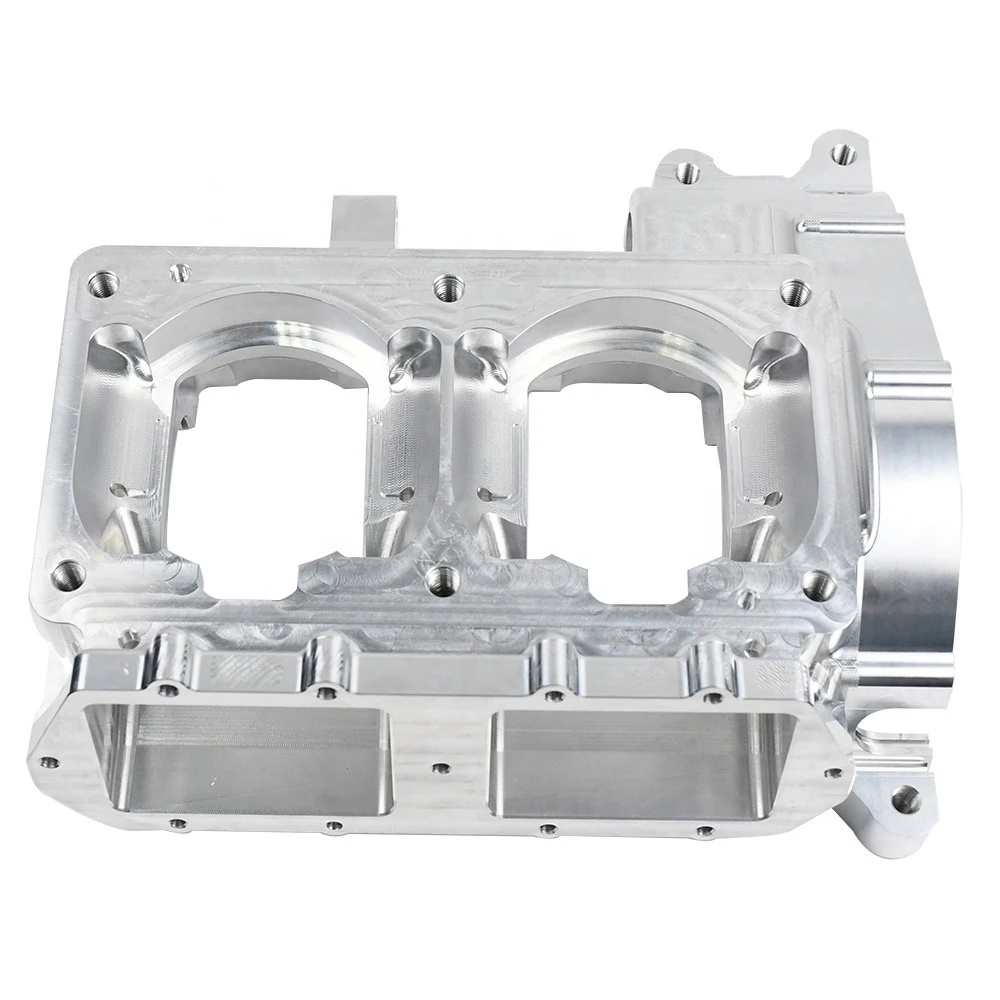
How a Portico Machining Center Is Built
The name comes from the structure: two columns rise from the bed, and a crossbeam spans them like a gateway. The spindle head rides on that beam, so the cutting tool moves in X and Z while the table stays put. On a C-frame vertical mill, the table does the traveling and the column is cantilevered off one side.
That difference matters once the part gets heavy. A 2,000 kg casting placed on a moving table forces the servo to accelerate and decelerate that mass every time the tool changes direction. On a portico machining center, the table only indexes or stays clamped. The moving mass is the ram and spindle head, which is a fraction of the workpiece weight.
The beam is usually a single casting or a welded steel box, ribbed internally. Ram sections of 400 × 400 mm and larger are common on bridge machines, and they resist bending when the spindle reaches down into a deep pocket. Thermal symmetry is another benefit: the columns sit on both sides of the work zone, so heat from the spindle and the chips spreads in a more balanced way than on a single-column machine.
Not every bridge machine is the same. A fixed-beam design locks the crossbeam in place and moves the table in Y. A moving-beam or moving-ram design keeps the table still and drives the beam or ram instead. Both are called portico or gantry machines, but they behave differently under load.
- 1Fixed beamBeam locked; table moves in Y. Good for medium plates and molds.
- 2Moving beamTable fixed; beam travels in Y. Best for very heavy or long parts.
- 3Moving ramBeam fixed, ram extends in Z. Suits deep cavities and tall parts.
- 4Double columnTwo columns carry the beam; widest work envelope.
Why the Bridge Design Holds Accuracy
Deflection is the enemy of tight tolerance. When a spindle pushes a 50 mm end mill through 4140 steel, the reaction force tries to bend the column and lift the table. A closed bridge frame puts two columns in the load path, so the bending moment splits between them. The result is less tool tip movement per unit of cutting force.
That translates into predictable sizes. On a well-maintained bridge machine, bores in the 200–600 mm range can hold ±0.005 mm when the setup is right, and flatness across a 1,000 mm face often lands within 0.02 mm. The machine alone does not guarantee this. Fixturing, tool runout, and thermal drift matter just as much.
Geometry control is another reason shops choose this design. A bridge machine can interpolate a large circular pocket or a long straight edge without the table reversing direction. Reversals are where backlash and servo error show up. Fewer reversals means fewer chances for a step or witness mark in the surface.
Surface finish follows the same logic. With the part clamped to a stationary table, there is no table motion to excite vibration. Finish in the Ra 0.8–1.6 μm range is routine on aluminum and mild steel, and Ra 0.2–0.8 μm is reachable with a light finishing pass, sharp tooling, and a stable fixture.
Where a Portico Machining Center Does Not Fit
A bridge machine is not a universal answer. It is slow on small parts. Setting up a 100 mm bracket on a 4,000 mm table wastes floor space and cycle time, and the spindle often cannot reach the corners of a compact pocket as freely as a 5-axis trunnion machine.
Five-sided work is another boundary. A 3-axis portico machine cuts one face per setup unless you add a right-angle head or a rotary table. If the part needs compound angles, undercuts, or a blended surface on five faces, a simultaneous 5-axis center is usually faster and more accurate than three setups on a bridge.
Floor and foundation requirements are real. A large bridge machine can weigh tens of tonnes and needs a thick, isolated slab. If your building has a thin floor or a lease you cannot modify, that alone can rule the machine out. Power, compressed air, and chip handling also scale up with the work envelope.
Finally, consider batch size. For one-off repair work, a bridge machine earns its keep because the part rarely moves. For a 10,000-piece run of small housings, a faster compact machine with pallet changing will beat it on cost per part. The portico design pays off when the part is large, heavy, or awkward to reposition.
Materials and Cutting Conditions That Suit the Design
The bridge structure shines on materials that demand heavy cuts. Cast iron, 4140, 4340, and A36 plate all cut well when the machine can take a deep axial depth without chatter. A rigid frame lets you push a 63 mm face mill at 2–3 mm depth and 0.15 mm per tooth on steel, which removes metal faster than many light passes.
Aluminum is where the design also wins on size rather than force. Long 6061 or 7075 frames, vacuum plates, and heat sinks need a big envelope more than they need high torque. Spindle speeds of 8,000–15,000 rpm with through-spindle coolant keep the chips moving and the part cool.
Titanium and Inconel change the picture. These alloys generate high cutting forces and heat, so the machine must be stiff and the process must be conservative. A portico machining center can handle Ti-6Al-4V structural parts, but feed rates drop and tool life shortens. Expect to run 40–60 m/min surface speed with heavy coolant.
Plastics and composites are usually not the reason to buy a bridge machine. They cut easily and generate little force. If your work is mostly POM, PEEK, or carbon fibre, a smaller high-speed machine will give better value unless the parts are very large.
- 1Steel plateDeep cuts, low chatter; good fit for the bridge frame.
- 2Aluminum framesSize drives the choice, not force.
- 3TitaniumPossible but slow; stiffness helps, heat does not.
- 4PlasticsRarely justify a bridge machine unless parts are huge.
Fixturing and Setup on a Fixed Table
Because the table does not move in X, workholding is simpler in one way and harder in another. You can clamp a heavy part directly to the T-slots without worrying about the servo pushing a heavy load. But you must reach every feature from the spindle side, so the fixture cannot block the toolpath.
For large plates, a grid of toe clamps and a machined sub-plate works well. For castings with uneven surfaces, three-point support plus adjustable jacks stops the part from rocking. Always indicate the part after clamping, not before. Clamping force can move a thin frame by 0.1 mm or more.
Probing is the practical way to find the part. A spindle probe touches the datum faces and sets work offsets automatically, which saves an hour on a large setup and reduces the chance of a manual error. On a 4,000 mm part, a 0.05 mm offset mistake is easy to make and expensive to find later.
Thermal growth is the last setup issue. A large machine takes time to reach steady state. Running a warm-up cycle for 20–30 minutes before the finishing pass keeps dimensions consistent between the first part and the last.
Portico vs C-Frame vs 5-Axis: Quick Comparison
Use this table to shortlist a machine type before you request a quote.
| Factor | Portico / gantry | C-frame vertical | 5-axis trunnion |
|---|---|---|---|
| Typical part weight | 500 kg to several tonnes | Under 500 kg | Under 300 kg |
| Work envelope | Up to 4,000 mm | Around 1,000 mm | Around 600 mm |
| Best for | Large plates, molds, frames | Small to medium batches | Complex contoured parts |
| Setups for 5 faces | Three or more | Three or more | One |
| Table motion | Fixed or Y only | X, Y, Z travel | Rotary + tilt |
| Floor space | High | Moderate | Moderate |
| Cycle time on small parts | Slow | Fast | Fast |
| Tolerance capability | ±0.005 mm on large bores | ±0.005 mm on small parts | ±0.005 mm on contours |
The Verdict
Choose a portico machining center when the part is large, heavy, or hard to reposition. Choose a C-frame or 5-axis machine when the part is small, complex, or needed in high volume.
Frequently Asked Questions
Is a portico machining center the same as a gantry machining center?
In practice, yes. Both names describe a machine where a bridge or crossbeam carries the spindle above a worktable. Some builders use gantry for a moving table and portico for a moving beam or ram, but the distinction is not universal. Always check the axis configuration, not the label.
What matters for your part is which axes move. A moving-table machine handles medium parts well. A moving-beam or moving-ram machine handles very heavy or very long parts better because the workpiece never moves.
What size part can a portico machining center cut?
It depends on the machine, but bridge machines are built for large work. Travels of 4,000 × 400 × 150 mm and larger are available, and the table can carry several tonnes. If your part fits on a 1,000 mm table, a bridge machine is usually overkill.
At GreatLight, the largest processing size is 4,000 mm, and the machine mix covers small to large work so the right machine can be matched to the part.
Can a portico machining center hold ±0.005 mm?
Yes, on the right features. Large bores and long edges often hold ±0.005 mm when the fixture is rigid, the tool is sharp, and the machine has reached thermal steady state. Thin walls and unsupported overhangs are harder.
The tolerance also depends on material. Aluminum moves less under cutting force than titanium, so it is easier to hold a tight band. Always confirm the critical dimensions with the shop before quoting.
Do I need a 5-axis portico machining center?
Only if the part has compound angles, undercuts, or blended surfaces on more than one face. A 3-axis bridge machine with a right-angle head can reach some side features, but it cannot contour them smoothly.
If the geometry is complex and the part is small, a 5-axis trunnion machine is usually the better fit. If the part is large and mostly prismatic, a 3-axis bridge machine with good fixturing is more cost-effective.
How long does setup take on a large bridge machine?
A first-time setup on a large part can take several hours, mostly for fixturing and probing. Once the fixture is proven, repeat setups drop to under an hour. A dedicated sub-plate with dowel pins makes the biggest difference.
Add 20–30 minutes of warm-up before finishing if the tolerance is tight. Skipping warm-up is a common cause of size drift between the first and last part of a run.
What materials are commonly machined on a portico machining center?
Steel plate, cast iron, aluminum, and stainless steel are the most common. Tool steel and 4140 are routine for mold bases and machine frames. Titanium and Inconel are possible but slow.
Plastics and composites are rarely the reason to use a bridge machine unless the parts are very large. For those materials, a smaller high-speed machine usually gives better value.
Send Us Your Large Part
Upload a STEP file and we will review the setup, machine fit, and tolerance before quoting. Quotation and DFM analysis within 12 hours.
12-hour quoteNo minimum order quantity100% inspection before shipmentNDA on request
More CNC Knowledge
We publish setup notes, tooling trials and inspection data from the factory floor.











