
What Is 8 Axis CNC Machine? In an era where product designs are growing increasingly complex—think aerospace turbine blades with intricate cooling channels, medical implants tailored to a patient’s unique anatomy, or robotic joints that demand seamless motion—traditional 3-axis or even 5-axis CNC machines sometimes hit their limits. Enter the 8 axis CNC machine, a pinnacle of multi-axis machining technology that unlocks new possibilities for precision, efficiency, and design freedom. As a senior manufacturing engineer with decades of experience in precision parts machining, I’ve seen firsthand how these advanced systems transform challenging projects into reality, and how partnering with the right manufacturing partner can make all the difference in leveraging their full potential.
What Is 8 Axis CNC Machine?
At its core, a CNC (Computer Numerical Control) machine uses programmed instructions to control the movement of cutting tools and workpieces across defined axes. While 3-axis machines operate along linear X, Y, and Z axes, 4 and 5-axis systems add rotary axes (A, B, or C) to enable the workpiece or tool to rotate, allowing access to more surfaces without repositioning. An 8 axis CNC machine takes this multi-axis capability to the next level by integrating additional linear or rotary axes, creating a system that can synchronize motion across up to 8 axes simultaneously.
Crucially, there’s no universal configuration for 8-axis machines—designs are tailored to specific use cases by manufacturers:
5-axis core with 3 extra rotary axes: This setup pairs standard X/Y/Z linear axes and two rotary axes with three additional rotary tables for workpiece manipulation, ideal for asymmetric parts that require multiple angles of access.
6 linear + 2 rotary axes: Suited for large-scale structural parts, this configuration combines extended linear travel with precise rotary adjustment to handle complex geometries over a broad workspace.
Tool changer with integrated axes: Some machines add independent axes to their automated tool changers, enabling simultaneous tool preparation and machining to cut non-productive cycle time.
The defining strength of 8-axis machining lies in simultaneous multi-axis interpolation: all 8 axes move in lockstep to maintain the optimal cutting angle relative to the workpiece at every moment. This eliminates the need for multiple setups, reduces human error, and unlocks the production of geometries that were once considered unmanufacturable with standard equipment.
Core Components and Operating Principles of 8 Axis CNC Machines
To deliver such exceptional performance, 8-axis CNC machines rely on a suite of specialized components working in harmony:
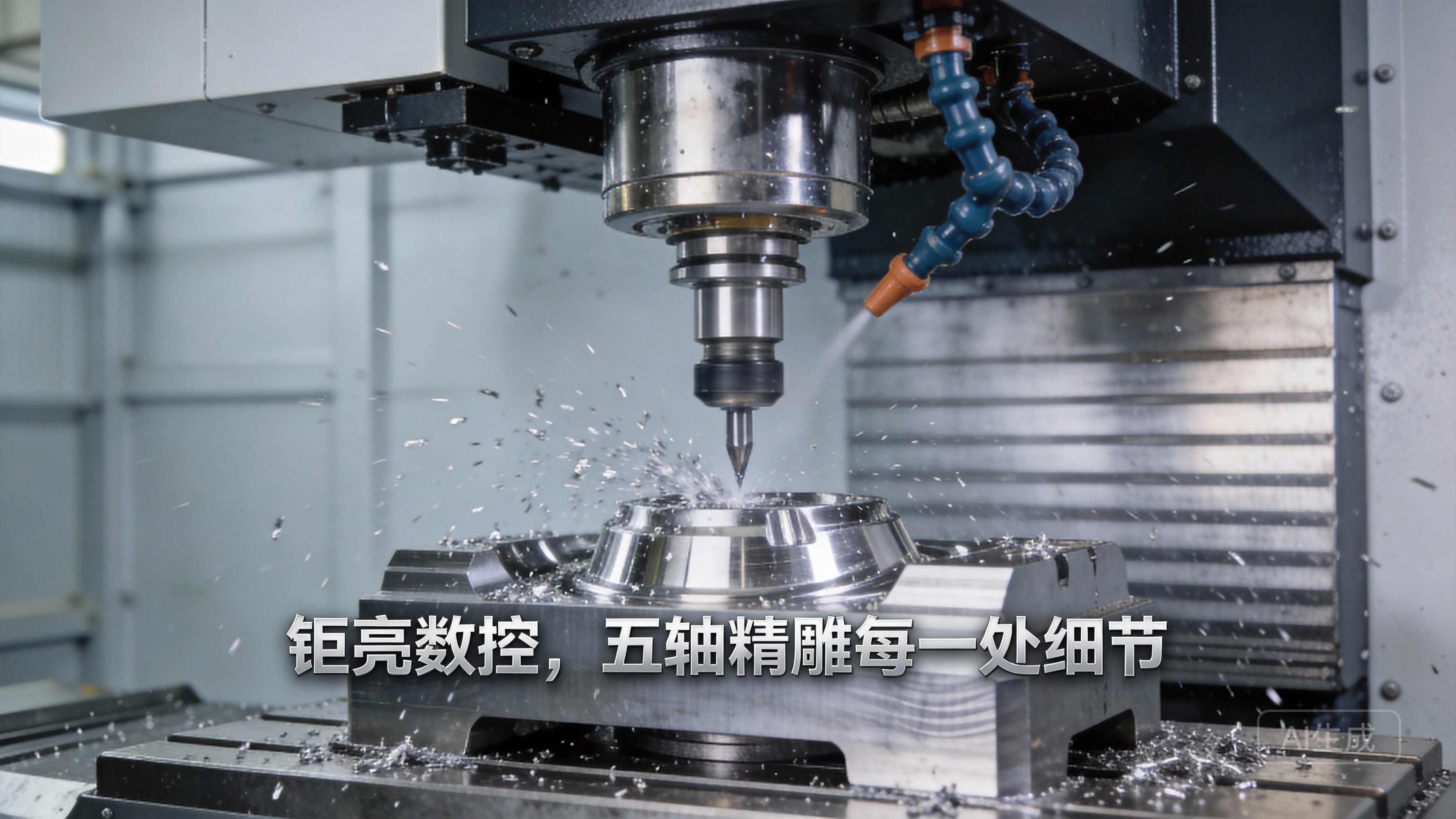
Advanced CNC Control System: The “brain” of the machine, which processes complex G-code programs to coordinate motion across all axes. Top-tier systems use real-time sensor feedback to adjust feed rates and positioning dynamically, ensuring precision even at high speeds.
High-Precision Linear and Rotary Axes: Linear axes (often X/Y/Z plus U/V/W) use ball screws or linear motors for smooth, backlash-free movement, while rotary axes (A/B/C/D/E) use servo-driven tables or swiveling heads to rotate workpieces or tools with repeatability measured in thousandths of a degree.
Multi-Functional Spindle: Many 8-axis machines feature a spindle that can both rotate the cutting tool and tilt/swivel (adding rotary axes), allowing access to hard-to-reach undercuts and internal features without repositioning the workpiece.
Custom Workholding Systems: Rigid yet flexible fixtures or robotic grippers secure the workpiece while enabling motion across multiple rotary axes. These systems are often tailored to specific part geometries to minimize vibration during machining.
In-Process Monitoring Tools: Integrated sensors track cutting forces, tool wear, and workpiece temperature in real time. If anomalies are detected, the control system adjusts parameters or pauses machining to prevent defects, reducing scrap and improving quality consistency.
Advantages of 8 Axis CNC Machining Over Lower-Axis Alternatives
While 8-axis machines represent a significant investment, their ROI for the right projects is undeniable. Here are the key benefits that set them apart:
Reduced Setup Time: Lower-axis machines may require 3–5 setups to access all surfaces of a complex part. 8-axis machining completes most operations in a single setup, cutting setup time by 70% or more.
Minimized Cumulative Error: Each setup introduces small alignment errors. By eliminating multiple setups, 8-axis machining achieves tolerances as tight as ±0.0005mm, critical for aerospace and medical applications.
Unmatched Geometry Flexibility: Parts with deep undercuts, 3D cooling channels, or asymmetric features can be machined in one operation. For example, turbine blades with intricate internal channels no longer require separate casting and machining steps.
One-Piece Machining for Structural Integrity: Critical parts like orthopedic implants or automotive transmission components benefit from being machined as a single piece, eliminating weak points from assembly and improving durability.
Superior Surface Finish: Simultaneous axis motion maintains a constant cutting angle, reducing tool marks and eliminating the need for extensive post-processing—essential for biocompatible or aerodynamic parts.
Higher Productivity: Combining multiple operations into one setup cuts non-machining time (e.g., repositioning, inspection), leading to faster cycle times and higher throughput for complex parts.
Typical Applications of 8 Axis CNC Machines
8-axis machines are specialized tools, best suited for high-value, complex projects across key industries:
Aerospace: Machining turbine blades, fan disks, and landing gear components that must withstand extreme temperatures and forces.
Medical Devices: Custom orthopedic implants, surgical instruments with complex gripping mechanisms, and dental prosthetics tailored to individual patients.
Automotive: High-performance engine components (camshafts, crankshafts) and EV battery housing parts that demand lightweight rigidity.
Robotics: Robotic arm joints, custom end-effectors, and sensor mounts that require seamless motion and precise alignment.
Defense: Precision weapon components and missile guidance systems that adhere to strict military-grade tolerances.
Navigating Complex Projects: GreatLight CNC Machining’s Multi-Axis Expertise
While 8-axis machining offers unparalleled capabilities, it’s not the only solution for complex parts. For many projects, a combination of advanced five-axis CNC machining (opens in new window) and complementary processes can deliver equivalent results at a more accessible cost. This is where partners like GreatLight CNC Machining Factory excel.
Founded in 2011 and located in Dongguan’s “Hardware and Mould Capital,” GreatLight is a leading precision manufacturer with over a decade of experience in multi-axis machining. Their 7600-square-meter facility houses 127 pieces of advanced equipment, including state-of-the-art 5-axis CNC machining centers, 3D printers (SLM, SLA, SLS), and EDM machines. Their team of 150 engineers specializes in transforming complex designs into high-quality parts, leveraging in-house expertise to optimize tool paths and reduce production costs.
For example, an aerospace client needed a complex structural bracket with tight tolerances of ±0.001mm and multiple undercuts. Instead of investing in 8-axis machining, GreatLight’s engineers used a 5-axis machine paired with a custom rotary fixture to mimic 8-axis motion, completing the part in a single setup. They also used in-process coordinate measuring machine (CMM) inspections to ensure every feature met specifications, delivering the part on time and within budget.
GreatLight’s commitment to quality is backed by international certifications: ISO 9001:2015, IATF 16949 (automotive/engine components), ISO 13485 (medical devices), and ISO 27001 (data security). They also offer one-stop post-processing services (anodizing, plating, polishing) and robust after-sales support, including free rework for quality issues and full refunds if rework doesn’t meet expectations.
Key Considerations When Choosing a Complex Machining Partner
If your project requires 8-axis machining or a similarly advanced solution, prioritize these factors when selecting a partner:
Multi-Axis Expertise: Look for a partner with case studies in handling complex parts using 5, 6, or 8-axis machines, and references from your industry.
Comprehensive Capabilities: A one-stop shop offering CNC machining, 3D printing, EDM, and post-processing reduces transfer errors and saves time.
Rigorous Quality Control: Ensure the partner uses in-process inspection tools (CMMs, vision systems) and holds relevant certifications for your industry.
Scalability: Choose a partner that can transition seamlessly from rapid prototyping (delivery in days) to mass production.
Data Security: For sensitive IP, opt for partners with ISO 27001 certification to protect your designs.
After-Sales Support: Look for guarantees like free rework and full refunds to mitigate quality risks.
Conclusion
In summary, What Is 8 Axis CNC Machine? It’s a cutting-edge manufacturing tool that pushes the boundaries of precision and design freedom, enabling the production of parts once thought impossible. While not every project requires 8-axis capabilities, understanding its benefits helps you make informed decisions about your manufacturing needs. For most complex projects, a partner like GreatLight CNC Machining Factory—with deep multi-axis expertise, one-stop services, and a commitment to quality—can deliver exceptional results. For projects that do require 8-axis machining, their industry connections and technical knowledge ensure you’ll get the support you need to succeed. To learn more about their capabilities, connect with GreatLight Metal (opens in new window).
Frequently Asked Questions (FAQ)
1. How much does 8 axis CNC machining cost compared to 5-axis?
8-axis machining is generally 2–3 times more expensive per hour than 5-axis, due to higher machine costs, specialized tooling, and expert labor. However, for parts that require multiple 5-axis setups, the total cost of 8-axis machining may be lower due to reduced setup time and scrap.
2. When should I choose 8-axis over 5-axis machining?
Opt for 8-axis machining if your part has geometries that cannot be fully machined in one 5-axis setup, or if minimizing cumulative error from multiple setups is critical. Examples include parts with deep undercuts or asymmetric features requiring simultaneous rotation of multiple axes.
3. What materials can 8 axis CNC machines handle?
8-axis machines can process a wide range of materials, including metals (aluminum, steel, titanium, nickel alloys) and plastics (PEEK, POM, ABS). The choice depends on the part’s application—titanium for medical implants, aluminum for lightweight aerospace parts, etc.
4. How long does 8 axis CNC machining take for prototypes?
Prototype lead times typically range from 3–7 days, depending on part complexity and material. Mass production runs may take 2–4 weeks, with schedules adjusted based on order volume.
5. Do I need to modify my design for 8 axis machining?
In some cases, 8-axis machining allows you to simplify designs by eliminating assembly steps. Working with a partner like GreatLight early in the design phase (using their DFM services) can help you optimize your part for 8-axis machining, reducing costs and improving quality.
6. Is 8 axis CNC machining suitable for mass production?
Yes, but it’s most cost-effective for high-value, complex parts where reduced setup time and improved quality outweigh higher machine costs. For high-volume simple parts, lower-axis machines are more efficient.
7. How do I ensure quality with 8 axis CNC machining?
Choose a partner with a robust quality control system, including in-process inspection tools and certifications like ISO 9001:2015. GreatLight offers free rework for quality issues and full refunds if rework doesn’t meet expectations, giving you peace of mind.



















