
What Are the Main Types of Die Cast Aluminum Material?
Four alloy families cover most die cast aluminum material decisions: A380, ADC12, A360 and B390. This page explains what each one does in the die, where it stops working, and how the choice changes your machining and finishing steps.
In this article
- 1
- 2
- 3
- 4
- 5
- 6
- 7
- 8
Why Aluminum Casts Differently from Zinc
Aluminum melts around 580–660 °C depending on the alloy. That is roughly double the working temperature of zinc, and it shapes every other decision on this page. Hot metal dissolves steel tooling, so aluminum runs in cold chamber machines where a ladle fills the shot sleeve, not in a hot chamber pot.
The die itself is usually H13 tool steel, water-cooled through drilled channels. Cycle time runs 30–90 seconds for a mid-size part, and about half of that is solidification, not injection. Your alloy choice is largely a choice about how fast the part freezes and how it behaves while shrinking.
Aluminum shrinks roughly 0.4–0.7% as it cools in the die. The alloy and the wall thickness set the exact number. A 200 mm housing can lose more than 1 mm across its length, which is why die cast parts are usually designed oversize on critical faces and then trimmed back on a CNC.
Porosity is the other constant. Gas trapped during the shot forms small voids, and they cluster where walls are thick or flow paths meet. Vacuum assistance and tighter process windows reduce it, but no die casting process removes it entirely. Design for it rather than pretend it away.
A380 and ADC12: The Default Choices
A380 is the alloy most Western die casters quote first. It flows well, fills thin walls, and holds dimensional stability across a long production run. Typical chemistry is 7.5–9.5% silicon, 2.0–4.0% copper, and up to 3.0% zinc. Tensile strength lands around 324 MPa, yield near 159 MPa.
The copper content is what gives A380 its strength and its weakness. Copper improves hardness and machinability, but it also drops corrosion resistance in salt spray. For an indoor electronics enclosure that is fine. For a part bolted under a vehicle, it is a conversation worth having before tooling is cut.
ADC12 is the Japanese designation for a composition close to A380. The two are interchangeable in practice for most parts, and many shops treat them as the same material on the shop floor. If your drawing calls out ADC12 and your foundry stocks A380, ask for the chemistry sheet before you accept the substitution.
Copper content also affects how the part machines. Higher copper means cleaner chips and better surface finish on a fly cutter. Lower copper grades can smear and require sharper tooling and a slower feed on the finish pass.
A360 and B390: Flow and Wear Resistance
A360 trades a little strength for markedly better corrosion resistance and pressure tightness. Silicon sits at 9.0–10.0% with copper held under 0.6%. It fills thin sections well, so it suits covers, pump bodies and parts that see moisture or road salt.
The trade-off is real. Lower copper means lower hardness, so A360 is softer under a cutting tool and less wear resistant on sliding surfaces. If a bore needs to run against a steel shaft, A360 is the wrong pick.
B390 goes the other direction. It carries 16–18% silicon, which forms hard primary silicon particles in the matrix. Those particles make the alloy highly wear resistant. They also make it hard on tooling: expect to machine it with PCD or coated carbide at reduced speed.
B390 is common in engine blocks, brake components and hydraulic parts where a bore or face takes continuous abrasion. It is rarely the right choice for a cosmetic housing, because the silicon tends to show as a mottled surface after anodizing.
A413 and K-Alloy: Pressure Tightness
A413 sits near the low end of the copper range and near 11–13% silicon. It is a pressure-tightness alloy. Where A380 might weep through a thin wall under 3 bar of air, A413 often holds, which is why you see it in manifolds and sealed enclosures.
The cost of that tightness is ductility and strength. A413 is more brittle and less forgiving of a cold shut or a sharp inside corner. It also machines to a slightly duller finish than A380, which matters if the part has a visible face.
K-Alloy is a proprietary low-copper family developed for parts that see moisture and salt. It offers corrosion resistance closer to A360 while keeping better castability in thin walls. Availability varies by region, so confirm your source before you design around it.
Both families are usually run with vacuum assist on the shot. The alloy chemistry helps, but the process window is what actually closes the leaks.
Mechanical, Physical and Composition Data in Context
A typical high-pressure aluminum die casting alloy shows 310–330 MPa tensile strength, 150–170 MPa yield, and 2–4% elongation. Hardness sits around 75–95 HB. Density is about 2.7 g/cm³ across the family, so weight differences between grades are small.
Do not read those numbers as a design allow. Cast tensile values are measured on separately cast test bars, and they assume low porosity in the gauge section. A real part with a thick boss next to a thin rib will not hit the same figure at that boss.
Thermal conductivity runs 92–121 W/m·K. That is why die cast aluminum works well as a heat sink housing. It also means the part pulls heat out of the die quickly, which is why cooling channel layout matters more than most people expect.
Thermal expansion sits around 20–22 × 10⁻⁶ /°C. If a die cast housing holds a steel insert or mates with a steel bracket over a 60 °C swing, the two materials move at different rates. Plan the clearance for the hot condition, not the assembly bench.
Where Die Cast Aluminum Material Reaches Its Limits
Wall thickness is the first boundary. Below about 1.0 mm the metal freezes before it fills the cavity, and you get cold shuts. Above roughly 4.0 mm the thick section cools last and pulls a shrinkage void into the middle of it. Ribs and bosses exist to keep sections even.
Draft is the second. Die cast parts need 1–3° of draft so they release without galling. That seems small, but on a 150 mm deep wall it becomes several millimeters of taper. A part designed with vertical walls will need secondary machining or a redesign.
Undercuts need slides or lifters, and each one adds tooling cost and a place for flash to form. If a feature can be machined in later, it is often cheaper than putting a slide in the die.
Porosity is the third. If the part must hold gas or hydraulic pressure, or if a tapped hole needs full thread strength, casting alone may not get you there. Vacuum assist, squeeze pins and local overflows help. So does leaving stock and machining the critical zone clean.
How Machining Changes the Material Choice
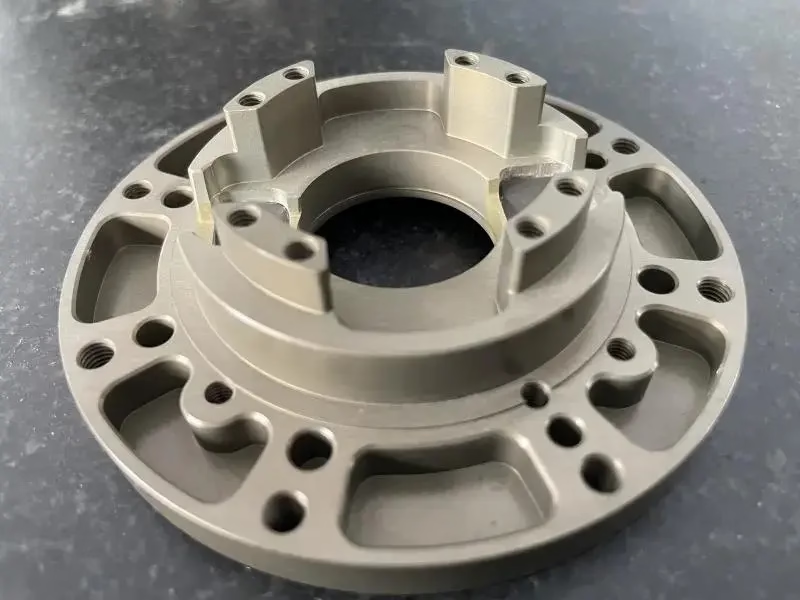
Most die cast parts we see are cast to near net shape and then finished on a CNC. The casting provides the 3D geometry and the machining provides the tolerances: ±0.005 mm on a bore, Ra 0.8–1.6 μm on a sealing face, a flatness callout on a mating surface.
That split matters when you pick the alloy. A380 machines cleanly at moderate speeds with coated carbide. B390 needs PCD inserts because the silicon particles will chip a carbide edge in a few hundred parts. A360 cuts softer and can tear unless you keep the feed up.
Castings also have a hard skin and a softer core. The skin comes from fast cooling at the die surface and it can be 0.3–0.8 mm deep. It is harder on the first pass, so a light cleanup cut before the finishing pass usually pays for itself in tool life.
We hold 127 CNC machines across three plants, including 16 simultaneous 5-axis centers and 12 four-axis mills. That mix lets us take a casting from a 4,000 mm frame down to a Ø400 mm rotary table without moving the job to another supplier.
Die Cast Aluminum Material Comparison
Values are typical ranges for high-pressure die casting. Confirm against your supplier's chemistry sheet.
| Alloy | Best for | Watch out for | Machining note |
|---|---|---|---|
| A380 | General housings, brackets, thin walls | Lower salt-spray resistance | Coated carbide, moderate speed |
| ADC12 | Same as A380, Asian supply chains | Check chemistry on substitution | Same as A380 in practice |
| A360 | Wet or road-salt environments, covers | Softer, less wear resistant | Sharp tooling, keep feed up |
| B390 | Wear faces, engine and brake parts | Hard on tooling, mottled after anodizing | PCD inserts, reduced speed |
| A413 | Pressure-tight manifolds and enclosures | Brittle, duller finish | Light cuts, watch cold shuts |
| K-Alloy | Moisture plus thin walls | Regional availability varies | Similar to A360 |
| 6061 / 7075 billet | Tight tolerance, low volume, no tooling | Higher unit cost at volume | 5-axis, ±0.005 mm |
The Short Version
If the part is a general housing and volume justifies tooling, use A380 or ADC12. If it sees salt or moisture, move to A360 or K-Alloy. If a surface must resist wear, use B390 and budget for PCD tooling. If you need ±0.005 mm on several faces and fewer than a few thousand parts, machine from 6061 or 7075 billet and skip the die.
Questions Engineers Ask Next
Can A380 and ADC12 be used interchangeably?
In most high-pressure die casting jobs, yes. The two compositions overlap closely enough that flow, strength and machining behavior are similar on the shop floor.
The difference shows up in documentation and in traceability. If your drawing or your customer's spec names one grade, ask for the chemistry sheet on the delivered lot rather than accepting a verbal assurance.
Which die cast aluminum material is best for anodizing?
Low-copper grades finish more evenly. A360 and A413 take a clearer anodic layer than A380 because copper tends to darken and mottle the coating.
B390 is the hardest to finish cosmetically. Its 16–18% silicon content produces a visible pattern after anodizing, so it is normally used where appearance does not matter.
How much stock should I leave for machining?
For a face that only needs cleanup, 0.3–0.5 mm per side is usually enough to clear the hard cast skin. For a bore held to ±0.005 mm, leave 0.5–1.0 mm and take it in two passes.
Leaving too much stock creates its own problem. The deeper you cut, the more likely you open a subsurface pore, and that pore becomes a leak path or a visible defect on the finished face.
Does die cast aluminum material work for pressure-tight parts?
It can, but the alloy is only half the answer. A413 and low-copper grades give you a better starting point than A380, and vacuum assist during the shot closes most of the remaining path.
For parts that must hold gas or hydraulic pressure, plan on leak testing every unit and on machining the sealing faces. Casting alone rarely holds a tight spec across a full production run.
When should I machine instead of casting?
Below a few hundred parts, tooling cost usually outweighs the per-part saving from casting. If the geometry changes during development, that tipping point moves even higher.
Machining from 6061 or 7075 billet also removes the porosity question entirely, which matters for thin sealing walls and for parts that must hold a vacuum.
What tolerances can I expect on a die cast part?
As-cast tolerances on a well-controlled part typically sit around ±0.1 mm on a 100 mm dimension, loosening as the dimension grows. Draft and shrinkage both add to the stack.
Anything tighter needs to be machined after casting. We hold ±0.005 mm on machined features and inspect 100% of parts before shipment, with reports available on request.
Send Us Your Drawing and Alloy Callout
We will review the casting, the alloy choice and the machining split, then come back with a quote and a DFM analysis within 12 hours.
12-hour quote100% inspectionNo minimum order quantity
More from the shop floor
We publish setup notes, tooling trials and inspection data from the factory floor.











