
Vacuum Casting Advantages: How Vacuum Changes the Fill
Vacuum casting advantages come from one physical fact: air is removed before resin enters the cavity. This page explains the mechanism, the wall-thickness and feature limits that follow from it, and the point where a silicone tool stops making sense. Written for design and process engineers deciding between urethane casting, CNC machining and injection molding.
In this article
- 1
- 2
- 3
- 4
- 5
- 6
- 7
What the Vacuum Actually Does Inside the Mold
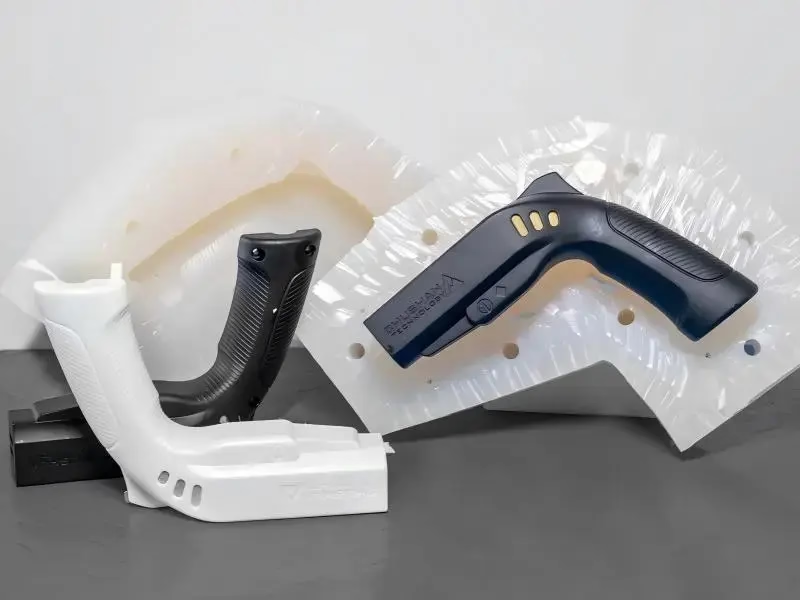
A vacuum casting setup is a silicone mold inside a chamber. The chamber is pumped down to roughly 1–10 mbar, resin is mixed and degassed under the same vacuum, and only then is it poured or drawn into the cavity. At that pressure the air that would normally be trapped in undercuts, blind holes and thin ribs is largely gone before the resin arrives.
The result is a fill that follows gravity and pressure difference instead of fighting trapped gas. That is the whole mechanical story behind most vacuum casting advantages. Nothing about the resin chemistry changes. The cavity simply fills without air pockets, so surface detail reproduces and the part comes out closer to the master pattern.
Because the mold is silicone, it is flexible. Undercuts and small back-cuts release by stretching the tool rather than by sliding cores. A master pattern machined to ±0.005 mm on our 5-axis centers can be reproduced in the cast part with the shrink factor of the resin applied.
Degassing also cuts porosity in thick sections. Resin that has been held under vacuum releases dissolved air before cure, so a 6 mm boss is less likely to show internal voids than the same boss poured in open air. That matters for parts that will be drilled, tapped or pressure tested later.
Feature Sizes That Vacuum Casting Handles Well
Wall thickness is the first number to check. Cast urethane fills reliably from about 0.8 mm up to roughly 6 mm. Below 0.8 mm the resin may not reach the end of a long rib before it gels. Above 6 mm the exotherm rises and shrinkage becomes uneven across the section, so thick blocks are better hollowed or split.
Fine detail reproduces well because the silicone copies the master surface. Text, logos and texture down to about 0.1 mm depth survive the cast. Sharp internal corners do not, since the silicone needs a radius to release without tearing. Add a 0.5 mm minimum internal radius and the tool will last its full shot count.
Draft is less critical than in steel tooling, but flat vertical walls still drag. A 1–2° draft on deep ribs reduces silicone fatigue and keeps the parting line clean. Through holes cast as holes are usually easier than holes drilled afterward, provided the core pin is at least 1 mm in diameter.
Size matters less than people expect. Silicone molds can handle parts up to roughly 500 mm on the longest side, but the larger the mold, the more it distorts during handling. For anything beyond that, CNC machining the end-use parts is usually the cheaper route.
Resin Choice Sets the Mechanical Properties
Vacuum casting uses polyurethane and epoxy resins, not thermoplastics. You pick a Shore hardness and a property profile rather than a named polymer grade. Common shop references run from Shore A 40 rubber-like resins through Shore D 70–80 rigid boards, with options that mimic ABS, PC, PP or glass-filled nylon in feel and stiffness.
The gap to real thermoplastics is real. A cast part that imitates ABS will be close in modulus but lower in heat deflection, typically softening well below the 100 °C range an injection-molded ABS grade can take. If the part sees oven cycles, engine-bay heat or steam sterilization, cast urethane is the wrong answer.
Filled resins change the picture. Glass-filled and mineral-filled urethanes raise stiffness and improve dimensional stability, and they machine and tap more cleanly than unfilled grades. They also wear the silicone faster, so expect the low end of the 25–50 shot range.
Color and finish are handled at the casting stage. Pigment goes into the resin, and a texture can be transferred from the master. Painting, laser marking and light bead blasting afterward are all normal, but heavy polishing on a soft resin will round edges.
Silicone Tool Life and What Ends It
A silicone mold is made by suspending the master pattern in a frame and pouring uncured silicone around it. After cure the mold is cut open along a planned parting line, the master is removed, and the two halves are registered by the frame or by locating keys. One master can produce several molds, which is how a 50-piece order gets split across two or three tools.
Shot life lands between about 25 and 50 casts per mold. Several things push it to the low end: hard or filled resins, sharp internal corners, deep thin ribs, and careless de-molding where the operator pulls instead of peeling. Polyurethane also attacks silicone slowly, so a mold left loaded with resin degrades faster.
Dimensional drift is the quiet cost. Each shot wears the cavity slightly, and the first cast is always the most accurate. If your drawing has a tight tolerance on a mating feature, either plan to inspect the first article and accept gradual movement, or move that feature to a machined insert.
Molds are cheap enough to revise. When a design change lands, cutting a new silicone tool costs far less than reworking a steel mold, which is why vacuum casting fits the stage of a project where the geometry is still moving.
Where the Cost Advantage Comes From
Vacuum casting wins on the front end of a program. There is no steel to cut, no cooling circuit to design and no press schedule to book. A silicone tool can be made in a day or two once the master exists, and the master is often a CNC-machined or 3D-printed part you already have.
The cost curve crosses over. Per-part price stays roughly flat as quantity rises, because each shot consumes labor and mold life. Injection molding starts expensive and then drops sharply. Somewhere in the low hundreds, the injection route usually becomes cheaper per part, and the exact crossover depends on part size and how many tools are needed.
Design changes are cheap at this stage. Revising a silicone tool or cutting a new one is a fraction of reworking a steel mold, so late changes do not stall the schedule. That is the main reason teams use cast urethane parts for pre-production builds and fixtures.
Speed to a physical part matters too. A quotation and free DFM analysis come back within 12 hours, production can start within 24 hours, and parts ship in 3–5 days. For a design review next week, that beats waiting on tooling.
Boundaries: When Vacuum Casting Is the Wrong Call
Do not use it for parts that carry load. Cast urethane creeps under sustained stress, and its fatigue behavior is far below that of a machined aluminum or steel part. A bracket that holds a static display is fine. A bracket that sees vibration and preload is not.
Do not use it where heat is part of the duty cycle. Reflow ovens, under-hood environments, autoclaves and hot-water sterilization all push past what most casting resins tolerate. Choose a material by its actual service temperature, not by the plastic it claims to imitate.
Do not use it for optically critical surfaces. A cast window can be clear, but it will not match the clarity and scratch resistance of a polished PMMA or PC part. Light pipes and lenses are better machined and polished.
Finally, do not use it for a production part that will never change. If the geometry is frozen and the volume is real, spending on a steel tool early usually pays back. Vacuum casting is a bridge, and bridges are meant to be crossed.
Vacuum Casting Compared With CNC and Injection Molding
Use this to pick a route by quantity, geometry and material, not by habit.
| Factor | Vacuum casting | CNC machining | Injection molding |
|---|---|---|---|
| Typical quantity | 1–50 parts per mold | 1–100+ parts | 1,000+ parts |
| Tooling cost | Low, silicone mold | None | High, steel mold |
| Lead time to first part | Days | Days | Weeks |
| Material range | Urethane and epoxy resins | Metals plus engineering plastics | Thermoplastics only |
| Heat resistance | Low, resin dependent | High for metals | High, grade dependent |
| Tolerance held | Looser, resin shrink applies | ±0.005 mm on our mills | Tight, tool dependent |
| Best for | Look and feel models, bridge builds | Functional metal parts | Stable high-volume parts |
| Weak point | Short tool life, drift | Cost per part at volume | Tooling cost and change cost |
The Short Answer
If you need 5 to 50 parts that look and feel like the final product and the design is still moving, vacuum casting is the cheaper and faster route. If the part carries load, sees heat above roughly 80 °C, or the design is frozen at volume, machine it from metal or go straight to injection molding.
Questions Engineers Ask Next
How tight a tolerance can a vacuum cast part actually hold?
Treat the silicone mold as a soft tool. A well-made master machined to ±0.005 mm will reproduce faithfully, but the cast part carries the resin shrink factor plus wear from each shot.
Practical shop tolerance on a stable, unfilled resin is around ±0.1 mm on small features, and it drifts as the mold ages. Put tight mating features on machined inserts or plan to ream them after casting.
Can vacuum casting produce clear or colored parts?
Yes. Clear resins exist and pigment can be mixed into the batch, so color matching across a run is straightforward.
Clear cast parts will not match the optical clarity or scratch resistance of polished PMMA or polycarbonate. For light pipes and lenses, machine and polish the part instead.
Does the vacuum remove the need for draft angle?
No. Silicone stretches, so draft is less critical than in steel tooling, but flat vertical walls still drag on release and fatigue the mold.
A 1–2° draft on deep ribs keeps the parting line clean and extends shot life. Sharp internal corners should carry at least a 0.5 mm radius.
What is the largest part that makes sense to cast?
Around 500 mm on the longest side is the practical ceiling, because large silicone molds distort when handled and the master itself becomes expensive to make.
Above that, machining the end-use parts from aluminum or plastic is usually cheaper and more dimensionally stable than a big soft tool.
How do I plan post-processing on a cast part?
Plan it before the mold is cut. Tapped holes, reamed bores and flat sealing faces are better machined after casting, and those features need stock left on the casting.
Painting, laser marking and light bead blasting are routine on cast urethane. Heavy polishing will round edges on soft resin grades.
Can vacuum casting be combined with CNC machining on one project?
That is the usual setup. The master pattern is CNC machined, the cast parts cover the visual and fit-check builds, and any load-bearing or heat-exposed component is machined from metal.
We run both under one roof, so a mixed bill of materials ships together and the tolerances stay consistent across the two routes.
Send the Drawing, Get a Straight Answer
Upload your part and we will tell you whether vacuum casting, CNC machining or injection molding fits your quantity and material, with a quotation and free DFM analysis back within 12 hours.
12-hour quote100% inspectionNDA on request
GreatLight elsewhere
We publish setup notes, tooling trials and inspection data from the factory floor.











