
CNC Machining Brand New Cummins ISX Engine Parts: How It Works
A plain explanation of what CNC machining actually does to a brand new Cummins ISX block, head, cover and bracket. Written for engineers and buyers who need to judge whether a part can be machined, what tolerance is realistic, and where the process stops being economical.
In this article
- 1
- 2
- 3
- 4
- 5
- 6
What CNC machining removes from a new ISX casting
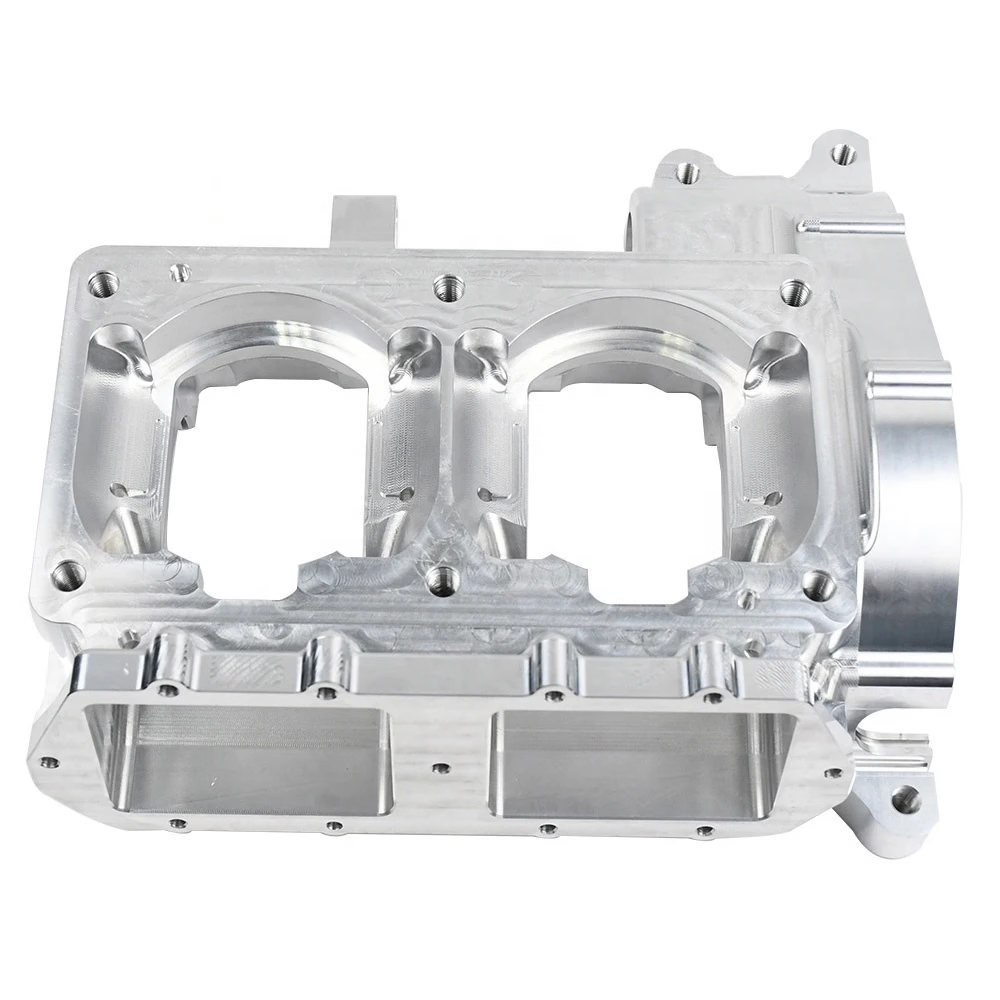
A Cummins ISX block or head starts as a casting or forging. The casting is close to final shape, but it is not final size. Surfaces arrive with draft angles, parting-line flash and 1–3 mm of stock. CNC machining brand new castings means cutting that stock away until the datums, bores and sealing faces sit where the drawing says they should.
The first operation is never about the finished surface. It is about creating a datum. Usually we face one side flat, then drill and ream two locating holes. Every later setup references those two holes. If the datum is off by 0.02 mm, the cylinder bore will be off too, and no amount of finishing will recover it.
Removal happens in passes. Roughing takes 60–75% of the stock with a 50–80 mm face mill at 0.3–0.5 mm per tooth. Semi-finishing leaves 0.3–0.5 mm. Finishing takes the last 0.1–0.2 mm at higher speed and lower feed to hold flatness and surface finish.
Cast iron and compacted graphite iron cut differently. CGI is roughly twice as strong in tension and much harder on tool edges. On an ISX-size block we expect insert changes every 20–30 minutes of cutting in CGI, versus 60–90 minutes in gray iron.
- 1Datum firstFace and ream two holes before any bore work.
- 2Stock splitRough 60–75%, semi-finish 0.3–0.5 mm, finish 0.1–0.2 mm.
- 3Tool lifeCGI wears inserts about twice as fast as gray iron.
Why fixturing decides the tolerance on an ISX block
An ISX block weighs several hundred kilos. The cutter pushes back, and that force has to go somewhere. Bolt it to a plate and the casting will spring. Support it on three points under the main bearing bulkheads, clamp over the stiffest ribs, and the distortion drops to a few microns.
Thermal drift matters as much as clamping. A block that sits on the bed at 20 °C and warms to 28 °C during two hours of cutting grows about 0.02 mm across 800 mm of cast iron. We rough in the morning, let the part equalize, then finish. That single pause is often worth more than a tighter machine spec.
For smaller parts such as covers, timing cases and brackets, a 5-axis setup with a Ø400 mm rotary table handles five faces in one clamp. Each unclamping adds error. Going from three setups to one typically cuts position variation by half.
Long parts need the right travel. Our largest envelope is 4,000 × 400 × 150 mm. A full-length ISX cylinder head fits there. If a part is longer than the machine, it has to be repositioned mid-cut, and that joint is where flatness suffers.
- 1Three-point supportUnder bulkheads, not under the thin walls.
- 2Thermal pauseRough, equalize, then finish critical faces.
- 3Fewer setupsOne 5-axis clamp beats three 3-axis clamps.
Which materials suit CNC machining brand new engine parts
Most ISX-family parts that reach a machine shop are cast iron, aluminum or steel. Aluminum covers and housings cut fast and hold ±0.005 mm without drama on a rigid machine. Heat-treated steel rocker components cut slower and move more after stress relief.
Grade matters more than alloy family. Aluminum 6061-T6 is stable and welds well. 7075 is stronger but galls and needs sharp tooling. On stainless, 316L resists corrosion and machines with a gummy chip; 17-4PH in the H900 condition is hard and should be roughed before final heat treat whenever the drawing allows.
Titanium and Inconel are possible but rarely economical for a full block. We do machine Ti-6Al-4V brackets and Inconel exhaust-side components. Both need low cutting speed, high coolant pressure and generous rigidity. Expect tool cost to dominate the quote.
Plastics show up for prototype intake runners and covers. PEEK and POM hold dimension well; ABS and PP do not, and they should not be used for anything that seals.
- 1Aluminum6061-T6, 7075, 6082. Fast, stable, tight tolerance.
- 2Cast ironGray iron cuts clean; CGI is harder on edges.
- 3Stainless303 for speed, 316L for corrosion, 17-4PH for strength.
- 4ExoticsTi-6Al-4V and Inconel work, but tool cost rules.
Where CNC machining brand new parts stops paying off
CNC wins when the geometry is complex, the quantity is low to moderate, or the tolerance is tight. It loses when the part is a simple shape needed in tens of thousands. A flat cover with four holes is a stamping or a die casting, not a milling job.
Deep bores are a boundary. A cylinder bore with a 10:1 depth-to-diameter ratio needs a boring bar long enough to chatter. Past roughly 8:1, we slow down, take lighter passes and often add a reaming step. Past 12:1, the process gets slow and the quote reflects it.
Internal corners are another limit. A 6 mm end mill leaves a 3 mm corner radius. If the drawing calls for a sharp internal corner, someone has to EDM it or the design has to change. Engineers who model a 0.5 mm corner and expect milling are usually the ones surprised by the quote.
Finally, surface finish has a price. As-machined at Ra 1.6–3.2 μm is standard. Going to Ra 0.2–0.8 μm needs a separate finishing pass with a small stepover, which can double cycle time on a large face.
- 1QuantityHigh volume simple parts belong in casting or stamping.
- 2Deep boresBeyond 8:1 the bar deflects; beyond 12:1 it is slow.
- 3CornersA 6 mm cutter cannot leave a sharp internal corner.
- 4FinishRa 0.2–0.8 μm can double the cycle on a large face.
How we prove an ISX part is in tolerance
Every part gets inspected before it ships. That starts with the raw material certificate, because a casting with a hard spot will scrap a batch. In-process checks catch drift while the part is still on the machine. Final inspection confirms what the drawing asks for.
On a block, the critical checks are bore diameter, bore straightness, deck flatness and main bearing alignment. Deck flatness on a head is typically held to 0.05 mm over the full length. Bore roundness is checked at three heights because a bore can be round at the top and oval at the bottom.
Reports are available on request. We do not ship a first article without dimensional data, and for automotive programs we follow the PPAP-style documentation that IATF 16949:2016 calls for.
The qualification rate across our plants is 99.99%. That number is not a marketing claim; it is what happens when you inspect 100% of parts instead of sampling.
- 1Material firstHard spots in a casting scrap a whole batch.
- 2In-processCatch drift before the part leaves the machine.
- 3FinalBore, flatness and alignment against the drawing.
When CNC is the right call for engine components
Match the process to geometry, volume and tolerance — not to habit.
| Part type | Typical process | Best when | Watch out for |
|---|---|---|---|
| Cylinder block | CNC boring and milling | Low volume, prototype, or rework | Spindle travel vs block length |
| Cylinder head | 5-axis CNC | Complex ports, tight deck flatness | Thermal drift over long cuts |
| Timing cover | CNC or die casting | CNC under 2,000 pcs, casting above | Sealing face flatness |
| Bracket | CNC or stamping | CNC for low volume, stamping for high | Sharp internal corners |
| Turbo housing | CNC + casting | Cast shape, machined flanges | Thin walls deflect |
| Prototype manifold | CNC or 3D printing | CNC for metal, print for fit checks | Surface finish on printed parts |
The short answer
If you need one to a few hundred brand new engine components with tight tolerances and a real inspection record, CNC machining is the right route. If the part is simple and you need tens of thousands, a casting or stamping tool pays back faster. Send the drawing and we will tell you which side of that line you are on.
Common questions
Can you machine a brand new Cummins ISX block from a bare casting?
Yes. We machine from customer-supplied castings or from billet when no casting exists. The first operation establishes the datum, then we cut main bores, deck faces and mounting pads.
Send the drawing or a 3D model with the casting number. We run a free DFM analysis within 12 hours and flag any feature that cannot be cut as drawn.
What tolerance can you actually hold on a large engine casting?
Our standard capability is ±0.005 mm on features we can reach in one setup with rigid support. On large castings, position tolerance across several setups is typically ±0.02 mm because of thermal and clamping effects.
If a drawing calls for tighter than that on a long part, the design usually needs a datum change rather than a tighter machine.
How do you handle confidential engine drawings?
Uploads are secure and confidential. We sign an NDA on request before any file is shared with the shop floor, and we hold ISO 27001:2022 for information security.
Customer drawings and models are never used in marketing material.
What is the smallest order you accept?
There is no minimum order quantity. We run from a single prototype to 10,000+ part runs.
For one-off engine parts, expect the quote to be dominated by setup and programming rather than material.
How fast can parts ship?
Quotation and DFM feedback come back within 12 hours. Production can start within 24 hours of approval, and parts typically ship in 3–5 days.
Large castings that need a thermal equalization pause between roughing and finishing add one day.
Do you provide inspection reports with engine parts?
Yes, on request. We inspect 100% of parts before shipment and can supply dimensional reports, material certificates and surface finish data.
For automotive programs we follow IATF 16949:2016 documentation practice.
Send the drawing, get a real answer
Upload your ISX component model and we will come back with a quote, a DFM note and a realistic tolerance range.
12-hour quote100% inspectionNDA on request
More from GreatLight
We publish setup notes, tooling trials and inspection data from the factory floor.











