
UPS Battery Rack Frame Aluminum: How the Structure Actually Carries Load
A UPS battery rack frame aluminum assembly sits between hundreds of kilograms of cells and the floor of a data hall. This page explains the mechanics, the alloy and temper choices, the weld and machining sequence, and the points where a frame stops being a simple rectangle. Written for design engineers and procurement staff who have to sign off on the drawing.
In this article
- 1
- 2
- 3
- 4
- 5
- 6
- 7
What a UPS Battery Rack Frame Aluminum Structure Has to Resist
A rack looks passive. It is not. Every cell in a string adds dead weight, and a 40-cell string at roughly 30 kg per cell puts about 1,200 kg onto rails that may only be 2 mm to 4 mm thick at the web. The frame has to carry that load without visible sag, because deflection changes how the cells sit in their trays and how the terminal links line up.
Three load cases matter more than the static one. First, short-circuit forces: a high-current fault pushes adjacent busbars and cables apart with a force that scales with the square of the current. Second, seismic events, which turn the rack into a lateral cantilever and drive bending into the base brackets. Third, thermal cycling, which expands and contracts the aluminum while the cells stay near ambient.
Enclosure stiffness is the other half of the job. The frame often doubles as the mounting surface for a sheet metal enclosure, so rack twist shows up as door misalignment and gasket gaps. A frame that passes a static load test can still fail an enclosure fit check if the diagonal tolerance is loose.
Aluminum is chosen here for a reason that has little to do with weight. The material is non-magnetic, it does not rust in a humid battery room, and it machines fast enough that short-run rack variants stay affordable. It is also easy to anodize, which matters when the rack sits in a visibly finished room.
- 1Dead loadCell mass plus trays plus cable weight, usually the design driver for rail section.
- 2Fault loadShort-circuit forces act on busbars, not on the frame directly, but they reach it through standoffs.
- 3Seismic loadBase brackets and anchor plates take the highest moment in the assembly.
- 4Enclosure loadDoor and panel alignment depends on frame squareness, not just on rail strength.
Why 6061-T6 and 6082 Dominate Battery Rack Frames
Almost every welded rack frame we machine is 6061-T6 or 6082-T6. Both are heat-treatable, both weld reasonably well, and both are available as standard extrusion profiles. The T6 temper gives yield strength around 275 MPa for 6061, which is enough for rails in the 3 mm to 6 mm wall range without adding mass.
The catch is the heat-affected zone. Welding drops the local temper toward T0 in a band roughly 10 mm to 25 mm wide next to the weld toe. Yield strength there can fall by 40% or more. If the drawing shows a welded corner bracket taking the full seismic moment, the analysis has to use the softened value, not the parent metal value.
When stiffness matters more than strength, 6063 is sometimes used because it extrudes into tighter profiles. It is weaker, around 170 MPa yield in T6, so it suits light trays and cable management arms rather than main rails. 5052 and 5083 turn up in sheet metal covers where formability and corrosion resistance beat strength.
We keep 6061, 6061-T6, 2024, 5052, 5083, 6063, 6082, 7075 and ADC12 on the shelf. For rack work the practical shortlist is 6061-T6 for machined brackets and 6082-T6 for welded frames, because 6082 holds a little more strength after welding.
Weld Distortion and the Machining Sequence That Controls It
A rack frame is usually welded first and machined second. That order exists because welding moves metal. A 1,000 mm rail with a 6 mm fillet at each end can pull 0.5 mm to 1.5 mm out of square depending on heat input, fixture stiffness and cooling rate. Machining after welding removes the distortion from the surfaces that matter.
Heat input is the lever. Tacking in a balanced sequence, letting each tack cool, and using the lowest current that still gives fusion will keep distortion inside 0.3 mm on most frames. Skipping the cool-down between passes is the most common mistake we see when a frame arrives out of tolerance from another shop.
After welding, the frame is stress-relieved where the drawing calls for it, then set on a fixture and machined in one setup where possible. Mounting hole patterns, tray datum faces and anchor plate bores all come off the same zero. That is how you hold ±0.005 mm on a bore while the overall frame is 2,000 mm long.
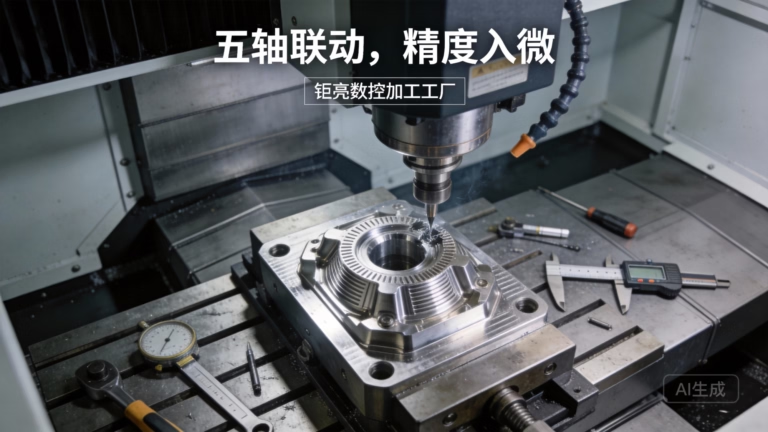
Our 16 simultaneous 5-axis centers and 16 mill-turn centers handle the compound angles on PDU brackets and anti-tip bases. For long rails we use the 4,000 × 400 × 150 mm travel machines. A Ø400 mm rotary table covers most circular anchor patterns in one pass.
How to Inspect a Rack Frame Before It Ships
Inspection on a rack frame is not one measurement. It starts with the raw material certificate, because a 6082 extrusion that arrives as 6063 will pass a visual check and fail a load test. We check alloy and temper on every incoming lot.
In process, the welder checks squareness after each sub-assembly, not after the whole frame is closed. Once a frame is welded shut, pulling it back into square means cutting and re-welding, which costs more than the original weld.
Final inspection covers the machined features, the diagonal, and the finish. We run 100% inspection before shipment, and reports are available on request. For rack frames that go into seismic-qualified assemblies, the report usually needs to show the bore diameters, the diagonal, and the finish on the anchor faces.
The qualification rate we hold on production work is 99.99%. That number only means something if the drawing defines what is critical. A frame drawing that calls every dimension out at ±0.1 mm is slower to inspect and no safer than one that marks the six features that actually carry load.
When Aluminum Is the Wrong Choice for a Battery Rack
Aluminum is not always the answer. If the rack has to survive a fire test that specifies a steel frame, or if the site standard calls for welded steel because the maintenance crew already has steel welding capability, aluminum adds a second material stream and a second set of procedures.
Very high fault currents are another boundary. Aluminum busbar standoffs carry current through the frame less gracefully than steel in some designs, and galvanic contact between aluminum and copper busbar needs a plated interface or a barrier washer. Skip that and you get corrosion at the joint, not at the rail.
Cost is the last boundary. Aluminum extrusion is cheap per meter, but a low-volume rack with many machined pockets and compound angles can cost more in machining time than a simple welded steel frame that only needs drilling. The crossover usually sits somewhere in the tens-of-units range, and it moves with how much of the frame is machined versus cut to length.
What we do not do is promise a frame will pass a seismic test we have never seen. We machine to your drawing, hold the tolerances you define, and give you the inspection data to support your own qualification.
Alloy and Temper Selection for Rack Frames
Pick by load case and joining method, not by habit.
| Alloy / temper | Typical yield | Welded rack use | Watch out for |
|---|---|---|---|
| 6061-T6 | ≈275 MPa | Machined brackets, bolted frames | Haz softening near welds |
| 6082-T6 | ≈260 MPa | Welded main frames | Slightly harder to anodize evenly |
| 6063-T6 | ≈170 MPa | Trays, cable arms, light rails | Too weak for main rails |
| 5052-H32 | ≈190 MPa | Sheet covers, drip shields | Not a structural frame alloy |
| 7075-T6 | ≈500 MPa | High-load anchor plates | Poor weldability, cost |
Tolerance and Finish Targets by Frame Feature
| Feature | Typical tolerance | Typical finish | Note |
|---|---|---|---|
| Anchor plate bore | ±0.005 mm | Ra 0.8–1.6 μm | Machined after welding |
| Tray datum face | ±0.05 mm | Ra 1.6–3.2 μm | Flatness matters more than Ra |
| Mounting hole pattern | ±0.1 mm | As machined | Reference from one datum |
| Frame diagonal | ±0.5 mm over 2 m | As welded | Drives door alignment |
| Exterior surfaces | Not critical | Anodize or powder coat | Hardcoat where wear occurs |
Bolted Frame or Welded Frame?
Choose a bolted 6061-T6 frame when the rack must ship flat, be reconfigured on site, or meet a seismic qualification that is easier to document joint by joint. Choose a welded 6082-T6 frame when stiffness per kilogram and a single rigid body matter more than field serviceability, and accept that the heat-affected zone sets the real strength limit near every weld.
Questions Engineers Ask About Rack Frames
Should the frame be machined before or after welding?
Weld first, machine second. Welding pulls the frame out of square by roughly 0.5 mm to 1.5 mm on a 1,000 mm rail, so any feature machined before welding will drift.
Machine the datum faces, bores and hole patterns after the frame has cooled and been fixtured. That is how a long frame still holds ±0.005 mm on a critical bore.
How much strength is lost in the heat-affected zone?
On 6061-T6, yield strength in the softened band next to a weld can drop by 40% or more, toward the T0 condition. The band is typically 10 mm to 25 mm wide.
Use the softened value for any joint that carries the seismic or fault moment, or move the joint to a bolted connection and keep the weld out of the load path.
Is 6063 acceptable for main rails?
Usually no. 6063-T6 yields around 170 MPa, well below 6061-T6 at about 275 MPa. It extrudes into tighter shapes, which makes it useful for trays and cable arms.
If the rail carries cell weight over a long span, the deflection check will push you back to 6061-T6 or 6082-T6.
What finish should a rack frame get?
Clear anodize suits most indoor racks and keeps the aluminum look. Hardcoat anodize is worth it on surfaces that see repeated tool contact or cable abrasion.
Powder coat gives better color control but can chip at bolted joints. Mask the datum faces and bores if you coat, or the coating thickness will throw off your fit.
How do you handle a rack that has to ship flat?
Design it as a bolted frame with machined locating features so the joints repeat in the field. We machine the mating faces and pilot holes to keep assembly square without a fixture on site.
Bolted frames also let you anodize or coat the parts before assembly, which is harder on a welded frame.
What do you need to quote a rack frame?
A 2D drawing with the critical tolerances marked, a 3D model if you have one, the alloy and temper, the finish, and the quantity. Note which features are load-bearing.
We return a quotation and a free DFM analysis within 12 hours. There is no minimum order quantity, so a single prototype and a 10,000-part run go through the same review.
Send Us the Frame Drawing
Upload your rack frame drawing and we will come back with a quotation and a free DFM analysis within 12 hours. Uploads are secure and confidential, and an NDA is available on request.
12-hour quote100% inspectionNo MOQ±0.005 mm
More From GreatLight
We publish setup notes, tooling trials and inspection data from the factory floor.











