
UK NZ CNC Partnership: How a Split Supply Chain Actually Works
A UK NZ CNC partnership is not a slogan. It is a way of splitting engineering, machining and inspection across two countries that sit 18,000 km apart. This page explains the mechanism, the tolerance and freight limits, and the part families where it pays off.
In this article
- 1
- 2
- 3
- 4
- 5
- 6
- 7
What a UK NZ CNC partnership really splits
Most UK and New Zealand manufacturing collaborations are described in marketing language. Strip that away and there are only three things that can move across the border: design authority, metal removal, and metrology. A UK NZ CNC partnership works when each of those three sits in the country that does it cheapest or fastest for that specific part family.
In practice the split is usually this. Design intent, tolerance stack-up and drawing release stay with the UK engineering team, because they own the assembly and the certification paperwork. Machining moves to a supplier with the machine hours available, which for many part families is a partner plant outside the UK. Final dimensional reports either travel with the parts or are produced at the receiving site.
The mechanism matters because it decides who owns risk. If a UK buyer keeps design authority and signs off on the inspection report, the partnership is a capacity arrangement. If the buyer also hands over tolerance definition, the partnership becomes a development arrangement and needs far tighter communication.
One more thing. A UK NZ CNC partnership is not the same as a UK supplier with a New Zealand sales office. The parts have to physically cross a border, clear customs, and survive a long air or sea leg. Everything below follows from that single fact.
Which part families suit the split
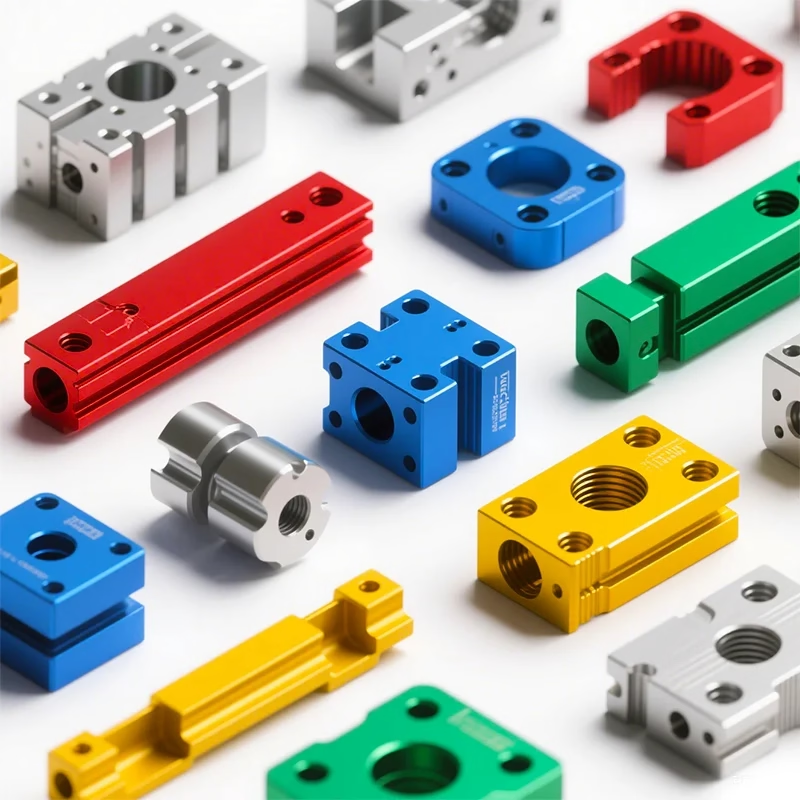
Split-country machining suits parts that are hard to make but easy to ship. A 400 g aluminium bracket with tight bores and a complex profile is close to ideal. It is light, it does not corrode in transit with the right packaging, and its value per kilogram is high enough that air freight does not destroy the business case.
It also suits low-volume runs where the UK shop is fully booked. Sending a 20-piece batch of 316L stainless manifolds to a partner with 16 simultaneous 5-axis machining centers can pull weeks out of a schedule. The machine hours exist; the buyer just cannot access them locally in time.
Parts that do not suit it: large weldments, anything over roughly 4,000 mm in the longest dimension, single-source castings that need rework, and assemblies that must be fitted together on site. Freight cost and handling damage scale with size, and one bent frame wipes out the saving on the whole batch.
Surface finish also sets a boundary. As-machined finishes at Ra 1.6–3.2 μm travel and rework fine. Fine finishes at Ra 0.2–0.8 μm can be damaged by handling, so they should be packed in individual cavities or finished at the destination.
Holding ±0.005 mm across a long supply chain
Tolerance is where most split-supply arguments happen. A machine can hold ±0.005 mm on a part it machines in one setup. The same nominal tolerance becomes a negotiation when the part is measured in the UK on a CMM that has never been correlated with the machine tool's own probe system.
The fix is straightforward. Agree on the datum scheme before the first chip is cut, and write it on the drawing. Datum A should be a surface that is machined in the first operation and never used as a clamp face afterwards. If the datum moves between operations, the tolerance stack moves with it.
Temperature is the second variable. An aluminium part measured at 30 °C in a warm shop will read differently than the same part at 20 °C. For work at ±0.005 mm, both sides should measure at 20 °C after the part has soaked for at least 4 hours. This is not bureaucracy; it is the difference between a rejected batch and a passed one.
Third, keep one inspection authority. Either the machining partner issues the dimensional report, or the UK site does. Two reports that disagree are worse than one report nobody reads. Reports on request, and the receiving site should be able to re-measure the same features without reworking the datums.
Material choice and what it does to the plan
Material decides shipping weight and, sometimes, customs paperwork. Aluminium grades such as 6061-T6, 7075 and 6082 are the default for split supply: light, stable, and available in most machine shops. Titanium TC4 (Ti-6Al-4V) and Inconel are also machinable but the part cost is high enough that freight becomes a rounding error.
Stainless 303, 304, 316 and 17-4PH sit in the middle. They machine well, resist transit corrosion, and are common in medical and food-equipment work. If the part needs passivation after machining, decide early whether that happens before or after shipping, because passivation changes the surface and can move a tight bore.
Magnesium AZ31B and AZ91D need extra care. They are light, which helps freight, but they are more sensitive to moisture and to clamping marks. If a magnesium part travels, it should be packed with desiccant and inspected on arrival before it enters the assembly line.
Plastics change the calculation in the other direction. POM, PEEK and PA are light and machine quickly, but they move with humidity and temperature. A plastic part held at ±0.005 mm should be measured in the same climate as the assembly, not in the shop where it was cut.
Freight, customs and the lead-time math
Air freight from a partner plant to a UK site typically adds days, not weeks, but it does add paperwork. Commercial invoices, HS codes and country-of-origin statements have to match the drawing revision. A mismatch at customs holds the whole batch, and the schedule slips by more than the machining time ever did.
Sea freight is cheaper and slower, and it suits heavier parts where the schedule allows. For a 10,000-part run of a stable part, sea freight can be the right call. For a 20-piece prototype batch, it rarely is.
Lead time should be built backwards from the assembly date, not forward from the order date. Add machining days, inspection days, packing, freight, customs and a buffer for a re-measure. A quoted 3–5 days to ship from the machine shop is not a door-to-door number.
Packing is part of the engineering, not an afterthought. Machined faces should never touch each other. Individual cavities, VCI paper for steel, and desiccant for magnesium and aluminium are standard. If a part arrives with a nick on a sealing face, the saving is gone.
Where the arrangement breaks down
The first failure mode is a drawing revision that only one side has. If the UK team changes a hole position on Friday and the machine shop cuts on Monday from the old file, the parts are scrap. Version control has to be explicit, with one file name convention and one release channel.
The second is inspection disagreement. This almost always traces back to datums or temperature, not to machine capability. When two sites disagree on a feature, the fastest resolution is to ship the part back for a joint measurement rather than to argue over numbers.
The third is capacity drift. A partnership built on spare machine hours breaks when the partner's own orders pick up. Build a second approved source before you need it, or accept that the arrangement is temporary and plan around it.
None of these are reasons to avoid the model. They are reasons to write down who owns design, who owns machining and who owns inspection before the first purchase order goes out.
When the split works and when it does not
Use this as a first filter before quoting.
| Part or condition | Split-country supply | Single-country supply |
|---|---|---|
| Complex bracket under 2 kg | Good fit, air freight | Fine if local capacity exists |
| 316L manifold, 20 pieces | Good fit, pulls weeks out | Good fit, shorter transit |
| Weldment over 1 m | Poor fit, freight and damage risk | Better fit |
| Tolerance ±0.005 mm | Workable with agreed datums | Easier to control |
| Finish Ra 0.2–0.8 μm | Finish at destination | Single handover |
| Prototype in 3–5 days | Possible, freight adds days | Faster door to door |
| 10,000+ part run | Good fit with sea freight | Depends on local capacity |
| Magnesium housing | Needs desiccant and re-check | Lower transit risk |
The verdict
If your part is under a few kilograms, needs 5-axis work, and the UK shop is booked, a split supply chain wins. If it is a large weldment or a fine-finish sealing surface, keep it in one country.
Questions engineers ask
How do we keep datums consistent across two countries?
Write the datum scheme on the drawing before quoting. Datum A should be machined in the first operation and never used as a clamp face afterwards. Both sites then measure the same features from the same surfaces.
If a feature is disputed, ship the part back for a joint measurement instead of comparing two reports that were produced under different conditions.
What temperature should parts be measured at?
For work at ±0.005 mm, measure at 20 °C after the part has soaked for at least 4 hours. Aluminium moves noticeably between a 30 °C shop and a 20 °C inspection room.
This applies to both the machining site and the receiving site. If only one side controls temperature, the numbers will not agree.
Does a long supply chain change the finish we can specify?
It changes where the finish is applied, not what is possible. As-machined finishes at Ra 1.6–3.2 μm travel well with individual packing. Fine finishes at Ra 0.2–0.8 μm are better applied at the destination.
Anodizing, plating and powder coating add a handling step. Decide before shipping whether coating happens at the machine shop or after arrival.
How should lead time be estimated?
Build it backwards from the assembly date. Add machining days, inspection, packing, freight, customs and a re-measure buffer. A quoted 3–5 days to ship from the machine shop is not a door-to-door number.
Sea freight suits heavy, stable, high-volume parts. Air freight suits light, high-value, low-volume parts.
What documentation should travel with the parts?
Commercial invoice, HS code, country-of-origin statement and the drawing revision the parts were cut to. The revision number is the one that causes most customs and quality holds.
Inspection reports can be issued by either site, but only one site should be the issuing authority.
Can prototypes and production runs use the same partner?
Yes, and it usually helps. The datum scheme, fixture design and inspection method carry over from prototype to run, which removes a whole round of first-article questions.
There is no minimum order quantity on the prototype side, so a single part can be cut first and the same setup used for the later run.
Send drawings, get a DFM review
Upload a STEP file and get a quotation plus free DFM analysis within 12 hours. Uploads are secure and confidential, and an NDA is available on request.
12-hour quote100% inspectionNo MOQ
More from the shop floor
We publish setup notes, tooling trials and inspection data from the factory floor.











