
What is caliber?
The caliber of the steel aims to heat the steel to a temperature above the critical temperature AC3 (hyperectomy steel) or AC1 (hyperectomy steel), keep it incubated for a period of time and make it completely or partially austenized, Then cool to a more than the critical cooling rate. Treatment to the solid solution of aluminum alloy, copper alloy, titanium alloy, tempered glass and other materials or the heat treatment process with rapid cooling process is generally also called extinction.
The purpose of the caliber:
1) Improve the mechanical properties of metal materials or parts. For example: improve the hardness and wear resistance of tools, bearings, etc., improve the elastic limit of springs and improve the complete mechanical properties of tree parts.
2) Improve the material or chemical properties of certain special steels. For example, improve the corrosion resistance of stainless steel and increase permanent magnetism of magnetic steel.
At the end of the choice, in addition to the reasonable choice of the extinction environment, there must also be correct soil methods.
After extinction, the steel parts have the following characteristics:
① unbalanced structures (that is to say unstable) such as martensitis, bathite and residual austenite are obtained.
② There is great internal stress.
③ Mechanical properties cannot meet the requirements. Therefore, steel parts should generally be tempered after the caliber
What is flame return?
Tremp is a heat treatment process that heats up the turned metallic material or the part at a certain temperature, maintains it in a certain way after a certain period of insulation. The room. The main objectives of extinction and caliber are:
1) Reduce internal stress and reduce fragility.
2) Adjust the mechanical properties of the part. .
3) Stabilize the size of the room. The metallographic structure can be stabilized by the caliber to ensure that there will be no deformation when subsequent use.
4) Improve the cutting performance of certain allied steels.
The effect of the flame return is:
① Improve the stability of the tissues so that the part no longer undergoes the transformation of the tissues during use, so that geometry and performance of the part remain stable.
② Eliminate internal stress to improve room performance and stabilize room geometry.
③ Set the mechanical properties of steel to meet the use requirements.
The reason why the temperature has these effects is that when the temperature increases, the atomic activity is improved and the iron, carbon atoms and other steel alloy elements can diffuse quickly, carrying out the rearrangement and the combination atoms, which makes them unstable. The unbalanced organization is gradually transformed into a stable balanced organization. The elimination of internal constraint is also linked to the decrease in metal resistance when the temperature increases. Generally, when steel ends, hardness and resistance decrease and plasticity increases. The higher the quenching temperature, the higher the change in these mechanical properties. Some alloy steels with high alloy elements will precipitate certain fine particles of metallic compounds when they are soaked in a certain temperature range, increasing their resistance and hardness. This phenomenon is called secondary hardening.
Temperament requirements: parts with different uses must be tempered at different temperatures to meet the requirements used.
① Tools, bearings, carburetor and caliber parts and surface caliber parts are generally temperate at low temperature less than 250 ℃. After low temperature caliber, hardness does not change much, the internal stress decreases and tenacity is slightly improved.
② The spring is tempered at average temperature at 350-500 ℃ to obtain higher elasticity and necessary tenacity.
③ Steel parts of medium carbon structure are generally temperate at high temperature at 500 to 600 ° C to obtain good coordination of appropriate resistance and tenacity.
When steel ends around 300 ℃, its fragility is often increased. Generally, it should not be tempered in this temperature range. Certain structural carbon alloy structural steels are easily fragile if they cool slowly at room temperature after high temperature. This phenomenon is called the second type of caliber fragility. The addition of molybdenum to steel or cooling the oil or water during the caliber can prevent the second type of caliber. This fragility can be eliminated by warming the second type of fragile steel at the original temperature.
In production, parts’ performance requirements are often based. Depending on the heating temperature, the caliber is divided into temperature at low temperature, soaking at medium temperature and temperature at high temperature. The heat treatment process combining extinction and high temperature caliber is called the caliber, which means that it has strong resistance and good plastic tenacity.
1. Constation at low temperature: 150-250 ℃, m withdrawal, reducing internal stress and fragility, improve plastic tenacity and have high resistance to hardness and wear. Used to make measurement tools, tools and bearings.
2. Used to make springs, forging matrices, etc.
3. High temperature temperature: 500-650 ℃, delayer S, with good complete mechanical properties. Used to make gears, vilellers, etc.
What is normal fire?
Standardization is a kind of heat treatment which improves the tenacity of steel. After heating the steel component at 30 to 50 ° C above the AC3 temperature, it is kept warm for a period of time and cooled by air. The main feature is that the cooling speed is faster than the receipt and the end of the finish. value) and reduce the tendency of component cracking. —— After normalized treatment of certain steel plates with low hot alloy content, shaped shapes and pieces of steel with low alloy, the complete mechanical properties of materials can be considerably improved and cutting performance can also be improved .
Standardization has the following objectives and uses:
① For hypoeutectoid steel, standardization is used to eliminate overheated coarse crystal structures and wei structures, forged and welded parts, and band structures in rolled materials;
② For too much -Tectoid steel, normalization can eliminate secondary cementitis from the mesh and the affine perlite, which improves not only mechanical properties, but also facilitates the subsequent spheroidin receipt.
③ For steel plates with low carbon carbon content, standardization can eliminate free cementitis at the limit of grains to improve its drainage performance in depth.
④ For low carbon steel and steel with low carbon content, standardization can obtain a thinner perlite structure, increasing the hardness of HB140-190, avoiding the phenomenon of the “adhesive knife” during the cutting and improving cutting performance performance. For average carbon steel, it is more economical and practical to use standardized steel when standardized steel and reception can be used.
⑤ For ordinary structural steels in average carbon, in situations where mechanical properties are not high, normalization can be used instead of extinction and high temperature caliber, which does not only make the structure and The dimensions of the steel stable.
⑥ High temperature standard fire (150-200 ℃ above AC3) can reduce the segregation of composition of molded parts and forged parts due to high high temperature diffusion speed. Coarse grains after high temperature normalization can be refined by the second later lower temperature normalization.
⑦ For some low and medium carbon alloy steels used in turbines and steam boilers, normalization is often used to obtain a bathite structure, then tempered at high temperature.
⑧ In addition to steel and steel parts, standardization is also widely used in the heat treatment of ductile iron, so that it can obtain a perlite matrix and increase the resistance of the ductile iron.
Since the standardized fire is characterized by air cooling, room temperature, stacking method, air flow and part size all have an impact on structure and performance after a fire standardized. The standardized structure can also be used as a classification method for alloy steel. Generally, alloy steel is divided into perlite steel, bathite steel, steel to martensite and austenite steel based on the structure obtained by air cooling after heating of the sample with a diameter of 25 mm at 900 ° C.
What is the receipt?
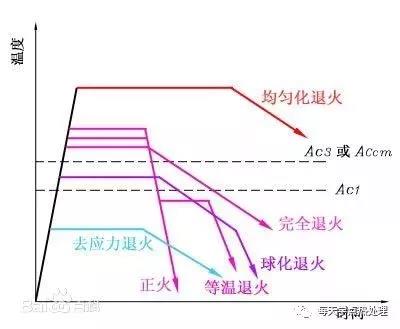
The receipt is a metal heat treatment process which slowly heats the metal at a certain temperature, maintains it for a sufficient time, then cools at an appropriate speed. The heat treatment of the receipt is divided into complete receipt, incomplete receipt and elimination of stress. The mechanical properties of the materials recurred can be detected by traction tests or hardness tests. Many steels are supplied in a state of recuite thermal treatment. Test the HRT hardness.
The purpose of the receipt is:
① Improve or eliminate various tissue defects and residual constraints caused by steel during casting, forging, bearing and welding, and prevent the parts from deforming and cracking.
② Softe the part for the cut.
③ Refine the grains to improve the structure to improve the mechanical properties of the part.
④ Make organizational preparations for final heat treatment (extinction, moving).
The commonly used reception processes are:
① Full reception. It is used to refine the coarse and overheated structure with poor mechanical properties that occur after casting, forging and welding medium and low carbon steels. Heat the part at a temperature above the temperature to which the ferrite is converted into austenite from 30 to 50 ℃, keep it in heat for a period of time, then cool slowly with the furnace. , so that the steel structure becomes thinner.
② Spherical reception. Used to reduce the high hardness of tool steel and rolling steel after forging. The part is heated to 20 to 40 ° C above the temperature at which steel begins to form austenite, then cooled slowly after insulation.
③ Isothermal receipt. It is used to reduce the high hardness of certain structural steels in alloy with a high nickel and chrome content for cutting. Generally, the austenite temperature is cooled to the most unstable temperature at a faster rate.
④ recrystallization receipt. Used to eliminate the hardening phenomenon of metallic wires and thin plates during cold drawing and cold bearing (hardness resistance and decrease in plasticity). The heating temperature is generally 50 to 150 ° C below the temperature at which steel begins to form austenite.
⑤ Graphitization receipt. It is used to transform the melting containing a large amount of cementitis in a fluid melting with good plasticity. The process operation is to heat the molded parts at around 950 ° C, to cool them properly after the insulation for a certain period of time, so that the cementite body can be broken down into a scroll graphite ball.
⑥ diffusion reception. Used to homogenize the chemical composition of molded alloy parts and improve their performance. The method is to heat the molded parts at the highest temperature as possible without melt, and keep them warm for a long time, then to cool slowly after the different elements of the diffuse alloy and to be distributed evenly.
⑦ Elimination of constraints. Used to remove internal constraints on steel molded parts and welded parts. The internal constraint can be eliminated after heating steel products and the temperature is 100 to 200 ° C below the temperature at which austenite is formed, then the heat is maintained and cooled in the air.
Daguang focuses on providing solutions such as precision CNC machining services (3-axis, 4-axis, 5-axis machining), CNC milling, 3D printing and rapid prototyping services.



















