
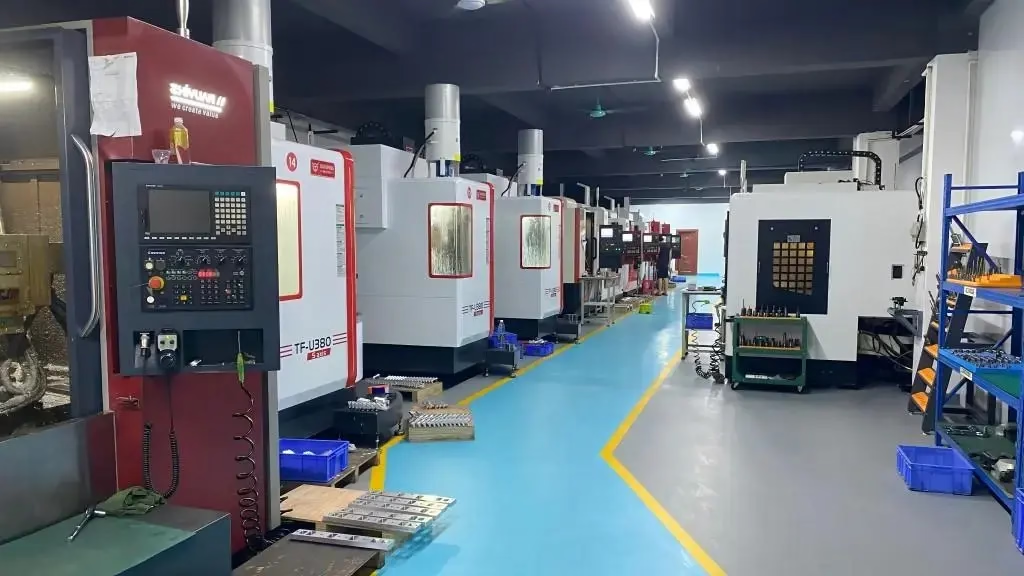
Three-line rail vertical machining center is a vertical CNC machine tool
A three-line rail vertical machining center uses three linear guide rails to carry the column, saddle and table on rolling blocks. This page explains how the load path works, where the design wins, and when a box way or a bigger frame is the better answer. Written for engineers and buyers who spec vertical CNC machine tools.
In this article
- 1
- 2
- 3
- 4
- 5
- 6
What "three-line rail" actually means on a vertical CNC machine tool
A three-line rail vertical machining center is a vertical CNC machine tool whose three linear axes each run on a recirculating linear guide rail. One rail pair carries the table in X, a second pair carries the saddle in Y, and a third carries the head or column in Z. The name describes the guide system, not the number of axes. A three-axis machine and a five-axis machine can both use the same rail layout.
Each rail is a hardened steel profile with a ground raceway. Load travels through the carriage, then through steel balls or rollers, then into the rail and the cast base. Preload is set by ball size or by a wedge, and it decides how much the assembly deflects under a side push. That preload is also what separates a rail that lasts from one that brinells in a year.
The alternative is a box way: a wide, hand-scraped sliding surface with oil film. Box ways spread load over a large area and damp vibration well. Linear rails trade that contact area for low friction and repeatable positioning at speed. The trade is the whole story of this machine class.
- 1Rail, not axis countThe label describes the guide type, not how many axes are controlled.
- 2Preload sets stiffnessHigher preload means less deflection but more drag and heat.
- 3Rolling contactBalls or rollers replace the sliding oil film of a box way.
How the rail stack carries cutting force
Cutting force enters the tool, passes into the spindle, then into the headstock, the column, the saddle, the table and finally the base. Every joint in that chain adds compliance. With linear rails, the carriage-to-rail interface is the softest joint because contact is a line or a point, not a full surface. That is why rail size, carriage count and mounting flatness matter more than the nominal machine weight.
Moment load is the real test. When a face mill pushes the part sideways, the head wants to rotate about the rail. Two carriages on one rail resist that rotation as a couple: the farther apart they sit, the stiffer the pair. Many VMCs use two carriages per rail precisely for this reason. If a builder uses one long carriage instead, the guide rail must be larger to reach the same moment stiffness.
Rails are bolted to a machined pad on the casting. If that pad is not flat, the rail bends to match it and the preload changes along the length. A rail that is flat to 0.01 mm over its travel will out-cut a larger rail bolted to a rough pad. This is a manufacturing detail, not a catalog number.
- 1Softest joint firstThe carriage interface deflects more than the casting under load.
- 2Carriage spacingWider spacing raises moment stiffness without a bigger rail.
- 3Mounting flatnessPad flatness controls preload consistency along the travel.
Which parts suit a three-line rail vertical machining center
Rail-guided verticals are strong at positioning and light-to-medium cutting. Aluminum and brass parts with many holes, pockets and profiles are the natural fit, because the machine can rapid between features and hold position without stiction. At GreatLight, our three-axis machines run travel envelopes of 500 × 500 × 450 mm and 500 × 310 × 200 mm, which covers most plate and housing work in those materials.
Stainless and tool steel are still workable, but the depth of cut drops. A rail machine will take a lighter radial step than a box way machine of similar size before chatter starts. If the part is mostly a deep pocket in 4140, cycle time climbs and the rail pays for itself only if positioning accuracy matters more than metal removal rate.
Rail machines also hold up well in automated cells. Low friction means the axis needs less torque to move, so a given servo can accelerate faster. That helps when a robot loads the table and the machine must return to a datum thousands of times a shift. For a job shop running mixed batches, that repeatability is the main benefit.
- 1Best fitAluminum and brass parts with many features and tight position calls.
- 2Workable fitStainless and alloy steel at reduced radial engagement.
- 3Poor fitDeep heavy cuts in hard steel where removal rate drives cost.
Accuracy, finish and thermal behavior
Positioning accuracy on a rail machine comes from the screw and the scale, not from the rail alone. A C3 ground ball screw with a preloaded nut and a linear scale can hold ±0.005 mm on a well-built frame. The rail contributes repeatability: low friction means the slide returns to the same spot instead of sticking and releasing. Repeatability is often what engineers actually need, not absolute accuracy.
Surface finish depends on vibration. Rolling elements are stiffer than an oil film but they also transmit higher-frequency chatter. A rail machine can produce Ra 0.8–1.6 μm on aluminum with a sharp cutter and a rigid setup. Pushing for Ra 0.2–0.8 μm usually means a finishing pass, a lighter stepover and sometimes a different tool geometry.
Heat moves the frame, not the rail. As the spindle and ballscrews warm up, the column grows and the tool point drifts. Rails do not fix that. Warm-up cycles, cooled ballscrews or a temperature-controlled shop do. On a long run, the first ten parts and the hundredth part can differ by more than the machine's static accuracy if thermal growth is ignored.
- 1Screw and scaleThey set absolute accuracy; the rail sets repeatability.
- 2Finish rangeRa 0.8–1.6 μm is routine; finer needs a dedicated pass.
- 3Thermal driftWarm-up and cooling matter more than guide type on long runs.
When a three-line rail vertical machining center is the wrong tool
If the job is heavy roughing in hardened steel, a box way machine or a horizontal mill will remove metal faster and damp chatter better. Rails can be damaged by a crash or by chips that get under a wiper, and repair means re-aligning the whole stack. A box way can be scraped back into tolerance in place.
If the part is long and slender, rail deflection under a heavy side load shows up as taper. Travel of 4,000 × 400 × 150 mm on our large machines is meant for long, shallow work, not for deep cuts at the far end of the stroke. Sag grows with overhang, so the same cut is stiffer near the column and softer at the end of travel.
Rail machines also dislike dirty environments. Fine cast iron dust and abrasive grit shorten wiper life. If the shop runs mostly castings, plan on more frequent wiper and way-cover service. That is a maintenance cost, not a performance limit, but it belongs in the quote comparison.
- 1Heavy roughingBox ways damp better and survive crashes more gracefully.
- 2Long overhangDeflection at the far end of travel causes taper.
- 3Abrasive dustWipers and covers need a shorter service interval.
Three-line rail vs box way vs large-frame rail
Use this to pick a guide type before you compare spindle tapers or prices.
| Criterion | Three-line rail VMC | Box way VMC | Large-frame rail VMC |
|---|---|---|---|
| Positioning speed | High, low friction | Moderate, oil film drag | High, heavier frame |
| Vibration damping | Moderate | High | Moderate to high |
| Heavy roughing | Not ideal | Best fit | Acceptable |
| Light alloy work | Best fit | Acceptable | Best fit |
| Crash recovery | Rail re-alignment | Rescrape in place | Rail re-alignment |
| Maintenance focus | Wipers and covers | Lube and way wear | Wipers and covers |
| Typical part size | Small to medium | Medium to large | Medium to large |
| Automation fit | Strong | Workable | Strong |
Pick the guide type from the cut, not the catalog
If the job is light-to-medium cutting in aluminum, brass or stainless with tight position calls, a three-line rail vertical machining center is the right pick. If the job is deep roughing in hard steel or a long slender part with heavy side load, choose a box way or a horizontal machine instead.
Questions engineers ask before specifying
Does a three-line rail vertical machining center have only three axes?
No. The name describes the guide system: three linear rail sets, one per axis. The machine can be a 3-axis mill, a 4-axis mill with a rotary table, or a 5-axis machine with two rotary axes.
A 5-axis machine still uses linear rails on X, Y and Z. The rotary axes sit on top of that stack and add their own compliance.
How does rail preload affect the parts I get?
Higher preload removes clearance and raises stiffness, so the axis deflects less under a side cut. It also raises drag, heat and wear. Too much preload on a small rail shortens life.
In practice, preload shows up as repeatability. If a machine returns to the same datum within ±0.005 mm after thousands of moves, the preload is doing its job.
Can a rail machine hold ±0.005 mm on stainless?
Yes, if the cut is light and the setup is rigid. The tolerance comes from the screw, the scale and thermal control more than from the rail itself.
Stainless work-hardens, so a dull cutter pushes the tool and shows up as taper or chatter. Tool life matters as much as machine stiffness here.
What causes rail damage in normal production?
Chips under the wiper, a crash, or a rail bolted to a pad that is not flat. All three change preload along the travel and show up as a tight spot or a repeatability error.
Regular wiper and cover checks catch most of it early. A dial indicator run along the axis will show a local bump before the parts go out of tolerance.
Is rail size the main stiffness factor?
Rail size matters, but carriage spacing and mounting flatness often matter more. Two carriages spaced far apart resist moment load better than one large carriage.
A smaller rail on a flat, rigid pad can out-cut a larger rail on a soft frame. Judge the whole stack, not one number.
How do you inspect a rail machine before shipping?
We check raw material, monitor in-process, and run a final inspection with reports on request. That includes geometry checks on the finished part, not just the machine.
For rail-guided machines, repeatability is verified by returning to a datum and reading the deviation. That is the number that predicts your production spread.
Send the drawing and we will pick the right machine
Quotation and free DFM analysis within 12 hours. No minimum order quantity, from one prototype to 10,000+ part runs. Uploads stay confidential and an NDA is available on request.
12-hour quote100% inspection±0.005 mmNo MOQ
More from GreatLight
We publish setup notes, tooling trials and inspection data from the factory floor.











