
The Heavy CNC Horizontal Tour Has a Wide Range of Applications
This page explains when a heavy CNC horizontal tour is the right machine for a part, and when a vertical or 5-axis setup wins instead. It is written for engineers and buyers who have to justify the machine choice before tooling is cut. You will get the geometry rules, the torque and rigidity numbers, and a comparison table you can bring to a kickoff meeting.
In this article
- 1
- 2
- 3
- 4
- 5
- 6
- 7
- 8
What matters before you choose horizontal
Why part shape decides the machine, not the other way around
The first question on any large part is not which machine is better. It is which faces the part needs, and how many setups the part can survive. A horizontal spindle sits parallel to the floor, so the tool approaches the work from the side. The part mounts on a rotary table or a tombstone, and the table indexes to bring each face into the cut.
That single geometry change removes a whole class of problems. On a vertical machine, a 300 mm deep bore collects chips at the bottom of the hole, and the operator has to stop and clear them. On a heavy CNC horizontal tour, gravity pulls chips down and out. Coolant flushes the rest. The boring bar stays supported and the hole stays round.
The trade-off is reach. A horizontal machine cannot easily cut a shallow pocket on the top face of a wide plate. It also needs a tombstone or angle plate for every part family, and that fixturing is real cost. So the decision usually comes down to part shape: cube-like and multi-face favors horizontal, flat and single-face favors vertical.
- 1Cube-like envelopeRoughly equal X, Y and Z dimensions, with features on three or more faces.
- 2Deep bores or pocketsDepth-to-diameter ratios above 4:1, where chip packing hurts vertical setups.
- 3Long boring barsBores that need 300–400 mm of tool overhang, where rigidity decides roundness.
What heavy actually means in the machine structure
Heavy is not a marketing word here. It describes a bed and column that resist deflection under a big cut. Box ways with hand-scraped contact surfaces spread the load over a large area, which keeps the spindle from drifting when a Ø100 mm face mill takes a 6 mm depth of cut in 4140 steel. Linear guides move faster, but they concentrate load on small rolling elements.
Spindle torque matters more than top speed on this class of work. A heavy CNC horizontal tour typically runs a geared or high-torque integrated spindle for low-rpm cutting with large-diameter tools. That is what lets you rough a 4340 block at 200 rpm without stalling, then finish a bore at 1,200 rpm with the same setup.
The bed also carries the rotary table. On our 4,000 mm machines, the table indexes to B-axis positions and repeats within a few arc-seconds. That repeatability is what lets you bore a line of holes on four faces and hold their center distances to ±0.005 mm without touching the part again.
- 1Box ways vs linear guidesBox ways for heavy interrupted cuts; linear guides for fast, light cycles.
- 2Spindle torque at low rpmNeeded for Ø80–125 mm cutters in steel and stainless.
- 3Table indexing repeatabilityKeeps multi-face hole patterns aligned without re-fixturing.
Which materials and part sizes fit this class of machine
Horizontal machining handles most metals we see. Aluminum 6061 and 7075 cut fast and clear well. Stainless 304, 316 and 17-4PH work when the spindle has the torque to push a carbide insert at the right feed. Tool steel and 4140 are common on this platform because the rigidity lets you take deep roughing passes instead of many light ones.
Part size is bounded by the machine envelope, not by the process. Our largest horizontal travel is 4,000 × 400 × 150 mm, with medium envelopes at 750 × 1,150 × 550 mm and 600 × 600 × 600 mm. A Ø400 mm rotary table covers round and near-round parts. If the part is taller than 1,150 mm in one direction, we look at a different machine.
Castings and weldments bring their own rules. Cast iron and ADC12 die-cast parts machine cleanly but need the first cut to remove skin without chipping. Weldments need stress relief before finishing or the bore will move after the part leaves the machine. We plan the roughing and finishing passes around that, not around the fastest cycle.
- 1Aluminum6061, 6061-T6, 7075, 2024, 5083, 6082.
- 2Steel and stainless4140, 4340, 1018, 304, 316L, 17-4PH.
- 3Special alloysTi-6Al-4V, Inconel, magnesium AZ31B.
Fixturing, setup count and where the cost really sits
The hidden cost on any multi-face part is setup. Every time the operator unclamps the part and re-dials it, you spend time and you add stack-up error. A horizontal machine with a tombstone can hold four or six parts at once and index between faces, so a part that would need four vertical setups becomes one horizontal cycle.
That changes the economics on runs above a few hundred pieces. The tombstone, the angle plates and the soft jaws cost money up front, but they pay back when cycle time drops and scrap from re-fixturing disappears. For a one-off prototype, that fixturing cost usually cannot be justified, and a 5-axis vertical machine is the better answer.
Pallet changers push the same logic further. While the spindle cuts, the operator loads the next pallet outside the enclosure. On a 10,000-part order the machine runs through breaks and shift changes instead of stopping. This is the main reason high-volume automotive and industrial machinery work lands on horizontal platforms.
- 1One setup vs fourTombstone fixturing turns multi-face work into a single cycle.
- 2Prototype runsBelow a few hundred pieces, 5-axis vertical is usually cheaper.
- 3Pallet changersKeep the spindle cutting through load and unload.
Industries where this machine earns its floor space
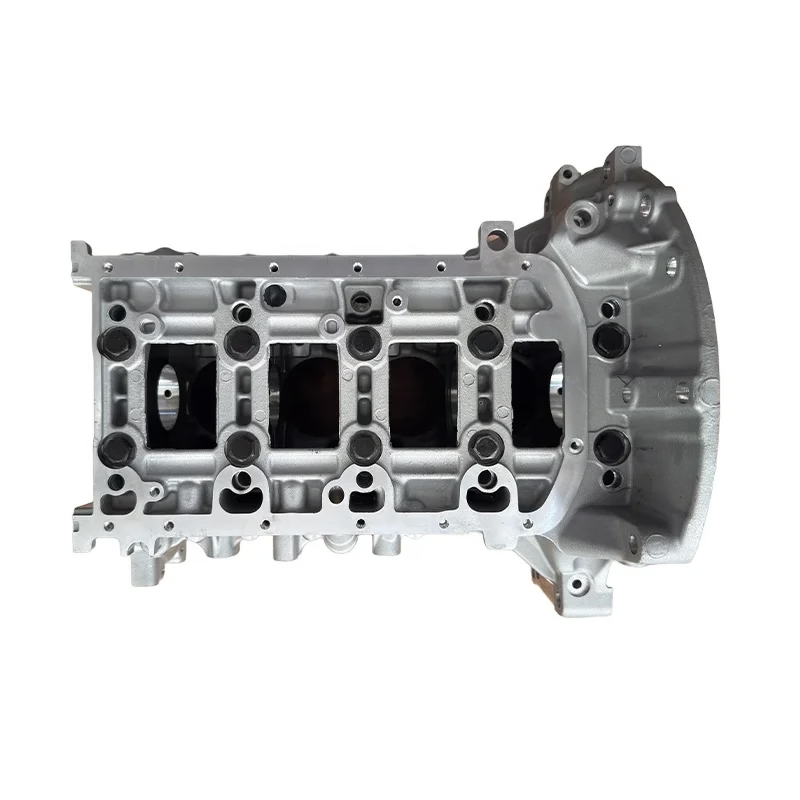
Automotive and EV work is the classic fit. Engine blocks, transmission housings, and EV motor housings are cube-like castings with bores on several faces. The part arrives as a casting, gets roughed and finished on one horizontal setup, and leaves with bore alignment held across the whole housing. IATF 16949 process control applies here because the same part runs for years.
Aerospace and industrial machinery bring larger, lower-volume parts. Pump housings, valve bodies, gearbox casings and structural brackets all share the same trait: features on multiple faces and bores that have to line up. Aerospace work usually needs tighter documentation, so we run 100% inspection and supply dimensional reports on request.
Medical devices and robotics use the same platform for smaller frames and manifolds, though often on the medium envelopes. New energy parts, such as battery tray brackets and cooling plates, lean toward the larger tables. The common thread is not the industry name. It is a part with several faces and bores that must stay aligned after machining.
- 1Automotive and EVBlocks, housings, motor cases on high-volume runs.
- 2Aerospace and industrialPump and valve bodies, gearbox casings, structural brackets.
- 3Medical and roboticsFrames and manifolds on medium envelopes.
Holding ±0.005 mm on a heavy cut
Tolerance on a large part is a system result, not a machine spec. The bed has to be rigid, the tool has to be short enough, and the thermal state has to be stable. A 400 mm boring bar in a light machine will deflect under cutting force no matter how good the control is. That is why we match the boring bar diameter to the bore depth before quoting.
We inspect at three points: incoming material, in-process, and final. In-process checks catch a drifting bore before the last pass, when there is still stock to correct it. Final inspection confirms the drawing before the part ships. Reports are available on request, and we inspect 100% of parts before shipment rather than sampling.
Surface finish follows the same logic. A fine finish of Ra 0.2–0.8 μm is achievable on bearing bores and sealing faces with the right insert and feed. General machined surfaces sit at Ra 1.6–3.2 μm. If a drawing calls for a finish tighter than the process can hold in a given material, we say so at the DFM stage, not after the part is cut.
- 1Tool overhangKeep the boring bar as short and stiff as the bore allows.
- 2Thermal stabilityWarm up the spindle and let the part reach room temperature before final cuts.
- 3FinishesRa 0.2–0.8 μm fine; Ra 1.6–3.2 μm as-machined.
Horizontal vs vertical vs 5-axis: which fits the part
Use part shape, face count and volume to pick the platform.
| Factor | Heavy horizontal | Vertical 3-axis | 5-axis vertical |
|---|---|---|---|
| Part shape | Cube-like, multi-face | Flat plates, single face | Complex contoured surfaces |
| Faces per setup | 4 faces via tombstone | 1 face | 5 faces, one setup |
| Deep bore ratio | Best above 4:1 | Poor, chip packing | Good to 3:1 |
| Typical volume | 500 to 10,000+ parts | 1 to 500 parts | 1 to 1,000 parts |
| Fixturing cost | High, pays back at volume | Low | Medium |
| Best material fit | Cast iron, steel, aluminum | Plate and sheet parts | Titanium, aluminum, plastics |
| Cycle time on cubes | Fastest | Slowest, many setups | Moderate |
| Setup count, 4 faces | One | Four | One or two |
The short answer
If the part is cube-like, needs three or four faces machined, and the order runs into the hundreds, choose a heavy CNC horizontal tour. If it is a flat plate or a one-off contoured part, choose a vertical or 5-axis machine and save the fixturing cost.
Questions engineers ask us
Can a heavy CNC horizontal tour hold ±0.005 mm on a 4,000 mm part?
It can hold ±0.005 mm on the features we control in one setup, provided the boring bar overhang is matched to the bore depth and the spindle is thermally stable.
On very long parts, the limiting factor is usually thermal growth and workholding deflection, not the machine. We check both at the DFM stage and tell you if the drawing needs a different approach.
What is the smallest batch that makes horizontal machining worthwhile?
Roughly a few hundred pieces, once you account for tombstone and angle-plate fixturing. Below that, a 5-axis vertical machine usually delivers the part faster and cheaper.
We quote both routes when the volume is borderline, so you can compare the real numbers.
Which materials cause the most trouble on this platform?
Titanium and Inconel, because they hold heat at the cutting edge and work-harden if the feed is too light. We adjust speed and feed rather than taking many shallow passes.
Magnesium needs chip control and fire safety procedures. Cast iron is straightforward but dusty, so we manage chip evacuation carefully.
Do you handle the finishing after machining?
Yes. Anodizing, plating, powder coating, black oxide, bead blasting, tumbling and polishing are all available in-house or through qualified partners.
Laser marking is also available, with a minimum character height of 1.5 mm.
How fast can a horizontal machining job start?
Quotation and free DFM analysis come back within 12 hours. Production can start within 24 hours after that, and parts ship in 3–5 days.
There is no minimum order quantity. We run from one prototype to 10,000+ part runs.
How do you protect our drawings?
Uploads are secure and confidential, and we sign an NDA on request before any file is shared.
We hold ISO 27001:2022 for information security, alongside ISO 9001, IATF 16949 and ISO 13485.
Send us the part drawing
We will tell you whether a heavy CNC horizontal tour is the right platform, quote both routes when it is close, and start production within 24 hours of approval.
12-hour quote100% inspectionNo minimum order
More machining notes
We publish setup notes, tooling trials and inspection data from the factory floor.











