
The GF Treatment Plan: What a Five-Axis Cell Changes on the Shop Floor
A GF treatment plan is not a service contract. It is the way a machine, its automation, and its tooling are specified together so parts come off with fewer setups. This page explains what changed in the Lotus F1 case, which parts benefit, and when a five-axis cell is the wrong purchase.
In this article
- 1
- 2
- 3
- 4
- 5
- 6
- 7
What a GF treatment plan actually covers
The name comes from the machine builder side of the story. A GF treatment plan bundles the machine tool, the automation that feeds it, the workholding, and the process parameters into one specification. The buyer is not shopping for a spindle. They are buying a defined route from raw stock to finished part, with the setup count written down in advance.
That matters because setup count drives everything downstream. Every time a part leaves the spindle and gets re-clamped, the stack-up of fixture error and datum shift grows. On a three-axis machine, a bracket with features on five faces may need four or five separate operations. Each one carries its own offset, its own probe cycle, and its own scrap risk.
A five-axis cell collapses those operations. The part stays in one fixture while the table or the spindle tilts, so the same datum is used for every face. The gains are not only cycle time. Rework drops, first-article approval gets shorter, and the operator stops babysitting a part through six handoffs.
The Lotus F1 team moved from three-axis milling to six Mikron HPM450U machining centers with five axes of automation. The published machine data is 30 kW and 20,000 rpm, with a seven-station automation system, 120 tools, and a rotary tilting table. Those numbers matter less than the arrangement: the automation keeps the spindle cutting while the operator loads the next tombstone.
Why fewer setups change the tolerance you can hold
Tolerance is a stack. If a bore and a mating face are cut in two separate setups, the error between them is the sum of fixture location error, thermal drift between operations, and probe uncertainty. Cutting both in one setup removes two of those three terms. We hold ±0.005 mm on critical features for exactly this reason.
Thermal behavior is the quiet one. A 30 kW spindle at 20,000 rpm puts real heat into the structure. If the machine sits idle between operations while the operator re-clamps, the casting cools and the geometry moves. Automation keeps the cycle continuous, so the thermal state stays closer to steady.
Tool count is the other lever. A 120-tool magazine means long roughing tools, finishing tools, and probes can all stay resident. The operator stops breaking the cycle to swap a drill. On a ten-hour unattended run, that is the difference between finishing the batch and finishing half of it.
None of this is free. Five-axis motion adds rotary axes that must be calibrated, and a collision is more expensive than on a three-axis machine. The return comes from part families that need four or more faces machined to tight relationships. If your parts are flat plates, the cell is overkill.
Which parts justify the investment
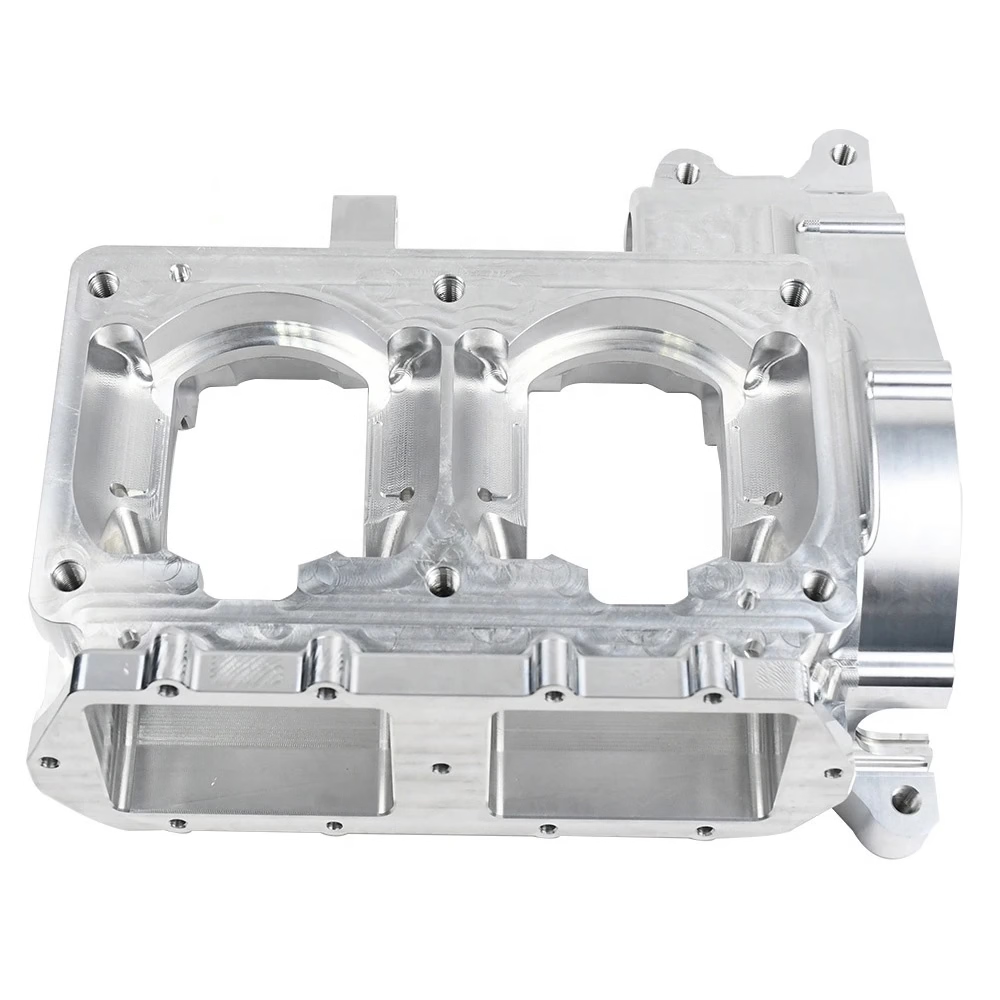
Motorsport and aerospace brackets are the classic case. They are thin-walled, pocketed, and have mounting holes on several orientations that must line up with a mating structure. Losing one setup removes the risk of a datum shift that would scrap a part worth more than the machine hour.
Impellers, bladed disks, and housings with compound-angle ports are the second group. These geometries are physically hard to reach with a three-axis approach, because the tool shank fouls the part before the cutter reaches the feature. Tilting the table brings the feature into a normal direction.
Medical instruments and robotics joints fall in the same bucket. They combine tight tolerances with low volumes, so the setup time is a large share of the total cost. Cutting that setup time is often worth more than shaving cycle time.
The parts that do not justify it are flat plates, simple shafts, and prismatic blocks with features on one or two faces. A three-axis machine with good fixturing will beat a five-axis cell on cost per part for those, and the operator will have an easier day.
Where the grinding capacity fits
The Lotus story ties the machining investment to grinding capacity. That is a common pattern in high-value manufacturing: milling gets the part close, then grinding sets the final size and surface. If the milled blank arrives with inconsistent stock, the grinder becomes the bottleneck.
A five-axis cell with in-process probing can leave a controlled grinding allowance. Instead of a nominal 0.3 mm, the operator measures the actual surface and adjusts the remaining stock to a known range. The grinder then removes a predictable amount, which protects the wheel and shortens the cycle.
Surface finish targets decide where the boundary sits. Milling reaches Ra 0.8–1.6 μm on aluminum with the right cutter and step-over. Below that, or on hardened steel above 45 HRC, grinding is the more reliable route. Trying to mill below Ra 0.4 μm on a production basis usually costs more than it saves.
The handoff between the two processes needs a written specification. Datum scheme, stock allowance, and inspection points should be agreed before the first blank is cut. When that is missing, the grinder ends up re-establishing datums the mill already had, and the capacity gain disappears.
How to judge whether a plan fits your shop
Start with the setup count on your current worst part. If it is three or more, and the features have tight relationships to each other, a five-axis cell will pay back. If it is one or two, look at fixture design first. It is cheaper and often solves the same problem.
Then look at the lot size. Automation earns its keep on repeat work. A seven-station pallet system with a 120-tool magazine is designed for parts that run again and again. If every job is a one-off with a new fixture, you are paying for automation you will not use.
Check the envelope against your actual parts. A 4,000 mm maximum processing size covers most large work, but a compact cell with a 500 × 500 × 450 mm travel will not. Measure the part plus fixture plus tool clearance before you commit, not after.
Finally, count the skills on the floor. Five-axis programming, probing, and rotary calibration are separate skills from three-axis work. A plan that does not include training time in the schedule will sit idle for the first month. Budget the learning curve as part of the purchase.
Limits and common mistakes
The first mistake is buying the machine before the process. A five-axis cell does not fix a bad fixture. If the part moves during roughing, it will still move in five axes, only faster. Fixture stiffness and clamping force come first.
The second is ignoring the post-processor. Five-axis toolpaths need verified simulation and a post that matches the machine kinematics. A generic post will produce code that looks correct and cuts air, or worse, cuts the table. Budget time to prove the post on a soft material before running production.
The third is treating the automation as optional. The gains in the Lotus case come from the combination of five-axis motion and pallet automation. A five-axis machine loaded by hand still loses the spindle during every part change. The two parts of the plan have to arrive together.
There is also a material boundary. Aluminum and mild steel are comfortable on a 20,000 rpm spindle. Titanium and Inconel need lower surface speed, more coolant, and a different tool strategy. The machine can do it, but the cycle time and tool cost are a different calculation than the aluminum case.
Three-axis vs five-axis cell: when each wins
Based on published machine data and typical part families.
| Factor | Three-axis | Five-axis cell |
|---|---|---|
| Setup count for 5 faces | 4 to 5 operations | 1 operation |
| Tolerance stack-up | Adds fixture error per setup | Single datum, lower stack |
| Best part family | Flat plates, simple shafts | Brackets, impellers, housings |
| Lot size fit | One-offs and small lots | Repeat production runs |
| Automation payoff | Low | High with pallet system |
| Programming skill | Common on most floors | Needs dedicated training |
| Collision risk | Lower | Higher, needs simulation |
| Cost per part, simple prismatic | Lower | Higher |
The verdict
If your parts need four or more faces machined to tight relationships and the job repeats, a five-axis cell with automation is worth the capital. If your parts are flat, prismatic, or one-off, spend the money on fixturing and a three-axis machine instead.
Questions engineers ask about five-axis cells
Do I need five simultaneous axes, or is 3+2 enough?
3+2 positions the part at an angle and then machines with three axes. It covers most prismatic parts with angled faces and is easier to program.
Simultaneous five-axis is needed when the tool must stay normal to a curved surface along a continuous path, such as an impeller blade or a compound-curve port. If your geometry is flat faces at angles, 3+2 will do the job.
How much does automation actually add to throughput?
The pallet system keeps the spindle cutting while the operator loads the next tombstone. On a part with a 20-minute cycle and a 5-minute load time, that is a 25 percent gain in spindle hours.
The real gain is unattended running. With a seven-station system and 120 tools, a shop can run through a shift change and into the night without stopping the spindle.
What tolerance can a five-axis cell hold in production?
We hold ±0.005 mm on critical features when the datum scheme is clean and the machine is thermally stable. That is a production figure, not a best-case measurement.
Tighter than that needs grinding or a controlled temperature environment. The machine geometry is only one term in the stack.
Where does grinding still beat milling?
Hardened steel above 45 HRC, and any surface that needs to hold below Ra 0.4 μm. Milling can reach Ra 0.8–1.6 μm reliably on aluminum; pushing further gets expensive fast.
Grinding also wins when the feature is a precision bore or a flatness callout on a large face, because the wheel averages out small errors instead of copying them.
How long does it take to get a five-axis part quoted?
We return a quotation and a free DFM analysis within 12 hours of receiving the files. Production can start within 24 hours of approval, and parts ship in 3–5 days.
There is no minimum order quantity. A single prototype and a 10,000-part run go through the same quoting path.
Can you sign an NDA before we share drawings?
Yes. Uploads are secure and confidential, and we can sign a non-disclosure agreement before any files change hands.
That applies to motorsport and aerospace work where the part geometry is the whole value of the program.
Send us the part that needs the most setups
We will tell you whether a five-axis cell helps, what the setup count would be, and what tolerance we can hold.
12-hour quote100% inspectionNo minimum order
More process notes
We publish setup notes, tooling trials and inspection data from the factory floor.











