
Data Acquisition Platform: How Machine Data Becomes Part Quality
This page explains what a data acquisition platform actually does on a CNC floor, which signals are worth collecting, and where the chain breaks. Written for process engineers and sourcing teams who have to judge whether the data is good enough to act on.
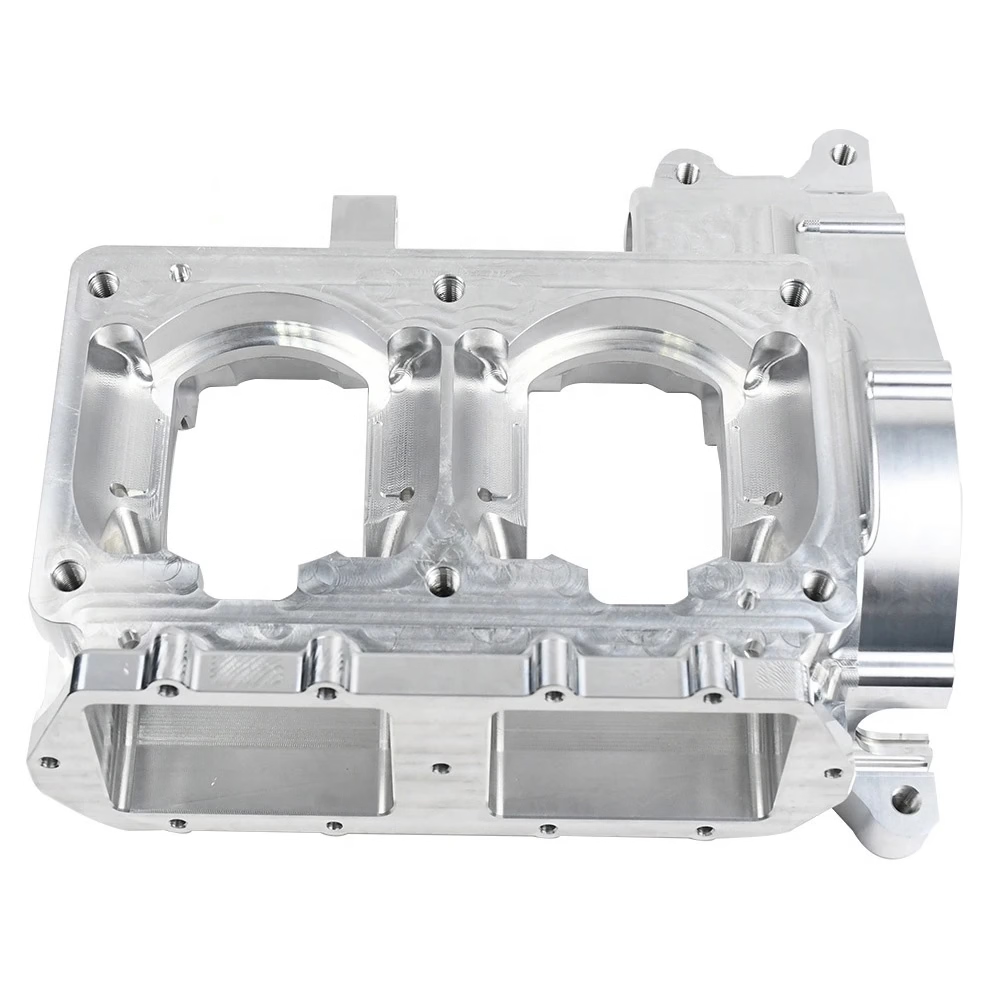
What a data acquisition platform does on a CNC floor
A data acquisition platform sits between the machine and the decision. On a CNC floor the chain runs: sensor or controller register, signal conditioning, sampling, transport, storage, then a model or a person who changes something. Break any link and the rest is decoration. A spindle load trace is useless if the sampling rate averages away the 40 ms cutter engagement that caused the chatter.
The most common failure is not the software. It is that nobody defined what decision the data supports. If the goal is catching a worn Ø6 mm end mill before it tears a batch, you need spindle current sampled fast enough to see each tooth pass, not a five-minute average. That single requirement sets sampling rate, buffer size and network budget.
On a 5-axis job the useful channels are usually spindle load, axis following error, coolant pressure, and a few thermal points on the casting. Servo drives already expose following error, so you read it instead of adding sensors. We pull temperature from the spindle housing and the table, because a 4 °C drift over a long cycle moves a 300 mm aluminum part more than the ±0.005 mm tolerance allows.
Signal conditioning matters more than dashboards. Thermocouples need cold-junction correction; accelerometers need anti-alias filters. Skip those and the platform stores plausible numbers that point at the wrong cause.
Edge filtering decides whether the data is worth keeping
Raw data from 127 machines is mostly noise. A three-axis mill at 12,000 rpm produces millions of samples per hour, and 95% of them describe normal cutting. Edge filtering turns that stream into a small number of events: tool load above threshold, following error spike, coolant pressure drop. What ships to storage is the event plus a short waveform around it.
Edge compute also sets the latency floor. A closed-loop reaction, such as retracting a tool when load jumps, must happen inside the controller cycle, in the tens of milliseconds. Anything routed through a cloud round trip arrives too late to stop a broken tool. Keep the fast loop local and let the cloud do trend work.
Bandwidth is the practical limit. One 4,000 mm gantry machine streaming three axes at 1 kHz fills a shop network by itself. Downsample on the machine, keep full rate for the channels tied to a real decision, and store the rest as summaries.
Time sync is the quiet requirement. If two machines stamp events with clocks that drift 200 ms apart, a supply-chain correlation becomes fiction. Use one time source across the shop, and log the sync offset with every record.
What the data changes in a machining process
Good data shortens the loop between a symptom and a fix. When a batch of 17-4PH housings starts drifting toward the high limit, the following-error trend on the finishing pass usually moves first. That gives a few hours of warning instead of a scrap pile.
It also replaces guesswork in quoting and process planning. Historical spindle load for a given material and cutter tells you whether a cycle time is realistic. On 7075 or Inconel, load traces show where the tool is rubbing rather than cutting, which is a programming problem, not a feeds problem.
Tool life is the clearest payback. Recording load per tool and per material lets you change inserts on condition instead of on a calendar. For a 10,000-part run in 6061 that difference is real money, and for a 20-part prototype run it is not worth the instrumentation.
Data does not fix a bad setup. If a fixture lets the part move, no amount of sampling will hold ±0.005 mm. The platform shows you the symptom; the fix is still mechanical.
Which signal to collect, and when it is not worth it
Match the channel to the decision it supports before buying sensors.
| Signal | Best for | Sampling need | Skip when |
|---|---|---|---|
| Spindle load | Broken tool, depth-of-cut drift | 1 kHz per tooth pass | Roughing with no tool-cost risk |
| Following error | Size drift, servo wear | Servo cycle rate | Open-loop or low-tolerance work |
| Coolant pressure | Clogged nozzle, thermal shift | 1 Hz | Dry cutting or short cycles |
| Casting temperature | Thermal growth on long parts | 0.1 Hz | Parts under 100 mm |
| Vibration | Chatter, surface finish | 10 kHz with anti-alias | Ra 3.2 μm or coarser |
| Air pressure | Clamping force loss | 1 Hz | Mechanical clamps with sensors |
| Program state | Cycle tracing, OEE | On event | Single-machine job shop |
Where we land
If your parts carry ±0.005 mm tolerances and runs repeat, instrument the spindle and the thermal path. If you make one-off prototypes under 100 mm, skip the platform and spend the money on fixtures.
Common questions
Do we need to replace our CNC controllers to collect data?
No. Most modern drives already publish following error, spindle load and program state over Ethernet or fieldbus. We read those registers first and only add external sensors where the controller exposes nothing useful.
Older machines can be instrumented with a clamp-on current sensor and a vibration puck. The data is coarser, but it still catches broken tools and thermal drift.
How much data should we keep?
Keep events and short waveforms around them, plus slow trends at 1 Hz or below. Full-rate streams are useful for a few weeks while you tune thresholds, then they mostly cost storage.
A practical rule: if nobody has opened a channel in three months, stop recording it at full rate and keep the summary.
Can the platform predict tool failure reliably?
It can flag a rising load trend for a specific tool and material, which is enough to schedule a change. Absolute prediction depends on material consistency, so treat it as a warning, not a guarantee.
Set thresholds per tool and per material. One global threshold will either miss wear in 6061 or fire constantly in Inconel.
Does edge computing replace the cloud?
No. Edge handles the fast loop and the filtering; the cloud handles cross-machine trends, quoting history and reporting. Splitting them keeps latency low and storage sane.
If your shop has one or two machines, an edge box plus local storage may be all you need.
How does data collection affect confidentiality?
Process data describes your parts and your volumes, so treat it like drawings. We work under NDA on request, and uploads for quoting stay secure and confidential.
If you keep the platform in-house, ask your machine builder what leaves the controller by default. Some telemetry is on unless you turn it off.
Send us the drawing, get a data-backed quote
Tell us the material, tolerance and volume. We return a quotation and a free DFM analysis within 12 hours.
12-hour quote100% inspectionNo minimum order quantity
More from the shop floor
We publish setup notes, tooling trials and inspection data from the factory floor.











