
Swiss CNC Machine Services: What to Check Before You Order
Swiss CNC machine services turn long, thin parts that a conventional lathe pushes out of tolerance. This guide is for engineers and buyers comparing suppliers. Read it and you will know which parts belong on a Swiss machine, which checks decide the order, and where quotes go wrong.
In this article
- 1
- 2
- 3
- 4
- 5
- 6
- 7
Key takeaways
Swiss CNC vs standard turning: when each one wins
Use this table to decide which process your part actually needs before you send an RFQ.
| Factor | Swiss CNC | Standard CNC turning |
|---|---|---|
| Part geometry | Long, slender, small diameter | Short, stubby, large diameter |
| Length-to-diameter ratio | Above 3:1, up to 20:1 with support | Below 3:1 without a steady rest |
| Typical diameter range | Ø 0.5–32 mm bar stock | Ø 20–500 mm chuck work |
| Tolerance held in production | ±0.005 mm | ±0.01 mm on a good lathe |
| Cycle time on small parts | Faster, one bar feeds many parts | Slower, one blank per cycle |
| Material waste | Low, bar stock cut close to length | Higher, chuck jaws grip and scrap ends |
| Best fit | Medical screws, pins, connectors | Flanges, housings, large bushings |
Pick the process first, then the supplier
If the part is slender and small, Swiss CNC machine services will hold tolerance where a standard lathe cannot. If the part is short and wide, a chucking lathe is cheaper and faster. Match the process to the geometry before you compare quotes.
How swiss cnc machine services hold tolerance on slender parts
A Swiss-type lathe does not clamp the part at one end and cut the other. The bar stock slides through a guide bushing, and the cutting tools work right at the bushing face. The unsupported length is a few millimeters, so the part cannot bend away from the tool. That is the whole trick.
On a conventional lathe, a Ø 3 mm pin 60 mm long will deflect under cutting force. The tool pushes, the part springs back, and the diameter drifts. On a Swiss machine the same pin runs inside the bushing and the diameter holds at ±0.005 mm across the batch. The bushing clearance sets the limit, not the part stiffness.
This matters for parts you might not think of as Swiss work. Guide wires, bone screws, connector pins, fuel injector needles, sensor stems. Any part where the diameter is small and the length is long will benefit. If your part is Ø 40 mm and 50 mm long, a Swiss machine is the wrong tool. Send it to a lathe with a chuck.
The trade-off is bar stock. Swiss machines feed from a bar, so the raw material must be round and straight within the bushing clearance. A cold-drawn bar works. A rough saw-cut blank does not. If your part needs a forged or cast blank, Swiss is off the table.
Seven checks that separate a capable supplier from a brochure
Every supplier claims tight tolerance. Fewer can show it on your part. Ask for a first article inspection report with actual numbers, not a pass or fail stamp. A twelve-point check on the critical diameters tells you whether the process is in control or the parts were sorted after the fact.
Check the bar feeder capacity. A machine with a 20 mm bar capacity cannot run a Ø 25 mm part no matter what the spec sheet says. If the supplier has to turn the part from a larger bar or use a different machine, the quote changes. Ask what bar diameter they will feed.
Look at the secondary operations. Swiss parts often need a cross hole, a slot, or a milled flat. A machine with a sub-spindle and live tooling can do that in one cycle. If the supplier has to move the part to a mill, you pay for a second setup and you add a second tolerance stack.
Ask about material certification. For medical and aerospace work, the bar stock needs a traceable heat lot and a mill cert. A supplier who buys bar stock by the bundle without lot control cannot give you that. This is a common gap and it shows up at audit, not at quote.
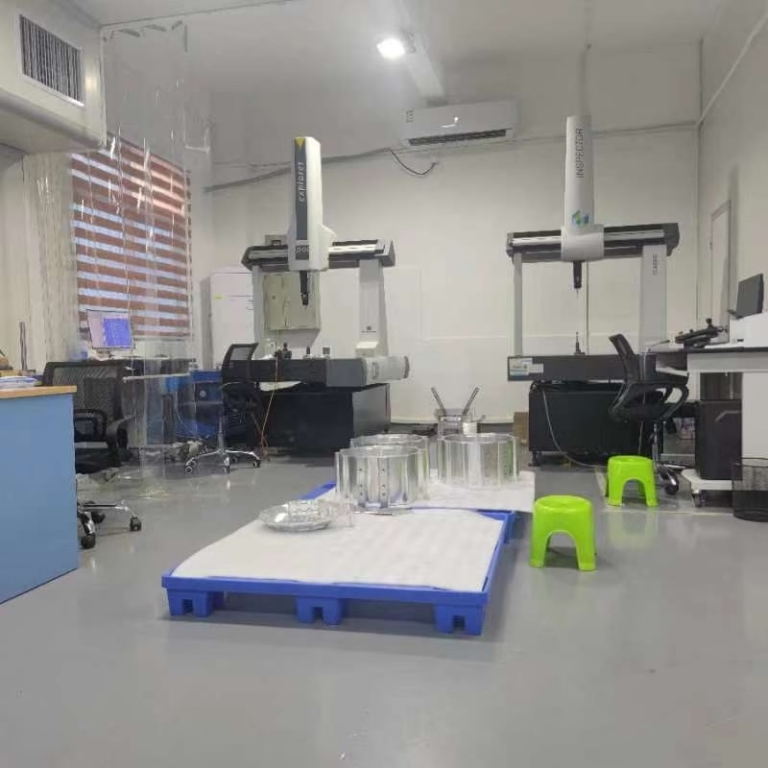
Confirm the inspection plan. Swiss parts are small, so a caliper is not enough. Pin gauges, optical comparators, and a CMM with a small stylus are the right tools. Ask what gauges they will use on your critical dimensions and how often they check during the run.
Ask about cleaning and packaging. Small parts get lost, tangled, and damaged in bulk bags. A supplier who counts parts and packs them in trays or tubes saves you a sorting step. For medical parts, the cleaning spec matters and should be agreed before the run starts.
Finally, ask who owns the program and the tooling. If the supplier writes the CAM program and you own the part, get the program ownership in writing. If you ever move the part, you want the setup data. This is a small clause that prevents a large problem later.
- 1First article reportActual numbers on the critical dimensions, not a pass stamp.
- 2Bar feeder capacityMust match your part diameter or the quote is fiction.
- 3Sub-spindle and live toolingKeeps cross holes and flats in one cycle.
- 4Material traceabilityHeat lot and mill cert for regulated industries.
Materials and finishes that change the quote
Swiss machines run free-machining grades best. 303 stainless, 12L14 steel, and 6061 aluminium cut clean and hold tolerance. 316L stainless and titanium Ti-6Al-4V are common in medical and aerospace work, but they work-harden and wear tooling faster. The cycle time goes up and so does the price.
PEEK and other plastics need sharp tooling and a controlled feed. They cut clean on a Swiss machine because the guide bushing supports the part, but chips must clear or they wrap and mark the surface. Ask how the supplier handles chip evacuation on plastic jobs.
Finishing is a separate cost center. Anodizing, passivation, electroless nickel, and laser marking all add lead time. If the supplier runs finishing in-house, you avoid a second shipping step and a second quality record. If they outsource, ask who holds the quality record and who inspects the finished lot.
Laser marking needs at least 1.5 mm character height to stay legible. If your part is Ø 2 mm, there is no room for a full part number. Plan the marking area early or you will be etching on a flat that does not exist.
Lead time, MOQ, and the quote terms that matter
A quote is only useful if it states what is included. Ask whether the price covers material, machining, finishing, inspection, and packaging. A low number that excludes finishing is not a low number. It is a partial number.
Volume changes the process. One prototype part and a 10,000-part run are different jobs. A supplier with no minimum order quantity will run the prototype, but the setup cost is spread over one part. That is fine for a design check and expensive for production. Ask for both prices so you can see the crossover.
Lead time has two parts: time to first article and time to ship the full run. A supplier who ships in 3–5 days after approval is fast. A supplier who takes two weeks to quote is slow before the work starts. Ask for the quote turnaround in writing.
Payment terms and shipping terms belong in the quote. FOB, DDP, and EXW change the landed cost. If the supplier ships from a plant in Dongguan or Singapore, the freight and duty differ. Get the incoterm in the quote so you compare the same thing.
How to qualify a swiss cnc machine services supplier in 6 steps
Run these steps in order. Each one filters out suppliers before you spend engineering time.
- 1Send the drawing with a tolerance calloutMark the critical dimensions and the datums. A drawing with a blanket ±0.1 mm title block does not tell the supplier where to focus.
- 2Ask for a DFM reviewA good supplier returns notes on wall thickness, tool access, and tolerance stack. If the reply is only a price, the review did not happen.
- 3Request a first article reportAsk for actual measurements on the critical dimensions from the first run, plus the gauge list used.
- 4Confirm bar stock and material certState the alloy and temper. Ask for the heat lot and mill cert for regulated parts.
- 5Agree the finishing and inspection planName the finish, the spec, and who inspects the finished lot. Put the marking height and location on the drawing.
- 6Lock the quote termsConfirm what is included, the incoterm, the lead time after approval, and the packaging method. Sign the NDA before you send sensitive files.
Swiss CNC machine services: common questions
What part size fits a Swiss machine?
Most Swiss machines run bar stock from Ø 0.5 mm to Ø 32 mm. The practical limit depends on the guide bushing and the bar feeder on the specific machine.
If your part is larger than the bar capacity, it belongs on a chucking lathe or a mill-turn center. Send the drawing and we will tell you which process fits.
Can you hold ±0.005 mm on a production run, not just a sample?
Yes, on the dimensions that the process controls. The guide bushing and the tool offsets hold the diameter. Length dimensions depend on the feed and the stop.
We inspect 100% before shipment and can supply reports on request. If a dimension needs a capability study, say so at quote stage so we plan the gauge and the sample size.
Do you have a minimum order quantity?
No minimum order quantity. We run from one prototype to 10,000+ part runs.
The setup cost is the same for one part or ten thousand, so the unit price drops as volume rises. Ask for both prices to see the crossover point.
Which certifications apply to Swiss parts?
We hold ISO 9001:2015, IATF 16949:2016, ISO 13485:2016 and ISO 27001:2022. The relevant certificate depends on your industry.
Medical device parts fall under ISO 13485. Automotive parts fall under IATF 16949. Ask for the current certificate for the plant that will run your job.
How do you protect our design files?
Uploads are secure and confidential. We sign an NDA on request before you send drawings or models.
ISO 27001:2022 covers our information security management. If your file release process needs a specific clause, send it and we will review it.
What lead time should we plan for?
Quotation and free DFM analysis come back within 12 hours. Production can start within 24 hours of approval, and parts ship in 3–5 days.
Finishing adds time because it runs after machining. If your part needs anodizing or passivation, add that step to the plan.
Send your drawing and get a DFM review in 12 hours
Upload the model and the tolerance callouts. We return a quote, a DFM note, and a process recommendation. No minimum order quantity, NDA on request.
12-hour quote100% inspectionNo MOQNDA on request
More from GreatLight
We publish setup notes, tooling trials and inspection data from the factory floor.











