
Why Spains CNC Processing Department Looks at China
An explainer for Spanish and European engineers deciding whether to move a machined part program offshore. It covers what travels well, what does not, and which numbers to fix before you send an RFQ.
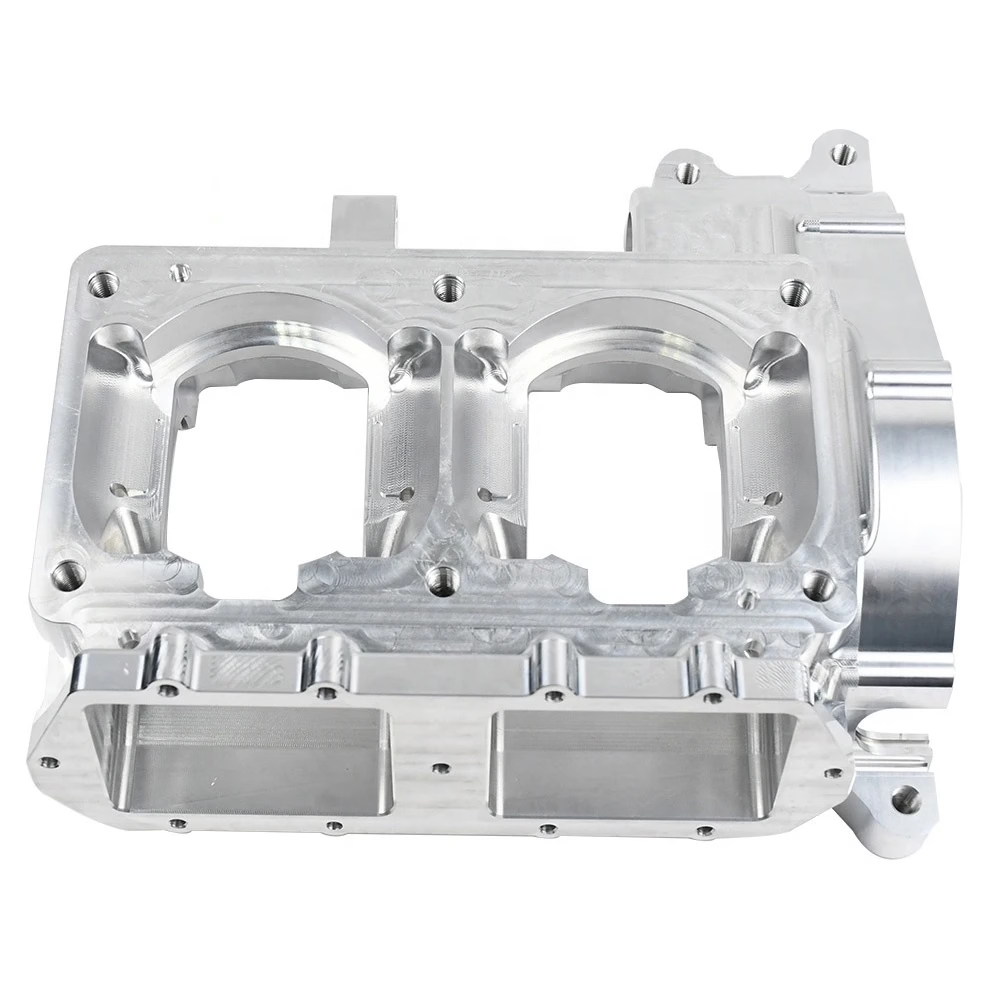
What Spains CNC processing department compares before quoting
A Spanish machine shop and a Chinese machine shop quote the same part from the same drawing, yet the totals rarely land in the same place. The gap is not one number. It is a stack: machine hour rate, setup amortization, material purchase, finishing subcontracts, packing, freight and duty. Spains CNC processing department looks at China when that stack leaves enough margin to justify the extra coordination.
The first layer is the hourly rate. Spanish shops carry European wages, energy tariffs and building costs into every spindle hour. A shop running 127 high-precision CNC machines spreads overhead differently, so a 5-axis hour in Dongguan and a 5-axis hour in Zaragoza do not cost the same. That difference is real, but it is only one line in the quote.
The second layer is setup. A part that needs three fixtures, two soft jaws and a custom probe routine carries setup cost that does not shrink with volume. On a 50-piece run the setup can outweigh the cutting time. On a 5,000-piece run it almost disappears. This is why the same part can be cheaper in Spain at low volume and cheaper in China at high volume.
The third layer is finishing. Anodizing, electroless nickel, powder coating and laser marking are often subcontracted. Each handoff adds freight, queue time and a chance for the surface to be damaged in transit. When one supplier runs machining, finishing and inspection under one roof, the handoffs drop and the schedule gets shorter.
Which part geometry actually travels well
Not every part belongs on a boat or a plane. Geometry decides more than price does. A part that fits in a 500 × 500 × 450 mm envelope, needs three setups and holds ±0.05 mm is a comfortable offshore job. A part that needs a 4,000 mm travel, six setups and a ±0.005 mm true position on a bore is a conversation, not an order.
Five-axis work is where the calculus changes. A part with undercut features, deep pockets at odd angles, or a sculpted surface that would need four separate fixtures on a 3-axis mill can often be cut in two setups on a simultaneous 5-axis center. Fewer setups means fewer datum shifts, and datum shifts are where tolerance stacks up.
Thin walls are the classic failure mode. A 0.8 mm wall on a 200 mm aluminum housing will move during roughing no matter who cuts it. The fix is process, not geography: leave stock, stress-relieve, then finish in a light pass. If the drawing does not allow that sequence, the part is hard to source anywhere.
Long shafts and thin plates behave the same way. They deflect under clamping force and spring back after the vise opens. A shop that has seen the problem will ask about fixturing before it quotes. A shop that has not will quote low and then explain the scrap later.
Tolerance, inspection and the numbers that must be fixed
Tolerance is the single line item that most often breaks an offshore job. A general tolerance block of ±0.1 mm is routine. A callout of ±0.005 mm on a bearing bore is a controlled process that needs a temperature-stable room, a calibrated probe and a CMM check. Both are achievable; they are not the same purchase.
Inspection is where the paperwork lives. A supplier that checks raw material on arrival, monitors in process and inspects 100% before shipment can hand over a report. Ask for the report format before you place the order, not after. If your quality system needs first-article, material certs and a dimensional report, say so in the RFQ.
Surface finish travels with tolerance. As-machined at Ra 1.6–3.2 μm is normal for a milled face. Ra 0.8–1.6 μm is a finishing pass. Ra 0.2–0.8 μm usually means a second operation, sometimes grinding or lapping, and it changes the price more than the tolerance does.
Material choice also sets the floor. Aluminum 6061 and 7075 cut fast and hold tight tolerances well. Stainless 316L and 17-4PH work-harden and need slower feeds. Titanium TC4 and Inconel move the cost up again because tool life drops. The geometry may be identical; the cutting time is not.
Lead time, freight and the real cost of distance
A European buyer usually starts with the cutting time and forgets the calendar. Production is only part of the timeline. A quotation and DFM review, material purchase, machining, finishing, inspection, packing and freight all sit in the chain. Any one of them can become the critical path.
Air freight is fast and expensive. Sea freight is cheap and slow. For a 20 kg bracket, air is often the right call because the freight is small next to the part value. For a 400 kg fixture plate, sea freight wins even with the extra weeks. The decision is driven by value density, not by habit.
Documentation matters as much as the box. Commercial invoice, packing list, HS code, country of origin and, where relevant, a mill certificate. A missing certificate can hold a shipment at customs longer than the machining took. Fix the paperwork at the quotation stage.
Distance also changes how you handle a problem. A dimension that is out of tolerance is easy to fix when the shop is a two-hour drive away. Across 10,000 km it becomes a return, a rework and a new shipment. That risk is small but it is not zero, and it belongs in the cost model.
When to machine in Spain and when to look at China
Match the part to the column before you send an RFQ.
| Part or order trait | Machine in Spain | Machine in China |
|---|---|---|
| Quantity per year | 1 to 50 pieces | 500 pieces and above |
| Tolerance on critical bore | ±0.005 mm, single feature | ±0.005 mm, repeatable process |
| Maximum part size | Fits a 750 mm table | Up to 4,000 mm travel |
| Geometry | 2.5D, three setups or fewer | 5-axis, undercuts, sculpted faces |
| Surface finish | As-machined, Ra 1.6–3.2 μm | Fine finish, Ra 0.2–0.8 μm |
| Engineering change rate | Weekly drawing revisions | Frozen drawing before release |
| Schedule pressure | Prototype in days | Production in weeks |
| Certifications needed | Customer-specific audit | ISO 9001, IATF 16949, ISO 13485 |
The short answer
If the part is small, tight, and still changing weekly, keep it in Spain. If the drawing is frozen, the volume is real, and the geometry needs five axes, look at China.
Questions engineers ask next
Does a Chinese shop hold ±0.005 mm on a production run?
Yes, on a controlled process with a temperature-stable room, a calibrated probe and a CMM check. The tolerance is not the hard part. The hard part is deciding which features actually need it. A drawing that calls ±0.005 mm on every dimension will cost far more than one that calls it on the two features that matter.
How do we protect the drawing and the design intent?
Send a simplified model with the critical features called out, and sign an NDA before the RFQ. Ask how the files are stored and who can open them. A supplier that runs ISO 27001 has a documented answer; one that does not will improvise.
What is the smallest order a shop will take?
It varies. Some suppliers quote from one prototype, which lets you prove the process before committing to a run. If a shop demands a high minimum, that usually means the setup cost is being pushed onto you rather than amortized.
Can machining and finishing come from one supplier?
Often yes, and it is worth asking. Anodizing, plating, powder coating and laser marking are usually subcontracted. When they run in house or under one roof, you remove the freight between operations and the risk of a finished surface being scratched in transit.
How fast can a quotation come back?
A quotation and a DFM review can come back within 12 hours when the drawing is clear and the material is standard. Vague callouts and unusual alloys slow it down. The DFM note is usually more valuable than the price, because it flags the features that will drive cost.
What goes wrong most often on a first order?
Missing documentation and unclear critical features. A shipment held at customs for a missing mill certificate costs more than the certificate. A drawing with no marked datum costs a rework. Both are fixed at the quotation stage, before any metal is cut.
Send the drawing, get a manufacturability read
Quotation and free DFM analysis within 12 hours. Uploads stay confidential, NDA on request.
12-hour quote100% inspectionNo MOQ
GreatLight elsewhere
We publish setup notes, tooling trials and inspection data from the factory floor.











